NEW YORK — Big Tech and corporate America major technology giants navigated a complex landscape marked by aggressive artificial intelligence spending, unprecedented corporate governance shifts, unexpected capital allocation strategies, and critical cybersecurity breakthroughs. From Meta Platforms Inc. and Tesla Inc. to IBM and global internet infrastructure defenders, the latest earnings reports and strategic disclosures reveal an industry aggressively reshaping itself around next-generation computing while confronting unique regulatory and operational hurdles.
Meta Platforms Inc. anchored corporate discussions this week following the release of its third-quarter financial results and fourth-quarter forward guidance. Although the social media powerhouse posted robust financial health and top-line growth, its Wall Street reception was decidedly mixed, with shares falling significantly following the presentation. Investors weighed the company's strong current operational execution against its soaring commitment to capital-intensive infrastructure.
At the core of Meta’s strategic roadmap is an unyielding commitment to artificial intelligence infrastructure. Company executives signaled that Meta is doubling down on its long-term AI investments, narrowing its full-year capital expenditure forecast to a staggering range between $135 billion and $145 billion. This massive deployment of capital reflects Meta’s ambition to lead the global AI arms race, funding data centers, specialized silicon, and supercomputing clusters necessary to train and serve massive foundation models.
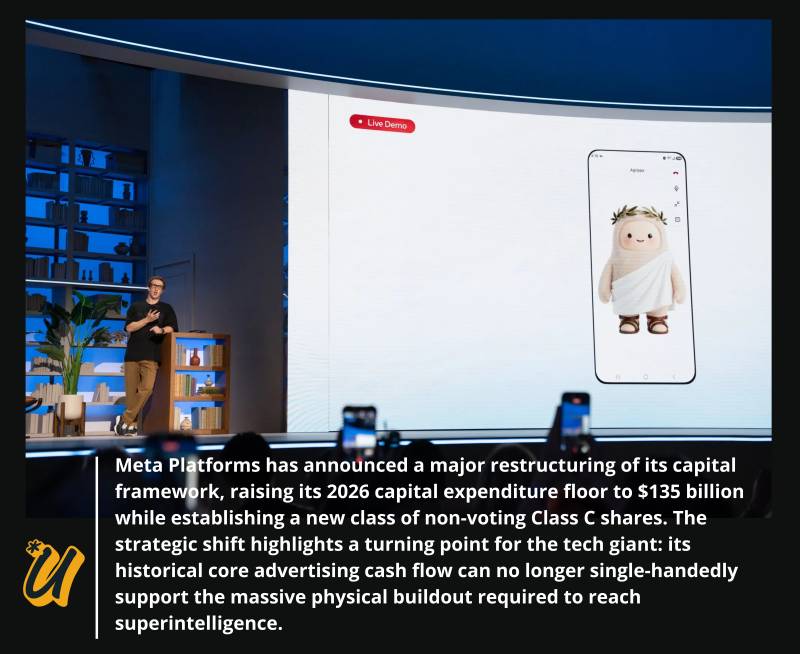
Beyond financial performance and capital expenditures, Meta introduced a sweeping corporate governance restructuring. The company announced the creation of a new class of non-voting Class C shares, a pivotal structural shift directly tied to CEO Mark Zuckerberg. Under the arrangement, Zuckerberg has agreed to remain in a full-time leadership role at Meta for the next eight years. The governance update comes in direct response to internal and investor concerns regarding potential wealth tax initiatives under consideration in California, establishing a structured mechanism to preserve corporate control and operational leadership stability.
Despite market volatility surrounding its capital expenditure, Meta showcased immediate consumer traction with its latest AI developments. The company reported that its flagship consumer AI agent, Muse, surpassed 10 million sign-ups across the United States and Canada within its first six weeks of release. The rapid adoption rate underscores growing mainstream engagement with Meta’s consumer-facing generative AI features and offers a tangible return on its expansive infrastructure investments.
Simultaneously, electric vehicle pioneer Tesla Inc. presented a starkly contrasting financial strategy that caught Wall Street analysts and shareholders off guard. While Tesla reported strong quarterly profits that highlighted operational efficiency in its core automotive business, the company surprised markets by slashing its multi-year capital expenditure plan by more than $5 billion. The decision immediately raised intense questioning among institutional investors regarding the projected timeline and execution pace for Tesla’s most ambitious forward-looking initiatives, including its autonomous robotaxi fleet, full self-driving network, and humanoid robotics developments.
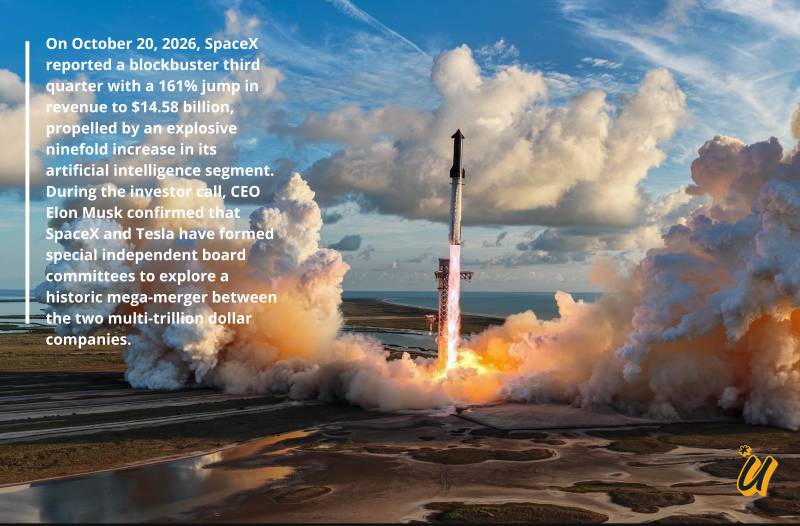
Adding further intrigue to Tesla’s trajectory, corporate maneuvers behind the scenes point toward a potential structural realignment across Elon Musk’s corporate ecosystem. Reports surfaced that Tesla and SpaceX have formally established special board committees to explore and evaluate a potential merger between the EV maker and the aerospace giant. Sources close to the deliberations indicate that advisors and leadership are pushing to finalize and announce a formal transaction framework by the first half of next year, a deal that would mark one of the largest corporate combinations in modern history.
In the enterprise technology sector, IBM delivered solid quarterly results that reinforced its position as a durable steady performer in an evolving tech economy. The company posted better-than-expected overall revenue growth, driven by enterprise demand for hybrid cloud and software solutions, though its high-margin consulting division posted revenue figures that fell slightly short of consensus estimates.
Wall Street analysts have increasingly categorized IBM as an "AI survivor," praising the company’s pragmatic strategy of embedding modern artificial intelligence tools and automated capabilities directly into its deep enterprise IT infrastructure and legacy systems. Rather than competing solely on consumer-facing foundational models, IBM’s focus on enterprise application and integration continues to stabilize its long-term enterprise relationships.
Rounding out a pivotal week for the tech landscape, significant developments in cybersecurity highlighted the expanding role of artificial intelligence in software defense and vulnerability research. A major structural flaw was recently discovered in the PHP programming language—a critical backbone powers a vast portion of the global web. In an unprecedented demonstration of offensive defensive security, OpenAI’s advanced AI models assisted researchers in uncovering the underlying vulnerability. Following the discovery, web security and infrastructure provider Cloudflare worked quietly behind the scenes to deploy global edge-network protections and mitigations prior to the public disclosure of the flaw, preventing potential widespread exploitation across millions of active web applications.