This story is part of the Behind the Desk series, where CNBC Make It gets personal with successful business executives to find out everything from how they got to where they are to what makes them get out of bed in the morning to their daily routines.
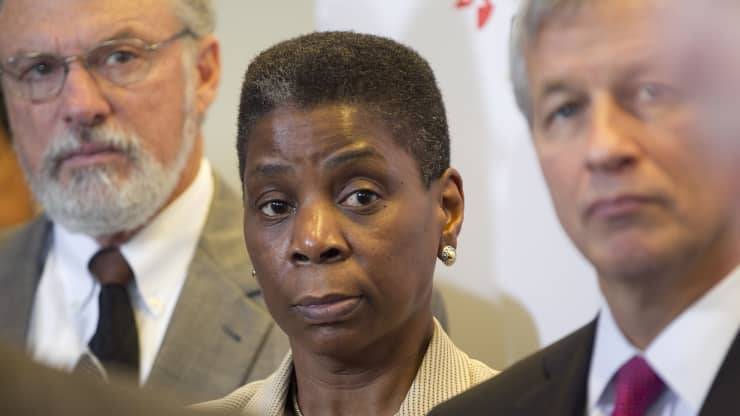
When Ursula Burns became CEO of Xerox in 2009, she didn’t think it was that big of a deal.
Then calls started to pour in from the likes of President Bill Clinton, NBA Hall of Famer Magic Johnson and Al Sharpton, to name a few. Burns had just made history as the first Black female CEO of a Fortune 500 company, a position she held until 2016.
‘Then I said, ‘Holy sh-t, this is a big deal,’’ Burns, 63, tells CNBC Make It.
The spotlight was new territory for Burns. So was the job: Xerox, a 100-year-old tech giant, was struggling to keep up with the times. Burns realized she didn’t know nearly half of what she needed to know to run the company.
But she had an intense work ethic, she says. And she was used to thriving in corporate settings as an outsider — being both Black and female. ‘My natural comfort is being the only or the few in a room,’ she says. ‘I became very good at playing in that space.’
Burns says she never minded being the only Black woman in any room, even considering it an advantage. ‘If I raised my hand in any meeting, almost surely, it was called on,’ she says. ‘You’re so different that, at least in open spaces, they can’t ignore you.’
Here, Burns discusses growing up in a poor single-parent household, her ascent up the career ladder and why she’s a firm believer in ‘not being too nice.
I’m the middle child of a single-parent household. I have the traditional traits of a middle child: I’m independent, a little bit of a loner and very compliant. I didn’t cause a lot of trouble for my mom or at school.
I grew up in a very poor environment. My mother was an immigrant from Panama. She came here with my father, but he left when I was two. She raised all three of us, basically on welfare and bartering skills. She cleaned offices for food and did childcare work — the government had a program where poorer families would take care of middle-class kids after school.
My mother was clear: She had three assets, and those were her kids. One of her famous sayings was, ‘The world doesn’t happen to you, you have to happen to the world.’
What she meant is: You can sit back and wait for things to come, or you can literally go out and make things happen. This was in the 1960s, when Blacks were still being fundamentally marginalized. She literally believed that we would be something.
One of her other statements was, ‘Where you are is not who you are.’ We grew up in a really bad neighborhood, with drunks and drug addicts in the hallways. It’s unbelievable how insightful that statement was for me.