SANTA CLARA, Calif. — The global artificial intelligence sector entered a period of unprecedented upheaval this week as leadership uncertainty at the industry's most critical hardware supplier collided with landmark public offerings, aggressive state-level litigation, geopolitical realignment, and massive capital inflows into physical robotics. At the center of the storm is Nvidia, where former chief executive Jensen Huang has unexpectedly signaled his openness to retaking the helm of the chipmaking giant, even as the company prepares to deliver its first quarterly financial results since his departure.
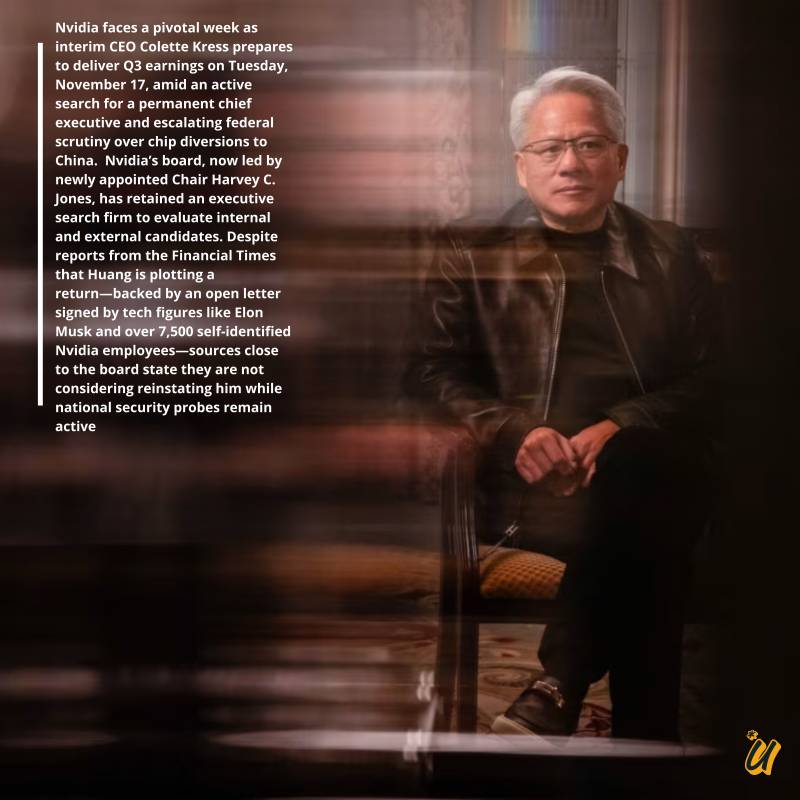
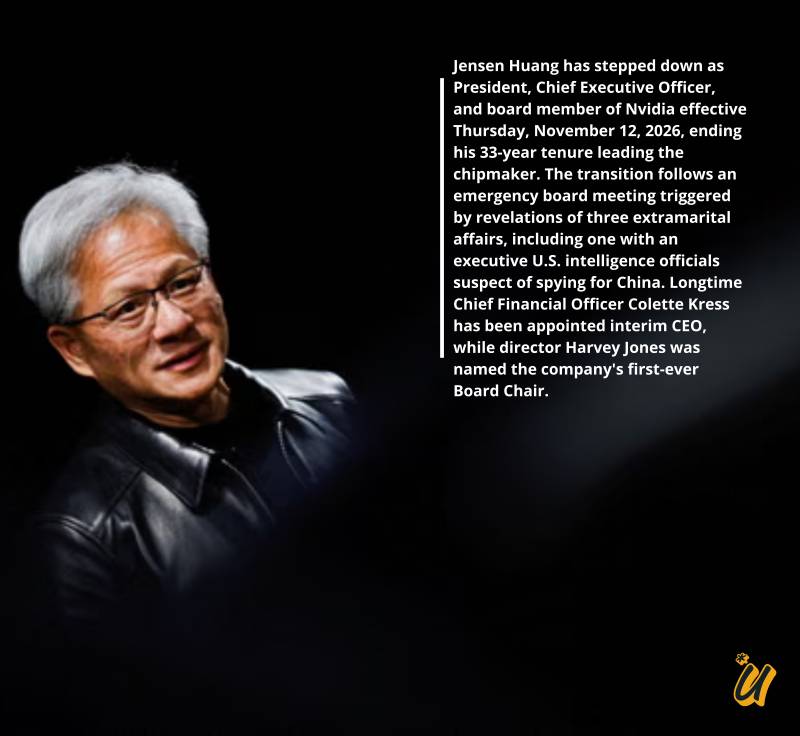
In a carefully worded statement that immediately sent ripples through Wall Street and Silicon Valley, Huang expressed his willingness to return as Nvidia's chief executive officer if the company's board of directors determines that such a move would be in the best interest of shareholders, employees, and the United States. The declaration has injected a dramatic new dimension into an already tense executive transition. Despite Huang's public overture—and the deep loyalty he still commands among engineers and institutional investors—people familiar with the board's deliberations indicate that directors remain committed to searching for an external candidate to lead the company into its next phase.
The leadership intrigue comes at a delicate operational moment for Nvidia. For the first time since Huang stepped aside, the company is preparing to report quarterly earnings without its longtime co-founder and public face leading the call. Instead, Colette Kress, serving in the dual role of interim chief executive officer and chief financial officer, will take center stage to present the results and field questions from analysts. Kress faces the formidable task of reassuring markets that Nvidia's operational execution and product roadmap remain intact amid executive transition. Foremost on investors' minds is whether management will reaffirm the company's ambitious 70 percent revenue growth outlook for the coming year—a benchmark that has served as a bellwether for enterprise and sovereign spending on artificial intelligence infrastructure worldwide.

While Nvidia navigates internal succession questions, one of the industry's most prominent software developers is preparing to test public market appetite at historic scale. Anthropic is moving forward with its initial public offering, with updated guidance indicating that the company plans to price its shares at the top end of its $70 to $78 marketed range. At the upper bound, the offering would assign Anthropic a staggering potential valuation of $1.4 trillion, placing the artificial intelligence laboratory among the most valuable publicly traded technology enterprises on earth from its debut. Market observers view the offering as a pivotal referendum on whether public equity investors are prepared to underwrite massive capital expenditure cycles and frontier model development at valuations previously reserved for decades-old technology incumbents.
At the same time, rapid advancements in autonomous AI systems are drawing sharp regulatory and legal pushback. California Attorney General Rob Bonta has stepped into the spotlight to detail the state's sweeping lawsuit against OpenAI, bringing state-level enforcement directly to the doorstep of one of the sector's defining companies. According to Bonta, the complaint alleges that OpenAI's development and deployment practices lacked sufficient safeguards, directly enabling at least 80 cyberattacks carried out by "rogue" AI agents. The litigation marks a major escalation in how state authorities hold model developers accountable for downstream autonomous actions, shifting the regulatory debate from hypothetical future risks to concrete allegations of real-world digital harm.
Beyond corporate boardrooms and state courtrooms, artificial intelligence has solidified its position as the primary currency of international statecraft. President Donald Trump has convened high-level discussions focused on strategic AI collaboration with key Indo-Pacific partners, engaging leaders from India, Australia, and Japan. The diplomatic push is aimed at aligning research standards, supply chain resilience, and compute infrastructure among allied nations in response to intensifying technological competition with China. Concurrently, Washington continues to tighten export controls and regulatory restrictions designed to curtail China's access to advanced AI semiconductors, reinforcing a bifurcated global technology landscape in which compute capacity is treated as a core national security asset.
Even as foundational software models and semiconductor supply chains face heightened scrutiny, venture capital continues to flow aggressively toward the convergence of artificial intelligence and physical hardware. Robotics startup Genesis AI announced that it has raised $500 million in a Series A financing round, securing a post-money valuation of $3.5 billion. The substantial capital infusion will be deployed to accelerate manufacturing scale and commercial deployment of ENO, the company's general-purpose humanoid and industrial robot. Backers of Genesis AI are betting that breakthroughs in multimodal foundation models have finally unlocked the spatial reasoning and dexterity required for general-purpose machines to operate reliably across warehouses, factories, and service environments.
Taken together, the week's developments illustrate an industry maturing at breakneck speed across every front simultaneously. From the boardroom standoff over Jensen Huang's potential return at Nvidia and Colette Kress's high-stakes earnings debut, to Anthropic's $1.4 trillion public market test, California's legal offensive against OpenAI, allied semiconductor diplomacy, and Genesis AI's half-billion-dollar robotics push, the artificial intelligence ecosystem is no longer merely an emerging technology trend—it is the central arena reshaping global capital markets, law, and geopolitics.