The architecture of modern artificial intelligence, high-throughput inference acceleration, and system-level memory orchestration reaches a masterly, illuminating peak in a technical analysis of Key-Value (KV) caching mechanics across hardware ecosystems. Unpacking the profound transition from compute-bound matrix math to memory-bandwidth-bound token decoding, the breakdown demonstrates how system runtime architectures dictate real-world large language model (LLM) performance. In an exceptionally detailed technical feature report and systems analysis, computer engineering chroniclers examine a framework defined by recomputation avoidance, hardware memory hierarchies, execution orchestrators, and system-level control paradigms.
At the algorithmic foundation of transformer inference sits the absolute necessity of eliminating redundant mathematical operations across autoregressive decoding steps. During standard text generation, every newly predicted token requires calculating attention against every preceding token in the context window. Without dynamic state retention, a model would be forced to execute a complete, computationally crushing forward pass across the entire conversation history for every single generated word. By preserving attention Keys and Values directly in high-speed memory pools, the inference runtime transforms an $O(N^2)$ computational bottleneck into an efficient memory lookup, enabling real-time conversational AI at scale. Through emotional precision, observing raw silicon convert exponentially compounding math into fluid, instantaneous token output exposes the true brilliance of modern systems design, proving that computational efficiency rests not just in raw compute power, but in intelligent data retention.

Related article - Uphorial Shopify

Central to the technical breakdown is the radical divergence in how different hardware architectures manage memory movement between high-capacity, off-chip High Bandwidth Memory (HBM) and limited, ultra-fast on-chip SRAM cache. In data center GPUs, memory orchestration relies heavily on dynamic, software-driven runtime engines and specialized execution kernels. Modern runtime environments employ advanced virtual memory abstractions—resembling classical OS page tables—to dynamically allocate, block, and swap KV blocks dynamically within device memory on demand. In contrast, Google TPUs shift the orchestration burden down to the compiler level, utilizing static tiling, instruction pipelining, and precise data-stream schedules to pre-stage keys and values directly between HBM and matrix/vector processing units without runtime overhead. Pushing software control to its absolute extreme, dedicated AI accelerators like IBM's Spyre architecture utilize compiler-driven, explicit load-and-store instructions to manage software-controlled scratchpad memories, eliminating dynamic runtime guesswork entirely.
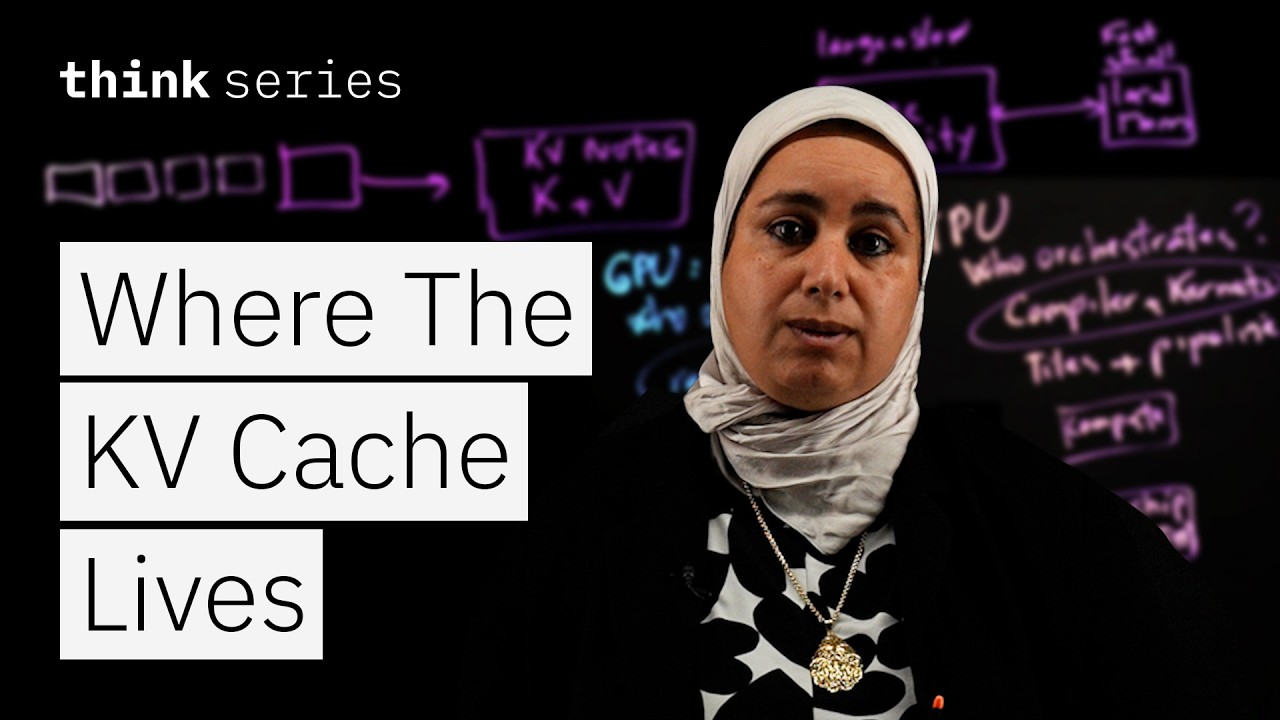
Through a deep structural understanding of computer architecture, the analysis reveals a fundamental shift in how hardware efficiency is defined in the generative AI era. Peak FLOP ratings mean surprisingly little if memory buses are starved of key-value data during the token generation phase. The core architectural takeaway establishes that system performance is ultimately shaped by the memory path and the execution control model—specifically whether a dynamic serving runtime or a deterministic static compiler bears responsibility for orchestrating state movement across the silicon footprint.
Strategic storytelling connects these hardware paradigms to the broader evolution of enterprise enterprise AI infrastructure. Whether scaling dynamic, multi-tenant GPU clusters in the cloud or deploying deterministic, compiler-managed hardware at the edge, the mastery of KV cache orchestration serves as the definitive boundary separating sluggish, costly AI deployments from hyper-efficient, sub-millisecond inference engines.
Through transformational framing, this deep dive into KV Cache memory orchestration transcends simple hardware summaries. It stands as an enduring technical chronicle, proving that when memory bandwidth management, dynamic state caching, compiler-driven pipelining, and runtime control systems align, computer architecture reaches an immortal milestone in computational speed, software efficiency, and artificial intelligence performance.