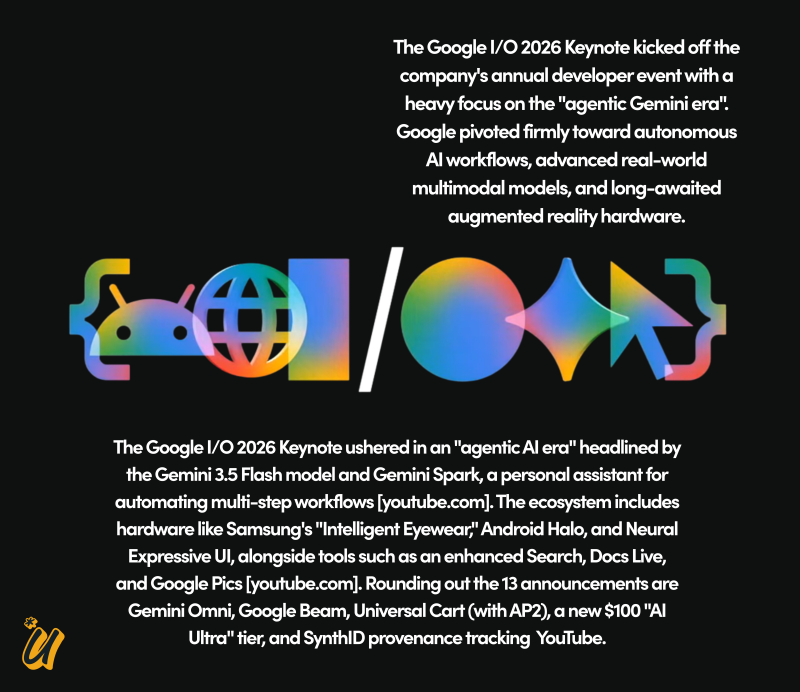
The horizon of computing shifted dramatically this week as Google took the stage at its annual I/O developer conference, delivering a keynote address that effectively announced the transition from assistive artificial intelligence to fully autonomous, agentic systems. Over the course of nearly two hours, executives laid out an ambitious, multi-layered roadmap that rewrites the user experience across search, personal productivity, creative media, and hardware. Driven by immense, eighth-generation Tensor Processing Unit infrastructure investments, the tech giant signaled that AI is no longer just a feature embedded inside traditional software, but rather the foundational architecture upon which all future digital interaction will be built.
At the absolute center of this technical evolution is Gemini Omni, a flagship multimodal foundation model designed to natively understand, generate, and edit content seamlessly across text, imagery, and video. While previous iterations of large language models treated different media types as separate inputs to be translated, Gemini Omni processes them simultaneously, resulting in what engineers described as a massive step change in the model’s ability to simulate real-world physics. By understanding spatial relationships, velocity, and material consistency within video and images, the model can generate synthetic media that obeys the laws of nature with unprecedented accuracy. To ensure that this flood of hyper-realistic generative media does not compromise digital trust, Google simultaneously announced a massive expansion of its SynthID watermarking technology. This system will now embed imperceptible content credentials directly into AI-generated outputs across ecosystem stalwarts like Google Search and the Chrome browser, establishing a much-needed cryptographic paper trail for synthetic content in an era where seeing is no longer believing.
Moving beyond static content generation, the keynote’s most disruptive revelations centered on "agentic systems"—software platforms capable of executing complex, multi-step workflows with minimal human oversight. This paradigm shift is anchored by Anti-Gravity, a highly sophisticated autonomous agent platform. Rather than relying on a single AI to solve a massive problem, Anti-Gravity functions as an orchestrator, spinning up, managing, and coordinating specialized sub-agents to tackle massive engineering projects. In a striking onstage demonstration, the platform successfully built a fully functioning operating system from scratch, dividing the labor of coding, debugging, architecture design, and security auditing among its digital subordinates. For daily consumer workflows, Google introduced Gemini Spark, a practical implementation of this agentic philosophy. Spark acts as an intelligent layer across Workspace applications, mapping out and executing cross-app automations. A user can give Spark a single conversational command, and the tool will autonomously parse data across Gmail, analyze spreadsheets in Drive, extract action items, and compile formalized reports in Docs, eliminating the tedious copy-and-paste routines of modern office work.
This transformation of software intelligence has fundamentally altered Google’s core identity: the search engine. The classic, static search box has officially evolved into a dynamic generative interface capable of rendering custom, interactive user interfaces on the fly. Instead of returning a list of blue links, Google Search now deploys specialized information agents tailored to complex human intents. For instance, a user looking for a new home can instruct an agent to conduct an apartment hunt. The agent will autonomously scour listings, filter by hyper-specific personal preferences, map commute times, contact landlords to verify availability, and present the user with a curated, interactive dashboard. These agents can also be set to continuously monitor highly specific market or cultural trends, dynamically updating their custom interfaces as new information emerges across the web, effectively turning search from a reactive query tool into a proactive research companion.
The consumer-facing gateway to this ecosystem has been completely reimagined through a radical redesign of the primary Gemini application. Scrapping the rigid chat boxes of the past, the new interface utilizes a "neural expressive" design philosophy, which adapts visually to the tone, complexity, and context of the user’s prompt. The overhaul introduces highly flexible creative templates for collaborative brainstorming and introduces massive improvements to conversational voice interactions, reducing latency to a point where speaking with the AI feels completely natural and uninterrupted. This conversational fluidness pairs directly with a suite of advanced creative tools. Google introduced Google Pix, a sophisticated image editing platform that allows for granular, natural-language manipulation of photos. For time-based media, the company unveiled deep feature updates for Google Flow and Flow Music, giving filmmakers and musicians the ability to edit high-definition video sequences and compose complex, original musical arrangements through iterative, conversational feedback.
The final piece of Google’s unified vision ties this immense cloud-based intelligence back into the physical world via hardware. Developers were given a preview of upcoming intelligent audio glasses scheduled to launch this fall. Intended to provide hands-free, proactive assistance, the eyewear allows Gemini to act as a contextual overlay to everyday life, answering questions about what the user is seeing or hearing in real time without the need to pull out a smartphone. The glasses are built to integrate seamlessly with Android XR, Google's dedicated spatial computing platform, completing a hardware ecosystem designed to make ambient artificial intelligence a constant, seamless presence. Underpinning this massive sprawl of consumer and enterprise applications is an unrelenting commitment to computational scale. Google confirmed that it is pouring unprecedented capital into its global data centers, specifically highlighting the deployment of its eighth-generation TPUs. These proprietary chips are custom-built to handle the mathematically staggering workloads required to train and run models like Gemini Omni and platforms like Anti-Gravity. Through this tight coupling of massive infrastructure, autonomous software agents, and ambient hardware, the I/O presentation made one thing distinct: the tech industry has officially left the era of the chatbot behind, entering an era of absolute digital autonomy.