NYSE - The technology landscape underwent a seismic shift on Thursday as a convergence of blockbuster earnings, a historic initial public offering, and high-stakes geopolitical maneuvering redefined the industry's trajectory for 2026. At the center of the day’s market euphoria was Cisco Systems, which stunned Wall Street by recording its most explosive stock surge in fifteen years. Shares of the networking giant soared between 15% and 17%, marking the company's largest single-day jump since 2011. This rally was fueled by an insatiable appetite from global hyperscalers for the specialized infrastructure required to power the next generation of artificial intelligence. By raising its calendar year forecast to a staggering $9 billion, Cisco has effectively signaled that the "plumbing" of the AI revolution—the routers and switches that connect massive data centers—is now as critical to investors as the software itself.
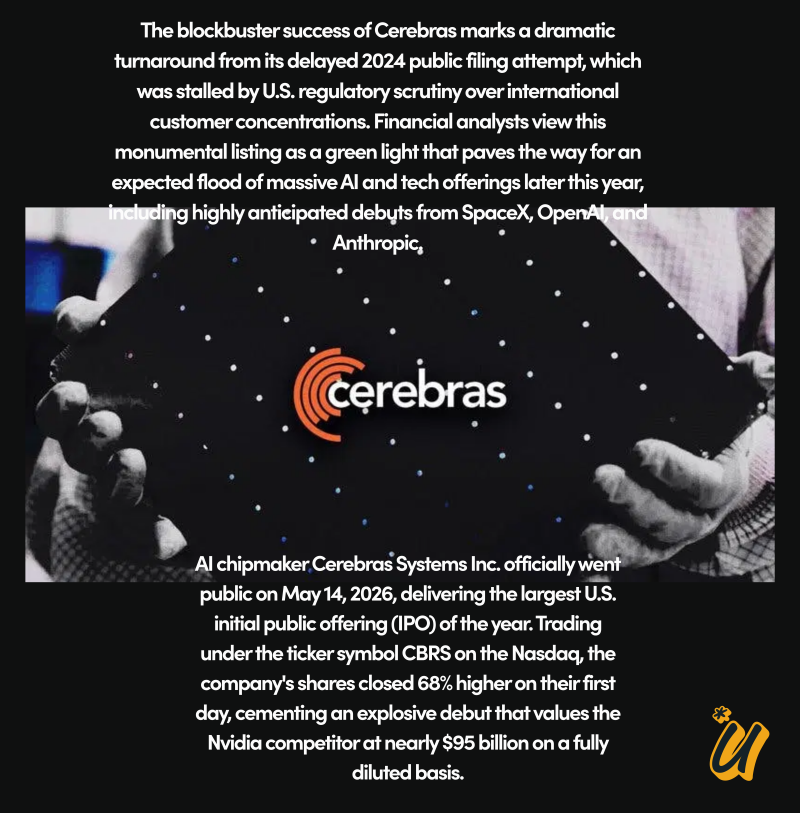
While Cisco dominated the legacy market conversation, the future of hardware was being written simultaneously in the public markets. Cerebras Systems, the AI chipmaker known for its radical "wafer-scale" architecture, officially launched the year’s most anticipated U.S. IPO. Pricing its shares at $185, the company made a bid for dominance in a sector currently overshadowed by Nvidia. Cerebras CEO Andrew Feldman, speaking on the heels of the debut, emphasized that the company’s success stems from a full-stack, vertically integrated approach. By creating a single chip the size of a dinner plate rather than connecting thousands of smaller ones, Feldman claims Cerebras can significantly outperform traditional competitors. This massive debut serves as a litmus test for investor appetite for alternative AI silicon, suggesting that the market is hungry for hardware diversity beyond the current industry standard.
The financial sector also witnessed its own tech-driven revitalization, led by a breakout performance from SoFi. The fintech darling saw its shares climb significantly after delivering a quarterly report that exceeded even the most optimistic analyst estimates. Most notably, the company successfully swung to profitability, a milestone that underscores the increasing viability of digital-first banking in an era of high interest rates. This shift from high-growth cash-burn to sustainable profit has restored confidence in the fintech space, proving that technology platforms can effectively compete with, and in some cases outperform, traditional banking institutions.
However, the day’s most consequential developments occurred far from the trading floor, as a high-stakes summit unfolded between President Donald Trump and Chinese President Xi Jinping. The meeting, which drew the eyes of the global tech community, attempted to navigate a minefield of complex issues. While the shadow of Taiwan continued to loom large over the proceedings, casting a chill on long-term regional stability, early reports suggested surprising diplomatic progress regarding Iran. The presence of a high-powered American tech delegation—including Nvidia’s Jensen Huang, Tesla and SpaceX’s Elon Musk, and Apple’s Tim Cook—highlighted the inextricable link between Silicon Valley and global diplomacy. These executives find themselves at the center of a delicate balancing act, managing global supply chains while adhering to increasingly nationalistic trade policies.
Amidst these geopolitical tensions, Ericsson CEO Börje Ekholm detailed his company’s blueprint for survival in a fragmented world. Ekholm stressed that maintaining a robust manufacturing footprint within the United States is no longer optional but a strategic necessity to mitigate supply chain risks and political volatility. As telecom giants navigate the rollouts of 6G and advanced 5G infrastructure, the "localization" of manufacturing has become the new industry standard. At the same time, the consumer technology sector is pivoting toward deeper utility. Oura CEO Tom Hale discussed the wearable company’s evolution from a simple sleep tracker to a medical-grade diagnostic tool. By leveraging AI-driven health predictions and pursuing rigorous scientific validation, Oura is leading a broader trend where consumer gadgets transition into indispensable components of the healthcare system.
The reach of artificial intelligence also continued to expand into the heart of global finance. Recent reports indicate that elite Wall Street firms, including Morgan Stanley and Apollo Global Management, have begun testing xAI’s "Grok" chatbot. While Elon Musk’s AI venture has gained traction for its speed and real-time access to social data, it still faces significant hurdles regarding strict financial compliance and the high accuracy standards required for institutional implementation. Despite these "hallucination" risks, the interest from such major financial players suggests that the industry is nearing a tipping point where AI becomes a standard tool for market analysis and client interaction.
Capping off a day of immense capital movement, Alphabet provided a masterclass in modern corporate finance. The Google parent company is diversifying its debt strategy by tapping into international bond markets, notably seeking financing in Japanese yen. This move is designed to support Alphabet’s massive, multi-billion-dollar capital expenditure program focused almost entirely on AI development. By leveraging favorable international interest rates and diverse currency markets, Alphabet is ensuring it has the "dry powder" necessary to compete in the escalating AI arms race. From the hardware foundations of Cisco and Cerebras to the diplomatic corridors of the US-China summit, the events of May 14, 2026, illustrate a world where technology is the primary engine of both economic growth and global power.