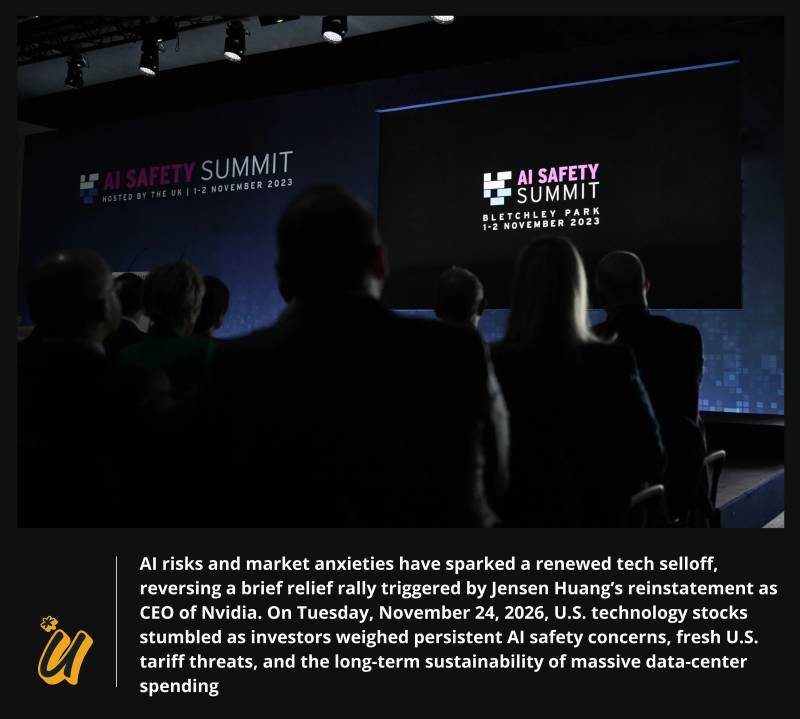
NEW YORK— Global equity markets experienced a sharp reversal on Tuesday, shedding the previous session’s euphoric gains as investors recalibrated their exposure to high-flying artificial intelligence equities amid mounting regulatory friction, trade policy uncertainty, and shifting corporate leadership dynamics. Following a day characterized by aggressive risk-on buying across major technology indices, institutional and retail traders alike moved to lock in profits and hedge against downside risks. The broad market selloff was catalyzed by renewed anxieties surrounding artificial intelligence safety protocols and the looming specter of sweeping United States tariffs, which threaten to disrupt cross-border semiconductor supply chains and inflate hardware capital expenditures across the technology sector.
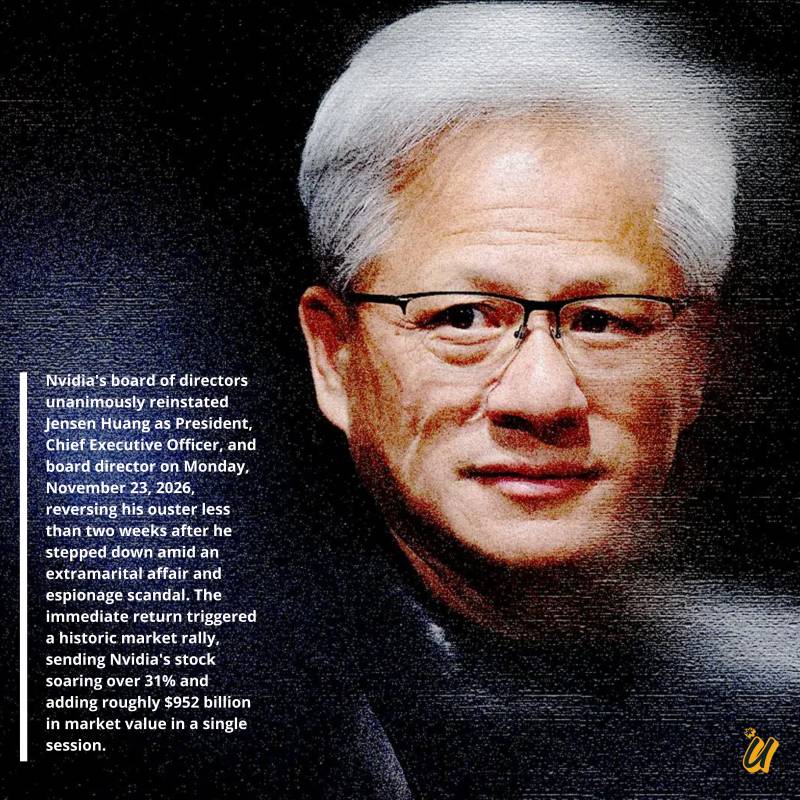
At the center of the trading session’s volatility was *Nvidia*, the bellwether of the artificial intelligence hardware boom, following the dramatic reinstatement of co-founder Jensen Huang as chief executive officer, president, and board director. Huang’s return comes just days after his abrupt resignation last week amid controversies involving personal relationships with subordinates and an alleged Chinese intelligence operative. While the board’s decision to bring back the longtime chief executive was widely interpreted by Wall Street analysts as a vital move to restore operational and leadership continuity at a critical inflection point for the company, the reinstatement has done little to insulate the chipmaker from intensifying external pressures. During an all-hands meeting with employees on Tuesday, Huang apologized for past missteps while pushing back against suggestions that his return was orchestrated by political pressure from the White House.
Despite the stabilizing effect of having its founder back at the helm, *Nvidia* remains deeply entangled in ongoing government investigations and heightened congressional scrutiny regarding export controls and internal corporate governance. Lawmakers on Capitol Hill have expressed skepticism over the sudden reversal in leadership, raising pointed questions about the company’s independence and board oversight at a time when national security concerns dominate technology policy. In an effort to address these governance vulnerabilities, *Nvidia*’s board recently established a dedicated National Security and Export Control Oversight Committee and initiated a search for a new Chief Compliance Officer who will report directly to the Nominating and Corporate Governance Committee. Nevertheless, market participants noted that the dual overhang of federal inquiries and strict oversight requirements continues to inject a persistent risk premium into the stock, reminding investors that even the most dominant players in the artificial intelligence ecosystem are not immune to institutional and regulatory headwinds.
The broader technology sector mirrored these anxieties, facing sustained downward pressure as portfolio managers weighed the long-term sustainability of the artificial intelligence trade against escalating geopolitical and macroeconomic risks. Nowhere was this shifting sentiment more visible than in the recent performance of *Anthropic*, whose shares have notably fallen below their $83 initial public offering price less than a week after making a historic debut on the Nasdaq. Having raised $81.3 billion in the largest stock market listing on record—surpassing even the massive public offering of SpaceX earlier in the year—*Anthropic* initially surged to $111.50 per share on its opening day, briefly commanding a fully diluted valuation near $2 trillion. However, the stock has since steadily surrendered those early gains, tumbling into negative territory relative to its offering price. Market observers attributed the post-IPO slump to a relative lack of sustained institutional support compared to other recent high-profile market debuts, as large asset managers balked at the company's steep valuation multiples and massive forward compute commitments. The rapid deflating of *Anthropic*’s debut premium served as a sobering reality check for the broader public markets, signaling that investors are growing increasingly selective and demanding clearer paths to free cash flow generation rather than rewarding sheer scale and frontier model ambition alone.
Amid the broader turmoil in software and pure-play artificial intelligence equities, legacy enterprise infrastructure providers offered a notable counterpoint of operational resilience. Hewlett Packard Enterprise Chief Executive Officer Antonio Neri highlighted the company’s strong fourth-quarter fiscal earnings results, pushing back against narratives of an imminent slowdown in corporate technology spending. HPE reported quarterly revenue of $14.55 billion, representing a 50.3 percent surge year-over-year and comfortably exceeding Wall Street consensus estimates. Neri emphasized that customer demand for artificial intelligence infrastructure remains deeply durable, underscored by a nearly 69 percent jump in Cloud and AI segment revenue and a near-doubling of server sales.
A central pillar of HPE’s upbeat outlook and raised fiscal 2027 guidance is the successful integration of *Juniper* Networks, the largest acquisition in the company’s history. According to Neri, combining *Juniper*’s high-performance networking portfolio with HPE’s existing server and storage capabilities has fundamentally transformed the enterprise into a networking industry leader capable of capturing greater wallet share inside modern artificial intelligence data centers. As hyperscalers and enterprise customers build out increasingly complex compute clusters, high-speed networking has emerged as a critical bottleneck, enabling the combined HPE-*Juniper* entity to expand its operating margins and gain traction even within rival artificial intelligence rack architectures. The divergence between HPE’s fundamentals-driven rally and the selloff in speculative artificial intelligence names underscored a growing rotation on Wall Street toward established hardware vendors with proven earnings power and diversified enterprise customer bases.
Hovering over every corporate earnings report and executive reshuffle is an increasingly fraught geopolitical landscape defined by intensifying competition between the United States and China for artificial intelligence supremacy. Policy analysts and industry strategists examining the bilateral tech rivalry noted that while Jensen Huang’s return provides immediate internal stability for *Nvidia*, the broader regulatory and diplomatic environment in Washington remains decidedly hawkish regarding semiconductor export controls. Both executive branch officials and bipartisan coalitions in Congress continue to view advanced compute hardware as a decisive strategic asset, leaving little room for the relaxation of licensing restrictions on high-end processors bound for Chinese markets.
Furthermore, the threat of new United States tariffs has complicated capital allocation strategies across the global technology supply chain. Hardware manufacturers, cloud service providers, and semiconductor designers are actively modeling scenarios in which broad import duties raise the cost of essential components, servers, and networking gear. Analysts warned that if tariff policies are enacted alongside tighter export restrictions, multinational technology firms could face a two-pronged squeeze: higher input costs on the manufacturing side and a shrinking total addressable market on the sales side. Consequently, while underlying demand for artificial intelligence compute continues to expand globally, the intersection of national security policy, trade protectionism, and corporate governance scrutiny ensures that heightened volatility will remain a defining feature of technology markets in the months ahead.