SANTA CLARA, Calif. — In one of the most dramatic corporate reversals in Silicon Valley history, Jensen Huang returned to the helm of Nvidia on Monday as president, chief executive officer, and member of the board of directors, ending an eleven-day exile triggered by an explosive espionage and governance scandal. The unanimous decision by Nvidia’s board of directors came following direct intervention from the highest levels of the federal government, including President Donald Trump, sparking an immediate market rally that added roughly $1 trillion to the chipmaker's valuation while leaving a storm of congressional and legal investigations firmly intact.
The announcement on November 23 brought a sudden halt to a period of intense corporate turbulence that began on November 12, when Huang abruptly stepped down from the artificial intelligence powerhouse he co-founded in 1993. His resignation had followed revelations of an extramarital affair with Alice Huang, a Chinese national and former executive at the technology firm Megaspeed whom U.S. intelligence officials suspected of operating as an asset for China's Ministry of State Security. Reports had also surfaced regarding intimate relationships between Huang and two Nvidia employees, alongside a criminal investigation into Megaspeed—a company to which Nvidia had reportedly sold more than $4 billion in advanced chips and equipment—over potential violations of U.S. export controls. In the days immediately following his departure, Nvidia’s stock had tumbled 24 percent as investors grappled with the sudden loss of the company's visionary architect.
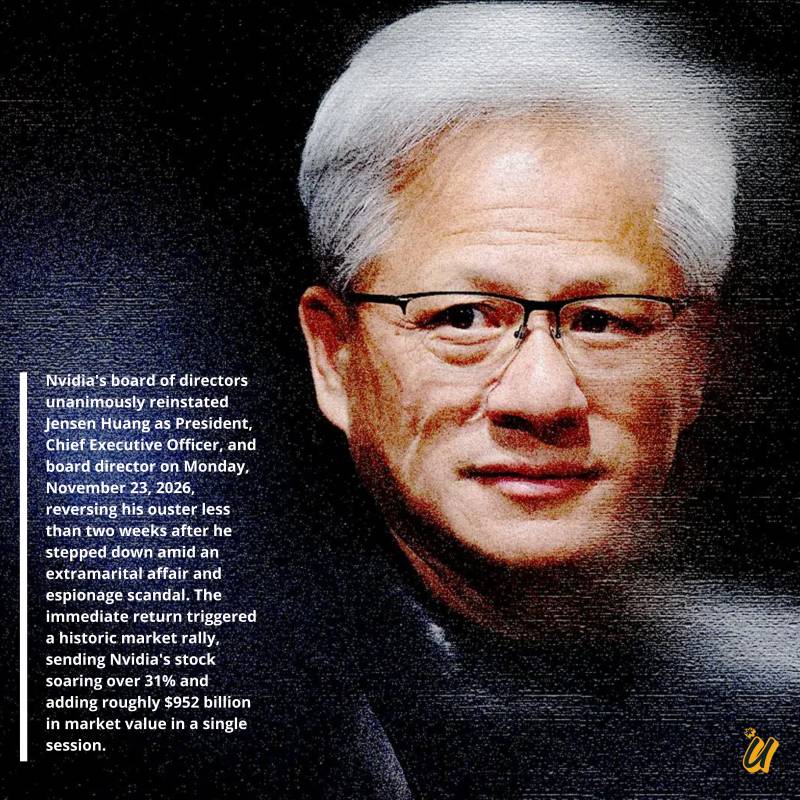
By Monday morning, however, the board pivoted sharply, declaring in a formal statement that it was "satisfied with respect to Mr. Huang’s candor and ability to lead NVIDIA" following a series of intensive meetings. Crucially, the directors noted that they had received "input from senior levels of the United States government" indicating that Huang’s immediate reinstatement "poses no national security risk". Upon returning to Nvidia's Santa Clara headquarters, Huang was greeted by roaring applause from employees gathered in the building's central atrium. Addressing the crowd, the returning chief executive acknowledged the tumultuous fortnight and vowed to apply its lessons moving forward, telling staff, "I am going to be a better CEO the second time around".
Behind the scenes, the path to Huang's rehabilitation was paved by an extraordinary political intervention from the White House. Over the weekend, President Trump publicly campaigned for the founder's return on social media, writing on Truth Social that he hoped Nvidia's board would rehire Huang because it would be "the best thing for the Company, and also, for the U.S.A.". Following the board's formal vote on Monday, Trump personally claimed credit for orchestrating the turnaround. Speaking to CNBC, the president stated that he had spoken both directly and indirectly with Nvidia's directors to advocate for the move, declaring, "I convinced them" and "I made the deal". Trump dismissed concerns that the personal scandal would damage the chipmaker's standing, suggesting to reporters that the controversy could ultimately prove to be a "net positive" for the company. The move also drew immediate applause from prominent figures across the technology sector, including OpenAI chief executive Sam Altman—who himself experienced a famous board ouster and reinstatement in late 2023—who celebrated the news with a single-word post on social media: "Jensen!".
Wall Street responded to the reinstatement with unbridled euphoria, triggering a massive surge in technology equities. Shares of Nvidia skyrocketed more than 30 percent—climbing roughly 32 percent, or $39.80 per share, in Monday trading—single-handedly adding approximately $1 trillion back to the company’s market capitalization in a matter of hours. Financial analysts noted that the sheer scale of Nvidia's rebound acted as a catalyst across global financial markets, igniting a broad "risk-on" rally throughout the semiconductor sector and lifting the broader NASDAQ 100 index as institutional investors rushed back into artificial intelligence and hardware stocks. For market participants, the return of the founder eliminated the primary existential overhang that had depressed valuations since mid-November, signaling continuity in Nvidia's product roadmap and supply chain execution.
Recognizing that restoring Wall Street's confidence would not be enough to satisfy regulators or governance watchdogs, Nvidia's board paired Huang's return with sweeping structural reforms aimed at overhauling its internal oversight. The company confirmed the establishment of a permanent, board-level National Security and Export Controls Committee composed exclusively of independent directors. Tasked with rigorous oversight of global trade compliance and national security vulnerabilities, the committee will be supported by dedicated outside legal counsel and advisers possessing specialized national security credentials. Simultaneously, Nvidia announced that it is actively recruiting its first-ever Chief Compliance Officer. Unlike traditional corporate compliance roles that report solely through internal legal departments, the new Chief Compliance Officer will report directly to the independent board committee to oversee company-wide regulatory adherence. Furthermore, the board emphasized that while it placed no formal conditions on Huang’s return to the corner office, its own independent internal investigation into foreign intelligence targeting and company conduct—led by independent directors and outside counsel—will proceed to its conclusion with Huang’s full cooperation.
Despite the celebratory atmosphere at Nvidia headquarters and on trading floors, political and legal headwinds in Washington remain fierce, with lawmakers from both parties warning that the board's vote does nothing to halt ongoing federal scrutiny. Bipartisan criticism erupted on Capitol Hill almost immediately after the reinstatement was announced. House Democratic Leader Hakeem Jeffries condemned the board's decision as "indefensible, irresponsible and incomprehensible," while Senate Minority Leader Chuck Schumer argued that the rush to bring Huang back underscored the urgent need for Congress to pass stricter legislative guardrails. Prominent Republicans echoed those concerns, with Senator John Cornyn expressing disbelief over the administration's purported security assurances and Senator Kevin Cramer warning that the potential for foreign extortion alone should have disqualified Huang from returning.
As a result, Huang faces a grueling schedule of congressional inquiries and regulatory probes in the coming weeks. A spokesperson for the House Intelligence Committee confirmed that the reinstatement "changes nothing" regarding scheduled Capitol Hill appearances. On December 1, Huang is slated to appear before three House committees for a closed-door, transcribed interview under oath, followed the next day by testimony from Nvidia General Counsel Tim Teter. Two days later, on December 3, Huang will face the television cameras as the sole witness in a high-profile public hearing before the Senate Banking Committee, chaired by Senator Tim Scott, focused squarely on U.S. export control enforcement.
Beyond Capitol Hill, financial analysts and legal observers caution that Nvidia remains under intense scrutiny regarding its global sales practices, supply chain tracking, and accounting transparency. Lawmakers and federal investigators are pressing for a full accounting of high-end artificial intelligence processors that have gone untraced or allegedly been diverted to restricted Chinese entities through third-party intermediaries like Megaspeed. Separately, House lawmakers have opened inquiries into whether familial ties between Commerce Department leadership and Nvidia influenced the federal government's handling of suspected chip smuggling. For Jensen Huang, reclaiming the title of chief executive required just eleven days of political maneuvering and boardroom persuasion, but proving that Nvidia can navigate heightened national security oversight, satisfy skeptical lawmakers, and maintain the integrity of its global sales channels will define the next chapter of his tenure.