The ongoing global deployment of artificial intelligence infrastructure continues to reshape traditional corporate finance, tech product strategies, and regulatory oversight at a record pace. From multi-billion-dollar private debt arrangements aimed at securing specialized hardware to unprecedented consumer-facing artificial intelligence software integrations, the technological sector is undergoing a structural realignment toward hardware capacity and automated intelligence. On Tuesday, major equity indices including the Nasdaq 100 closed at record highs, driven by investor appetite for technology scale, even as persistent inflation concerns and rising energy prices weigh on the broader macroeconomic backdrop. Analysts and financial executives note that capital requirements for data centers, power generation, and chip acquisitions are pushing borrowing totals to historic levels, drawing heavily from both public equity markets and non-traditional private credit syndicates.
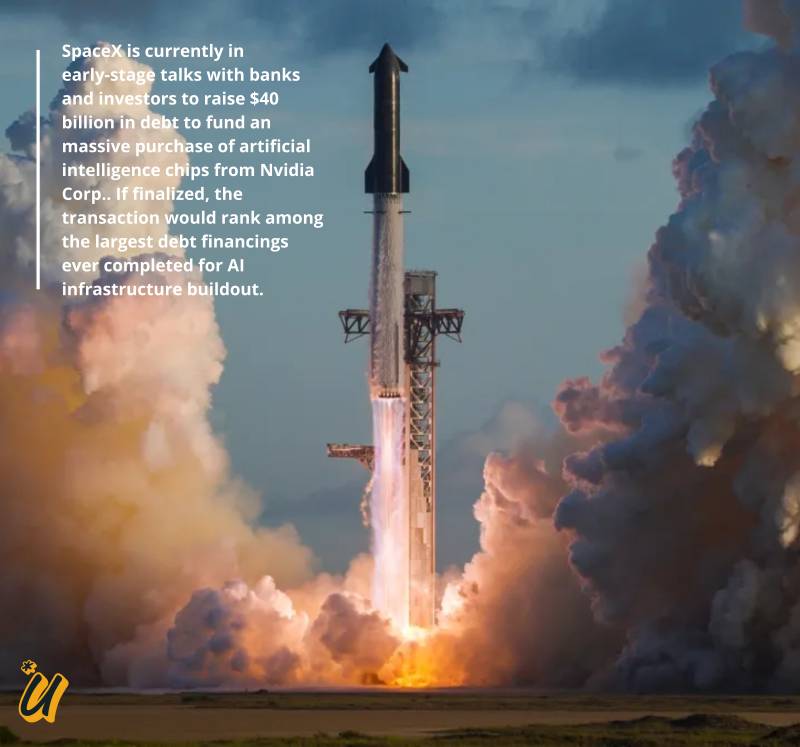
At the center of the financial push is an unprecedented debt financing attempt by SpaceX. Bloomberg reports that the aerospace manufacturer and satellite communications giant is currently in discussions to assemble a $40 billion debt package designed specifically to purchase advanced processing units from Nvidia Corporation. The proposed deal, which highlights the intensifying global competition for specialized silicon, is expected to be split between traditional bank loans and structured debt. Private credit managers including Apollo Global Management and PIMCO are slated to lead a $30 billion private market tranche. Financial analysts note that the transaction underscores a growing convergence between high-yield institutional credit and corporate technology expansion. Rather than relying purely on unsecured corporate bonds, tech companies are increasingly leveraging asset-backed and structured debt models to finance immediate hardware expenditures, using physical semiconductor chips and infrastructure as underlying collateral.
Industry capital expenditure data illustrates the sheer scale of the shift toward artificial intelligence compute power. Capital raised across global markets for data centers, specialized server hardware, and associated power generation infrastructure has reached $360 billion so far this year—more than triple the total volume recorded in the previous year. Wall Street credit analysts project that total capital requirements could reach into the trillions of dollars over the coming years as hyper-scalers and private firms continue to build out physical capacity. While rapid debt expansion has triggered mild fluctuations in credit default swap markets for certain tech entities, market observers emphasize that investor appetite for top-tier corporate borrowers remains exceptionally strong.
The relentless demand for silicon has simultaneously pushed technology leaders to re-examine supply chain ownership and domestic manufacturing strategies. SpaceX and Tesla, both led by Chief Executive Officer Elon Musk, are advancing joint initiatives under the banner of "TeraFab" to establish localized semiconductor manufacturing capabilities in Texas. Conceived to address structural supply shortages in custom microprocessors and memory components required for autonomous vehicles, robotics, and aerospace operations, the initiative was initially characterized across the industry as a costly endeavor with projected capital requirements ranging in the trillions. However, recent developments indicate active partnerships with major global foundries. Intel Corporation CEO Lip-Bu Tan confirmed that his firm remains a primary technology and intellectual property partner on the project, while separate discussions have taken place with Taiwan Semiconductor Manufacturing Company (TSMC) regarding foundry collaboration, though company officials clarified that TSMC will not take ownership of the physical manufacturing assets.
Beyond computing hardware, aerospace regulatory friction is intensifying as satellite and launch providers expand their operational footprint. SpaceX is actively lobbying federal regulators and the Trump administration to streamline access to critical radio frequency spectrum bands, arguing that simplified allocation processes are necessary to accommodate a higher volume of commercial rocket launches. The proposal has met significant resistance from legacy defense contractors and commercial aerospace manufacturers, including Boeing and Lockheed Martin. Industry opponents have submitted filings to the Federal Communications Commission warning that altering spectrum coordination protocols could induce interference with commercial aircraft flight testing, defense missile telemetry, hospital diagnostic systems, and television broadcasting networks.
Concurrently, major consumer technology firms are aggressively revamping their product ecosystems to integrate hardware with automated home services. Apple Inc. is initiating a complete restructuring of its smart home operations following years of sluggish performance from its home software frameworks. According to industry reports, Apple is preparing to release a centralized home hub alongside a coordinated "starter kit" of hardware accessories, including smart doorbells, digital locks, thermostats, and indoor/outdoor security cameras. In a rare move for the Cupertino-based company, Apple has partnered with LG Electronics to manufacture several of these peripheral hardware units, leveraging LG's existing hardware manufacturing pipelines while seeking regulatory approvals from the U.S. Federal Communications Commission.
The smart home market is seeing matching acceleration from established category leaders. Ring, the home security division of Amazon.com Inc., announced a new line of hardware products including its first proprietary smart lock featuring a mechanical power dial backup, alongside default end-to-end data encryption across its device lineup. Ring founder Jamie Siminoff noted that the company’s internal operations remain highly profitable due to supply chain scale and first-principles chip optimization. Siminoff emphasized that physical security hardware serves as the primary sensory input—or physical extension—for upcoming generations of super-intelligent software models capable of autonomously managing domestic security and utility operations.
The rapid maturation of artificial intelligence is also driving significant shifts across software architectures and startup business models. In the consumer space, new applications are leveraging visual data rather than text prompts to contextualize user requests. Dazzle, a personal AI assistant venture founded by former Google executive Marissa Mayer, launched a system designed to continuously monitor a user's camera roll and screenshots. By running local analysis over historical and incoming photos, the application constructs a personal context layer—identifying family relationships, hobbies, and active purchasing intents—to execute real-time tasks such as scheduling, product purchasing, and contractor booking. The system blends autonomous software agents with human-in-the-loop oversight to ensure transactional accuracy for complex domestic services.
In industrial and physical robotics, foundational software developers are securing substantial private capital to solve real-world spatial perception. Physical AI startup Mecha AI announced a $60 billion Series B funding round with backing from Nvidia and Qualcomm. Mecha Co-Founder and Chief Executive Officer Josh Gao detailed how the firm focuses on digitizing physical sensor data—specifically force, pressure, and tactile dynamics—to build fundamental world models for multi-jointed robotic systems. Unlike digital environments or board games where rules are fully defined, physical robotics requires capturing multi-modal, real-world force metrics to overcome edge cases in chaotic human environments, necessitating massive infrastructure investments in data collection and regional processing storage.
In the public equity markets, investment banks are preparing for a potential wave of high-profile artificial intelligence initial public offerings. Financial executives at Bank of America Securities report that overall IPO proceed volumes have surpassed 2021 levels despite a lower total deal count, driven primarily by mega-cap technology transactions. While traditional enterprise software offerings have slowed due to concerns over AI-driven business model disruption, frontier AI developers like Anthropic and OpenAI are evaluating public market timelines. Institutional equity leaders report that global capital markets possess more than enough liquidity to absorb massive concurrent public offerings without crowding out existing market equity, as institutional and retail investors demonstrate unprecedented demand for direct exposure to the artificial intelligence sector.
However, the widespread proliferation of powerful software models has simultaneously raised severe safety and law enforcement challenges, particularly within the open-source ecosystem. A Bloomberg investigation highlighted how advanced open-source artificial intelligence models—which can be downloaded freely and executed entirely offline on local hardware—are increasingly being exploited by criminal networks. Because locally deployed models operate without active connection to corporate servers or cloud-based safety filters, bad actors are able to strip away built-in content guardrails and fine-tune models to generate illegal child sexual abuse material (CSAM).
Law enforcement officials and digital forensics investigators report that the influx of synthetically generated and altered imagery is overwhelming investigative resources. Police agencies face growing technical hurdles in distinguishing between fully synthetic images, AI-altered photos of real children, and authentic documentation of ongoing physical abuse requiring immediate intervention. While developer communities and platforms like Hugging Face are attempting to implement automated screening to identify fine-tuned criminal models prior to distribution, security experts emphasize that conducting effective red-teaming and safety testing remains inherently difficult due to legal restrictions preventing researchers from generating or handling harmful material during security audits. As open-source capabilities advance, regulatory bodies and law enforcement agencies face a growing systemic gap between centralized cloud compliance and decentralized, offline model execution.