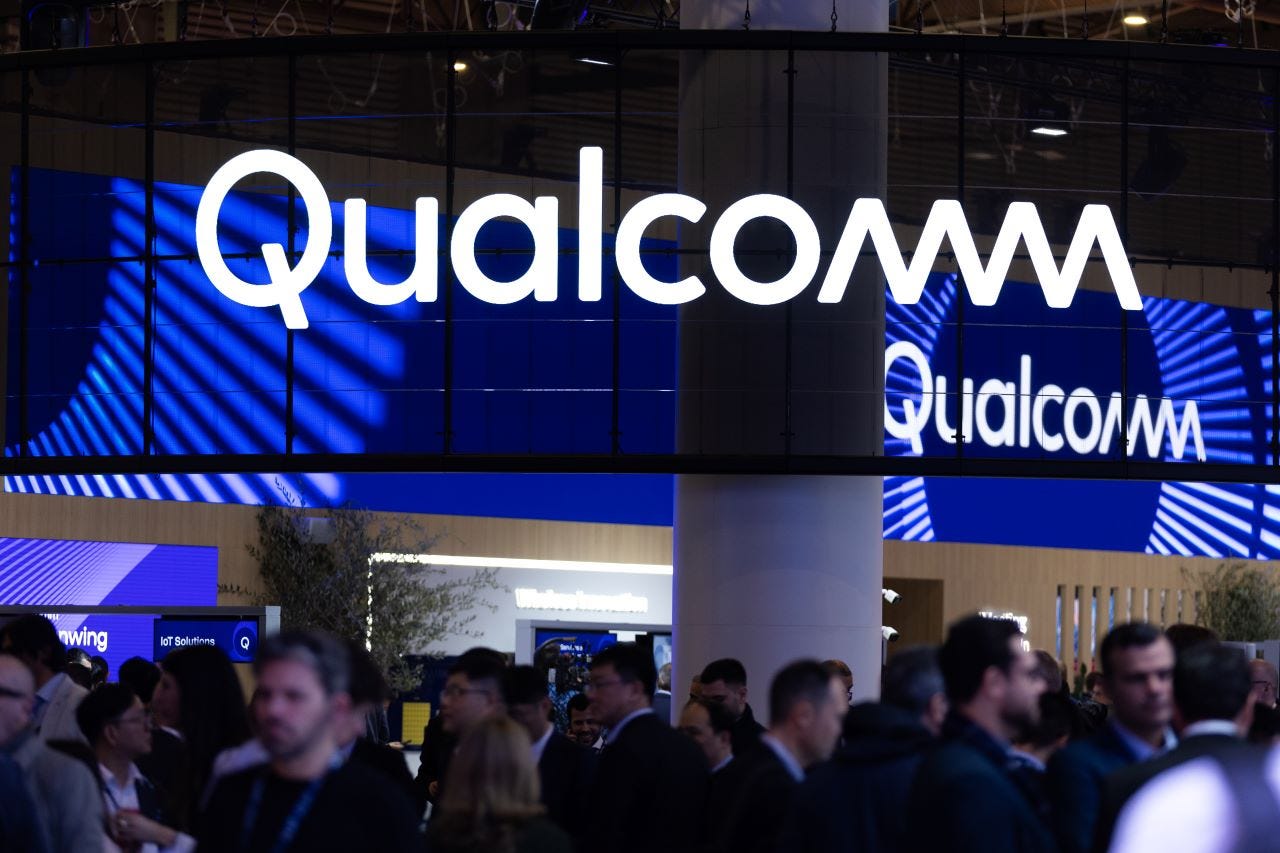
This week kicked off with a major market story: the surge in Qualcomm stock, which Ed Ludlow noted was up 22% and tracking its biggest jump since April 2019. The catalyst for this rise was Qualcomm’s unveiling of a new data center chip—a specifically designed NPU (Neural Processing Unit)—aimed at Artificial Intelligence (AI) and machine learning. Caroline Hyde framed the move as Qualcomm "trending on Nvidia’s toes". The chipmaker is signaling a serious, long-term commitment despite being "late to the party," having a follow-up chip already planned, and securing a key customer. Ed Ludlow highlighted that the reaction was "severe" and the story is "important". This technology is a derivative of their mobile technology, scaled up for the data center world, and the company is reportedly speaking with "all of the large data center operators" and "all of the hyper scalers," seeking "real, real deployments" to prove this is more than just an experiment.
Beyond hardware, Ed Ludlow emphasized that this is a critical week for technology markets, as five of the "Mag 7" tech giants are set to report earnings. Investors are keenly focused on Capital Expenditure (CAPEX) to gain clarity on the Return on Investment (ROI) from the industry’s enormous AI spending. Caroline Hyde noted the universal bullishness, pointing out that there is not a "single sell rating" on the hyper scalers reporting this week, which include Microsoft, Amazon, Alphabet, and Meta—four of the major Nvidia customers.
The dialogue also turned to the ongoing "A.I. bubble" debate. Discussing the historical context, Denise Chisholm of Fidelity Investors explained that when expensive valuations are matched with high earnings growth, as they are today, this situation has been "much more predictive historically" than environments of low growth and low valuations. She argued that relative valuations were 70% higher in the year 2000, and unlike the prior bubble, technology operating margins are currently increasing, which suggests that sometimes things "are expensive for a reason". Ed Ludlow summarized the distinction, noting that a stock bubble involves prices driven up without fundamental support, whereas the current situation is an entire industry, "saying we’ll keep investing in this technology" with the future expectation of a return on investment.
In the infrastructure space, Ed Ludlow reported on Crusoe, an AI data center startup that raised a billion-dollar funding round, putting its valuation over $10 billion, partly for its Stargate campus in Abilene, Texas. Crusoe CEO Chase Loch Miller described their "vertically integrated energy first approach" as crucial, particularly in unlocking access to 1.2 gigawatts of power for the Abilene campus. Caroline Hyde noted the importance of this integrated approach when it comes to energy, which differentiates them from other cloud providers. Ed Ludlow also pointed out that the Trump Administration’s announcements to cut red tape and deregulate are helping speed up the electrical hookup process for data centers, which is critical for Crusoe’s operations. Loch Miller confirmed his excitement over the administration’s support, noting that waiting for permits is "one of the more frustrating things" to slow down their goal to "move fast and make things".
Geopolitically, the focus is on the U.S.-China trade impasse ahead of President Trump’s meeting with Xi Jinping. Ed Ludlow highlighted the "interesting dynamic and curious timing" of Nvidia holding its G.T.C. D.C. conference just blocks from the White House. Caroline Hyde emphasized that policymakers are torn over the "hawkishness" that should be maintained towards China and whether to allow access to deep technology. Nvidia CEO Jensen Huang is making significant efforts to reverse the loss of the Chinese market, which once accounted for 80% of its sales, through intense lobbying in Washington. However, as Caroline Hyde noted, a primary concern for policymakers is that granting China access to sophisticated AI chips could allow Beijing to employ the technology for military and intelligence purposes.