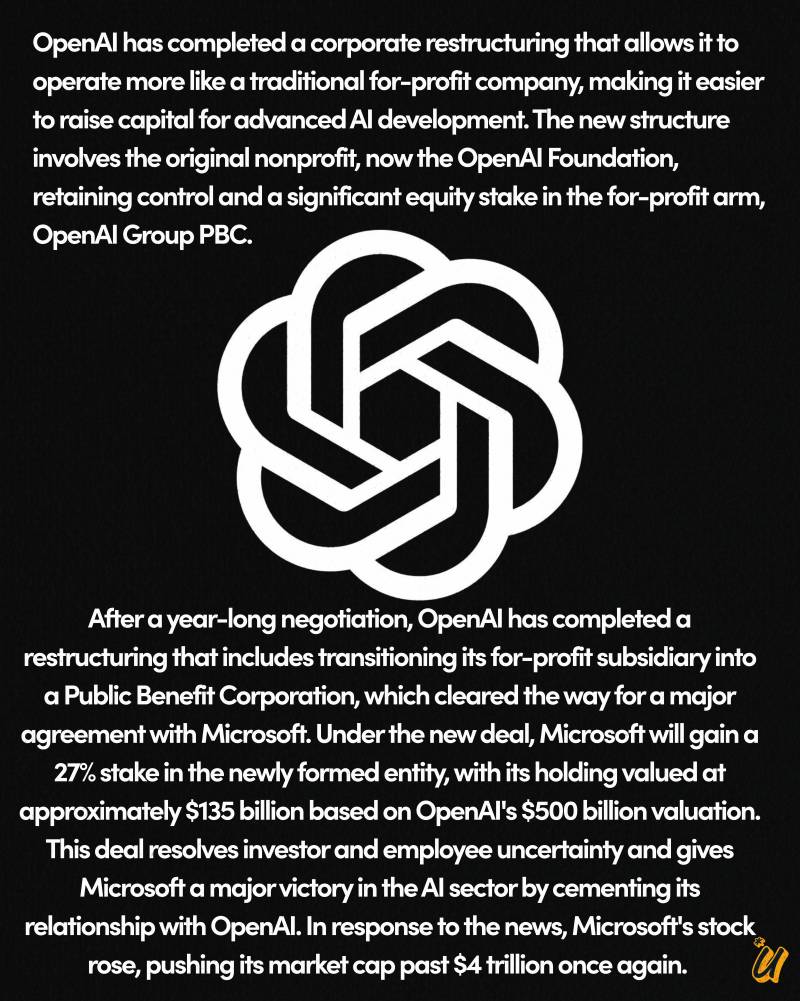
Ed Ludlow led the breaking news detailing the finalization of a new agreement between Microsoft and OpenAI. Microsoft has secured a 27% ownership stake in the AI startup, a deal valued at approximately $135 billion. This move, described as a "bigger move for OpenAI," resolves the uncertainty around its evolution into a for-profit venture and provides "some certainty for investors". Crucially, Microsoft will maintain access to OpenAI's technology until 2032, which encompasses the period when OpenAI is anticipated to achieve AGI (Artificial General Intelligence)—the state where AI can think like a human. The resolution of this partnership removes a hurdle, as Microsoft was considered one of the final holdouts in solidifying this evolution. The resolution also allocates resources to the nonprofit OpenAI Foundation, tying up "another loose end".
The market’s attention was also fixed on NVIDIA, which was trading at a record high ahead of Jensen Huang's keynote address at the GDC conference. The event was labeled the "AI Super Bowl" on the Bloomberg Terminal, generating "very high" expectations for announcements that "move the needle". Analysts expect Huang to introduce new products, features, and partnerships to accelerate the dissemination of artificial intelligence across various sectors, including healthcare, transportation, and robotics. Huang has been promoting the concept of the "AI factory takeover," where AI is utilized to develop ideas. A significant headwind, as noted in the coverage, is U.S. export control, which has restricted NVIDIA’s access to China, the world's largest semiconductor market. Ed Ludlow mentioned that President Trump expects to see Huang soon, as Huang is scheduled to travel to South Korea after the keynote, potentially signaling a desire for changes to those export controls. Further showcasing its strategic investment in AI dissemination, NVIDIA made a $1 billion equity investment in Nokia, subscribing to new shares that will grant it nearly a 3% stake (2.9%) in the European telecommunications company. This capital is intended to accelerate Nokia's strategic plans around AI, a move that triggered the "NVIDIA effect," boosting Nokia's shares.
In the governance spotlight, Caroline Hyde hosted Tesla’s Board Chair, Robyn Denholm, who was meeting with key institutional shareholders in New York to lobby for the approval of Elon Musk's $1 trillion pay package. Denholm defended the package as performance-based, asserting that Musk "gets nothing if he doesn't perform against the pretty audacious part of the performance criteria". Denholm stressed that the central issue for Musk is securing "voting influence" in future shareholder meetings, potentially seeking more than 25% control. Ed Ludlow posed the critical question regarding "Plan B" if the vote is "No". Denholm acknowledged the "real risk" that a "No" vote could impact Musk’s leadership. She unequivocally confirmed that there is currently "no other person" lined up as a backup leader, arguing that Musk is the "right leader for the company over this next decade" due to his unique prowess in manufacturing and AI development. Denholm confirmed that the Board looked at different instruments to separate economic value from voting rights, but found it "just not possible" to introduce a special class of voting shares once the company was public.
Corporate strategy across the tech ecosystem emphasized AI efficiency and integration. The Adobe CEO, in conversation with Ed Ludlow, expressed confidence that the long-lasting value of AI will be in "inference"—the usage and workflow—rather than just the costly infrastructure training phase. He argued that Wall Street is too focused on monetization via training infrastructure, causing the stock to be "undervalued right now," prompting the company to buy back stock. Meanwhile, PayPal shares surged following raised earnings guidance and a new partnership with OpenAI, aiming to integrate digital commerce into the ChatGPT project, seamlessly converting searches into purchases. Conversely, Caroline Hyde highlighted that Amazon confirmed 14,000 corporate job cuts. This move follows signals from CEO Andy Jassy that generative AI is expected to allow the company to achieve "more with less" regarding headcount. Meta is also shifting its top metaverse executive to focus on AI products and has been undergoing job cuts. SoFi’s CEO, appearing on Bloomberg Tech, discussed the company’s 17 consecutive quarters of revenue growth and confirmed they are expanding their engineering workforce to support product innovations, including the AI-driven "Cash Coach" and cryptocurrency offerings.
The conversation concluded with Substrate, a secretive American chip startup, emerging from stealth with a $1 billion valuation. The company unveiled a new lithography tool that its founder claims uses acceleration and X-ray wavelengths to etch intricate designs sharper than ASML’s UV machines, directly challenging TSMC’s dominance. The company plans to build an American foundry. The founder, James Proud, stated that the company is driven by a strong ideological commitment to ensuring U.S. sovereignty over national security critical technology, and noted that the current administration has been "incredibly supportive and engaged" since "literally day one". Caroline Hyde found it "so interesting" that the U.S. invented all this technology, and Ed Ludlow reiterated that the vision is rooted in American sovereignty.