NEW YORK — In a landmark day for the global technology landscape, major shifts across artificial intelligence hardware, corporate leadership, public financial markets, and energy infrastructure are reshaping the future of the digital economy. From unprecedented capital investments in custom silicon architectures to an end-of-an-era executive transition at Silicon Valley’s most valuable consumer enterprise, today’s developments signal a rapid evolution in how compute power is built, funded, and deployed worldwide.
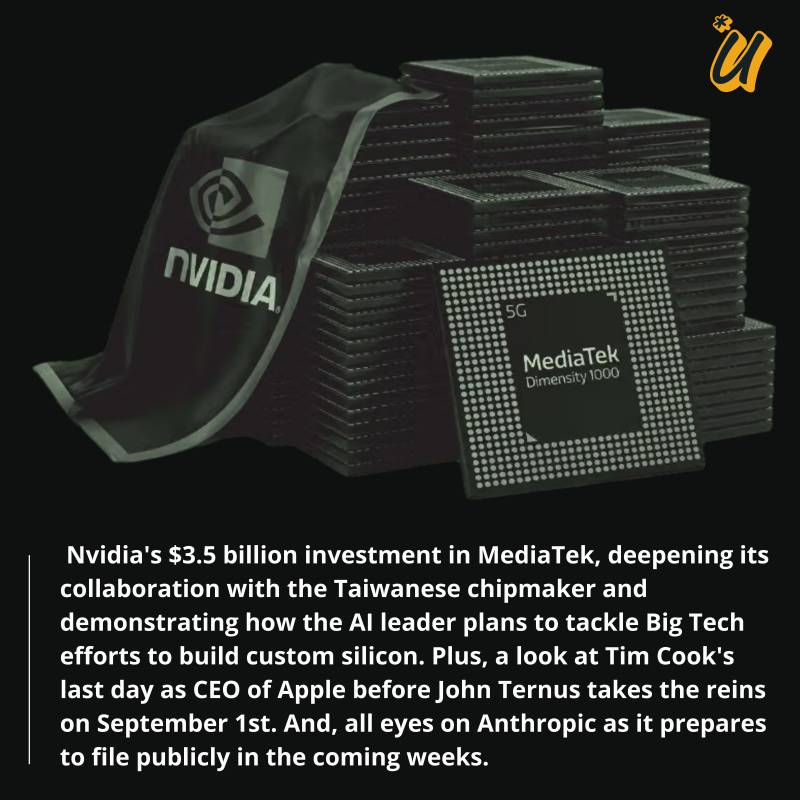
At the center of the hardware ecosystem, Nvidia has executed a monumental strategic move by announcing a $3.5 billion investment in MediaTek via convertible bonds. This multi-billion-dollar deal establishes a high-stakes partnership designed to bridge the gap between bespoke silicon and established enterprise infrastructure. Under the terms of the agreement, MediaTek’s custom AI accelerators, known as XPUs, will be directly integrated into Nvidia’s proprietary, high-speed NVLink interconnect architecture.
For hyper-scalers and technology conglomerates attempting to build their own custom application-specific integrated circuits, the strategic implication is profound. Rather than abandoning Nvidia’s ecosystem to build standalone custom chips, tech giants can now deploy specialized MediaTek silicon while remaining comfortably anchored within Nvidia’s high-throughput compute framework. The move effectively allows Nvidia to capture value from the custom silicon trend while reinforcing its architectural dominance across modern data centers.
Simultaneously, the corporate world is witnessing a historical passing of the torch in Cupertino, California. Today marks the final official day for Tim Cook as Chief Executive Officer of Apple, concluding a extraordinary era of operational expansion and market valuation growth. On September 1st, John Ternus officially assumes the role of CEO, taking the helm during a critical moment in Apple’s hardware and AI integration timeline.
Industry analysts emphasize that while the formal title changes hands, the practical leadership transition will be a deliberate, gradual process. Tim Cook will remain closely involved in an advisory capacity as Executive Chairman, ensuring operational continuity while Ternus navigates the company through its next generation of device innovation and spatial computing platforms.
In the public markets, Wall Street’s focus has locked firmly onto the artificial intelligence sector as anticipation builds for Anthropic’s upcoming initial public offering. Expected to be one of the largest public filings in tech history, the market listing is viewed as a definitive litmus test for commercial AI valuations. A broad line of venture-backed technology companies are reportedly delaying their own public offerings, choosing to stand on the sidelines until Anthropic sets the benchmark pricing, investor appetite, and regulatory tone for high-growth artificial intelligence firms entering the public sphere.
While software and chip architecture dominate market headlines, the physical infrastructure needed to power next-generation workloads is driving significant government action. In a major move toward energy security and decentralized power for critical operations, the United States Army has selected five defense and technology firms for nuclear micro-reactor development under the Janus initiative. Leading the contract allocations, Radiant has secured a $750 million deal to supply 15 portable, 1-megawatt nuclear reactors designed to deliver reliable, off-grid power to defense facilities and isolated operational bases.
Underpinning all of these technological advances is an increasingly complex geopolitical backdrop surrounding AI governance and trade policy. Ongoing tensions between the United States and China continue to escalate as Beijing outlines strict preliminary terms for prospective bilateral AI regulation discussions. Crucially, Chinese officials have voiced sharp opposition regarding Anthropic’s public stance on export controls, highlighting how corporate governance policies and global safety guidelines are now intertwined with national security, trade restrictions, and international diplomacy.