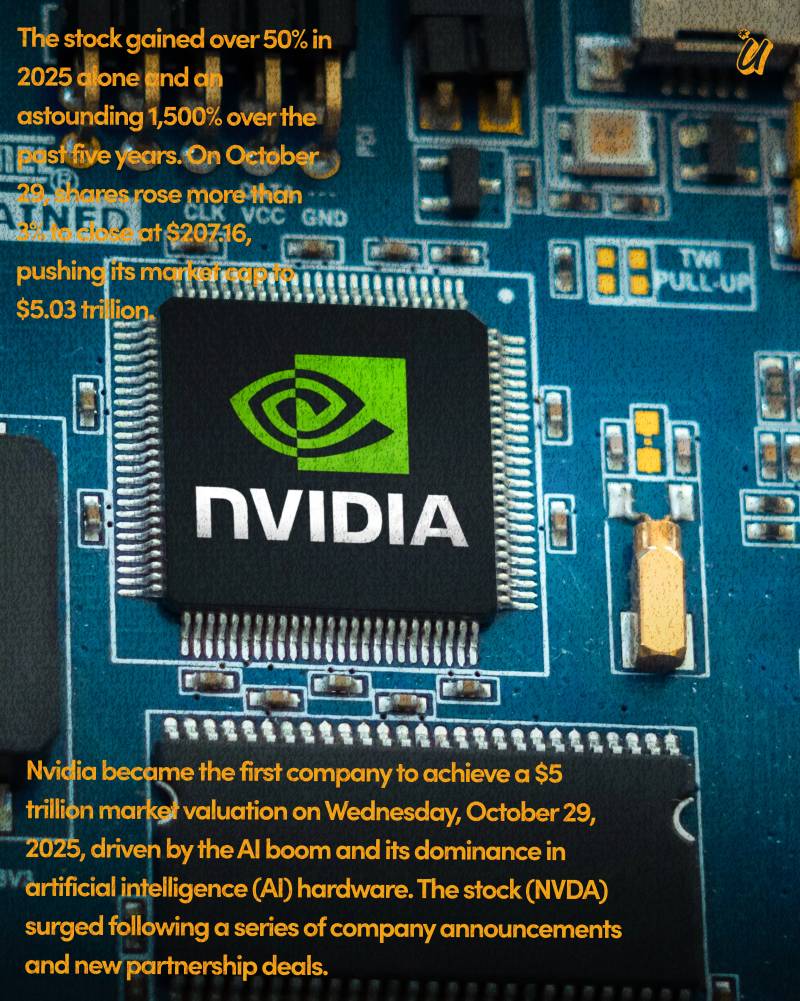
NVIDIA has officially cemented its position as the undisputed AI behemoth, becoming the first company to reach $5 trillion of market value, or market capitalization, NVIDIA has officially cemented its position as the undisputed AI behemoth, becoming the first company to reach $5 trillion of market value, or market capitalization, a milestone achieved rapidly after crossing the $4 trillion threshold. Bloomberg Technology was live from coast to coast, with Caroline Hyde reporting from New York and Ed Ludlow anchoring coverage from San Francisco, detailing the convergence of geopolitical drama and strategic dealmaking driving this extraordinary surge.
The immediate spike in NVIDIA’s stock, climbing 4% in a single session, was triggered by a dramatic revelation: President Trump announced onboard Air Force One that he would be speaking about NVIDIA’s new Blackwell chips with China’s President Xi Jinping during their upcoming meeting. The President confirmed, “WE WILL BE SPEAKING ABOUT BLACKWELL. IT’S A SUPERDUPER CHIP”. Ed Ludlow noted that the focus is on NVIDIA’s role in these high-level talks. Analysts clarified that the market’s previous understanding was that China might only be allowed a reduced version of the new chip line, not the leading-edge Blackwell chips. If President Trump is indeed referring to the whole of the Blackwell line—NVIDIA’s best chips—it would represent a massive expansion of the opportunity and explain the intense market excitement, although this is considered unlikely.
Caroline Hyde highlighted that the level of excitement was already extraordinary even before the President’s statement, noting that CEO Jensen Huang had already outlined rampant demand for Blackwell chips even without any China demand whatsoever. Huang previously forecast half a trillion dollars (500billion) of sales for the new Black well chips over a five−quarter period, a figure that is significantly higher than the company's total revenue estimates for the next couple of years, which are in the 300 billion range. This 500billionfigurealonewasabout 100 billion higher than some analyst models for the data center business.
Jensen Huang has been actively using partnerships and investments to counter the primary market concern that the industry is "building ahead of the actual business case for A.I.". This strategy, which is all "channeled in the same direction," aims to show that "A.I. IS REAL" and to "get rid of some of these problems".
A major element of this strategy is NVIDIA’s plan to make a $1 billion equity investment in Nokia, securing a near 3% stake in the European telecommunications company. This announcement caused a massive surge in Nokia shares. This deal thrusts NVIDIA into the mobile infrastructure market, with the goal of deploying AI computing services on top of radio networks. Huang explained that this partnership is essential because Nokia is in millions of base stations around the world, and NVIDIA needs a partner to get its computers inside those stations. The investment funds Nokia to rewrite and optimize its hardware and software stack for NVIDIA’s platforms, a costly endeavor. As Caroline Hyde observed, this is another instance of NVIDIA utilizing its cash stockpile in a very smart way to ensure its technology is integral across every industry group.
Ed Ludlow noted that beyond deals with giants, NVIDIA has become a "juggernaut" in the venture capital world. Through October of this year, NVIDIA has backed 59 different AI startups, outpacing its entire investment total from the previous year. While the company denies any obligation for recipients of its capital to buy its chips, the practical reality is that by funding hundreds of startups, money will inevitably flow back to NVIDIA as the market leader in AI chips. This strategy helps diversify NVIDIA’s revenue streams, which are heavily dependent on a handful of larger tech firms.
Despite the staggering $5 trillion valuation, Margaret Patel of All spring Global Investments told Bloomberg Technology that it is "very hard to be negative on NVIDIA" because this period represents a "huge sea change in technology" comparable to a "tsunami". Patel added that companies funding this AI growth, like Amazon, Alphabet, and Microsoft, have high cash flow. This financial strength is seen as fundamentally different from the dot-com bubble because the investments are not "artificially borrowing money to make investments that look pie in the sky". Ed Ludlow recalled asking Jensen Huang directly about the market bubble concern, and Huang insisted that the shift is a "natural transition from an old computing model to accelerated computing" and that AI is now generating tokens "worth paying for" due to its reasoning and capability.
The massive capital expenditure required to keep up with NVIDIA’s pace was underscored in the earnings analysis. Caroline
Hyde reviewed upcoming results for Alphabet, Microsoft, and Meta. Meta expects to spend as much as 72billion on Capex. Alphabet (Google) recently changed its guidance for AI infrastructure spending to 85 billion for 2025, a $10 billion increase. Microsoft is also expected to focus heavily on Capex, anticipating spending more than 125billion this fiscal year. Michael Turin, Senior Technology Analyst at Wells Fargo, noted that the chief concern for Microsoft is maintaining its cloud market share dominance, particularly in Azure, given the landscape where competitors are striking deals with AI startups, such as GCP’s1 million TPU deal with Anthropic.
Rounding out the broadcast, Ed Ludlow detailed the decision by AI startup Character.ai to ban kids from having conversations with chatbots on its platform. This move follows growing pressure from lawmakers and lawsuits alleging harm to children, including instances up to and including suicide. Caroline Hyde noted this could be interpreted as the company "front running" potential regulation, particularly a Senate bill that seeks to outlaw the use of AI chatbots by people under 18.