Record market highs and a massive debt offering for AI infrastructure dominated the week’s financial news on Bloomberg Technology, with hosts Caroline Hyde and Ed Ludlow steering the analysis of major shifts in semiconductors, quantum computing, and the volatile trade environment. The S&P and NASDAQ reached a new record high, with a real tech hire on the day end. Caroline Hyde noted this optimism was largely due to inflation cooling, which grants the Federal Reserve greater latitude for rate cuts that the market had already been pricing in.
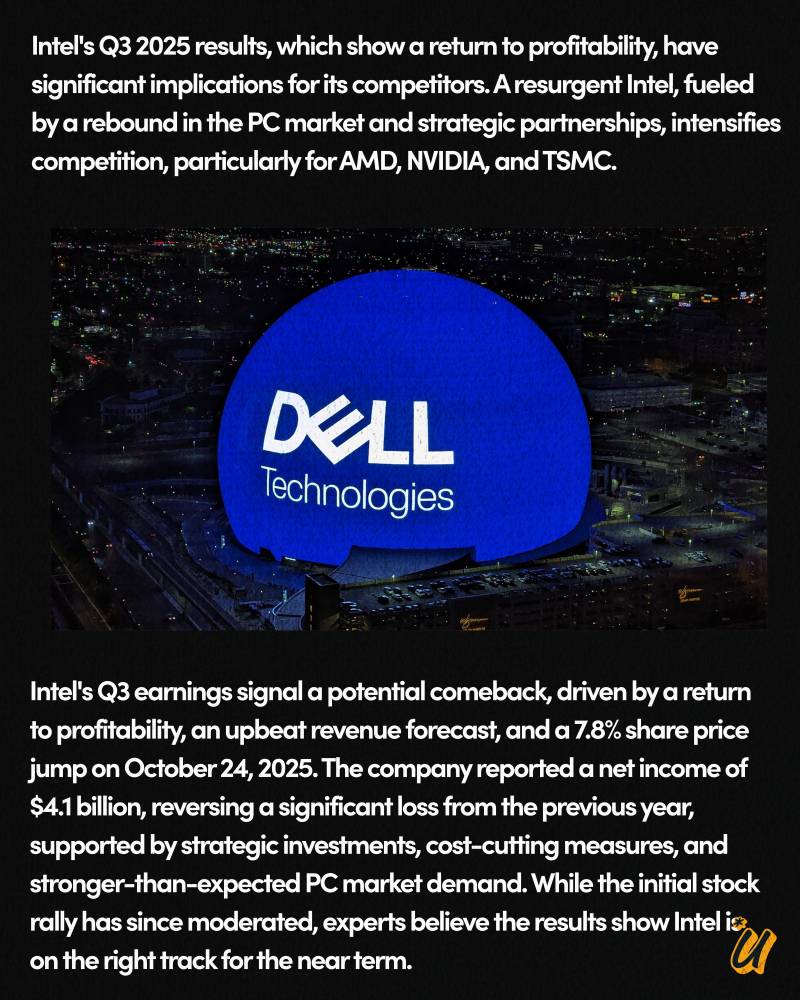
Ed Ludlow reported on the mixed signals from Intel’s post-earnings performance, noting that its rally had faded significantly. Although Intel returned to profitability for the first time in a long time on a net income basis, its initial gain of almost 8% quickly eliminated most of its gain of the day, settling to up just half a percentage point. The comeback effort shows "the first sign in the right direction," driven by a P.C. market that performed better than expected and progress in the server and foundry segments. Ed Ludlow mentioned that Intel’s CFO was surprised by the demand on the product side, particularly servers, arguing that hyper scalers suddenly realized they needed to update their C.P.U.’s and invest in them, which is expected to result in year-to-year unit growth. Caroline Hyde pressed on the importance of Intel's future fabrication roadmap, specifically the 18-A iteration. Intel's long-term success relies on "a coalition" of partners and industry policy.
Shifting to the immense capital demands of the AI revolution, Caroline Hyde announced that banks are preparing to launch a $38 billion debt offering to help fund data centers tied to Oracle, marking a record for A.I. infrastructure. Ed Ludlow stressed the clarification that this debt is not being taken on by Oracle, but by Vantage, the developer handling the project. This sheer scale of packages is necessary because massive contracts, such as the reported $300 billion deal between OpenAI and Oracle, need financing to convert into sales, requiring data centers and equipment. The issuance of debt is raising concerns; Caroline Hyde cited a report that the Bank of England is probing data center lending due to worries about an A.I. bubble brewing. Analysts on Bloomberg Technology drew a distinction between extreme valuations, which is the current state, and a full A.I. bubble, which would require far more aggressive sentiment and debt issuance.
The program also included an interview with the CEO of European A.I. start-up Mistral, which announced the release of a new platform to help enterprise clients create customizable A.I. tools. Ed Ludlow welcomed Mistral’s CEO to the program to discuss this significant milestone. Mistral differentiates itself by offering a highly integrated platform and stressing that enterprises should own their A.I. system, with their I.P. and data remaining with the company and not flowing back to Mistral. Caroline Hyde inquired about how Mistral competes against others already serving the enterprise market, such as Anthropic and OpenAI. The company is building its own compute capacity, called Mistral Compute, which is focused on creating digital G.P.U.’s in Europe where capacity is currently lacking. They are financing this capacity through bank debt based on long-term contracts, which gives them confidence that they are not overly exposed to debt.
Ed Ludlow also covered Google’s major milestone in quantum computing, announcing they ran an algorithm that is verifiable and 13,000 times faster than today’s best super computers. Caroline Hyde asked about the timeline for this technology, with Google Quantum A.I. expressing optimism about seeing real-world applications in areas like science and medicine in the next five years. In the financial sector, Ed Ludlow detailed that JPMorgan is set to allow institutional clients to use Bitcoin and Ether as collateral for loans by the end of the year. Caroline Hyde noted the irony of this move given CEO Jamie Dimon’s past skeptical remarks about crypto, which he once called "pet rocks". The bank avoids touching the crypto directly by having clients transfer their holdings to a third-party custodian.
Finally, Ed Ludlow brought up President Trump’s sudden halting of trade talks with Canada over an advertisement citing a Reagan-era comment, calling trade talks "the toddler that just won’t go to bed". Analysts warned Caroline Hyde that rolling back globalization stands to reason as a potential headwind for earnings, even if there is "no discernible effect" on earnings or inflation yet. The U.S. market broadly is considered "quite expensive" across almost every sector, according to an analyst on the show.