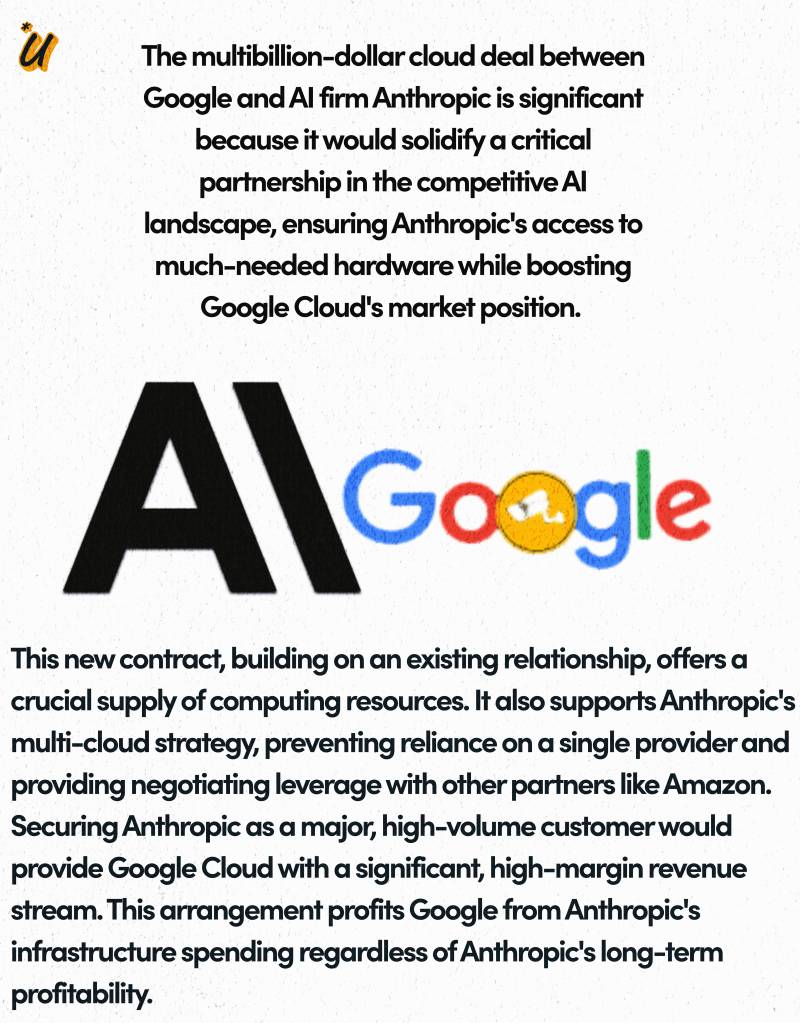
Breaking news, broken overnight by Bloomberg, reveals that Anthropic and Alphabet, specifically Google, are discussing a massive deal for cloud computing services, potentially valued in the high tens of billions of dollars. This development immediately affected the market: Alphabet shares jumped, while Amazon's stock fell. As reported by Bloomberg Technology's Ed Ludlow, reporting from San Francisco, the discussions center on Anthropic's plan to utilize Google's Tensor Processing Units (TPUs) for its AI workloads, noting that TPUs are specifically "in the mix". Anthropic, an existing Google Cloud customer and investment partner, also maintains a similar relationship with Amazon. Ed Ludlow emphasized the competitive context, noting that this pursuit of specialized capacity signals that building the advanced AI models Anthropic develops is "extremely compute intensive". Bloomberg Intelligence noted that the simplest explanation is that Anthropic, which has been seeking capacity globally, "needs as much capacity as it can get" because the entire industry is experiencing capacity strain. Some sources confirmed that the talks are specifically about TPUs.
Shifting to corporate performance, Ed Ludlow interviewed AT&T CEO John Stankey regarding the company's recent earnings, which reported higher-than-expected subscriber growth. John Stankey acknowledged analyst concerns about rising churn and lower average revenue per user (ARPU), but he defended the strategy, telling Ed Ludlow that the company had a "really strong growth" quarter. The CEO explained that the strategic goal is to acquire customers with great lifetime values who will "turn less," even if it means initially offering a "better price for their loyalty". John Stankey highlighted a critical success metric: the quarter delivered AT&T’s "best broadband gain on our strategic products and services, fixed wireless, and fiber, that we have had in eight years," with a net gain of over 230,000 customers. He clarified to Ed Ludlow that the lower ARPU is a designed consequence of penetrating value segments and offering bundle deals that combine wireless and broadband, a necessary trade-off to "grow in aggregate service revenues" over time.
Meanwhile, the earnings narrative was complicated by Netflix, whose stock dropped significantly, tracking for its biggest decline since April 2022. The decline was primarily attributed to a tax dispute with Brazil that required back payment on unclear legislation from 2022, resulting in a large, idiosyncratic hit to operating margin. Despite this, Netflix highlighted 17.5 percent sales growth and strong financial health, generating close to $8 billion in free cash flow annually. In the semiconductor space, Texas Instruments gave a "lackluster forecast," projecting an "anemic return to growth for the whole industry," signaling that investment is not returning as quickly as hoped amid macro-related uncertainty outside of AI. Providing a counterpoint to the capacity hunt, Alphabet also announced a quantum computing breakthrough: an algorithm run on its Willow Want Him chip can outperform classical supercomputers, a discovery that may clear the path for useful quantum applications within five years.
Finally, the AI infrastructure boom continues to drive capital deals, with Meta set to finalize the largest private capital deal on record—a nearly $30 billion financing package for a massive two-gigawatt data center site in rural Louisiana. Conversely, Bloomberg exclusively reported that Apple's plans for a foldable iPad have hit snags related to display engineering and weight reduction, potentially delaying its release until 2029 or beyond.