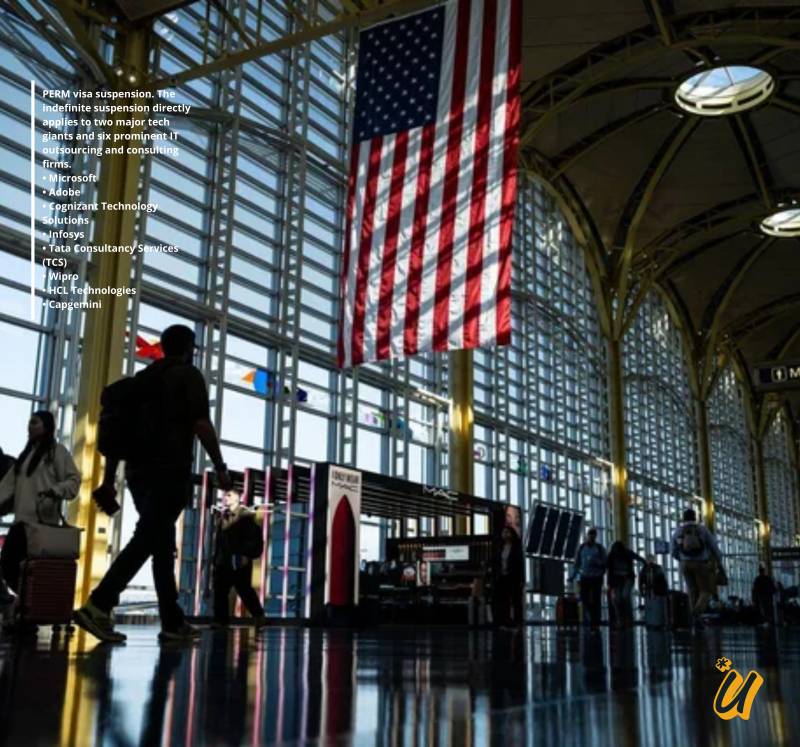
WASHINGTON / SAN FRANCISCO — In a dramatic policy shift that sent immediate shockwaves across public financial markets and technology corporate boardrooms, the Trump administration announced a sweeping suspension of access to key foreign worker visa programs for several of the world’s prominent technology corporations, targeting Microsoft Corporation and Adobe Inc., as well as major IT consulting giants including Cognizant, Infosys, Tata Consultancy Services, Wipro, HCL Technologies, and Capgemini.
The dynamic action focuses on the Department of Labor’s Permanent Labor Certification program, commonly known as PERM, which serves as a primary regulatory pipeline allowing U.S. employers to sponsor foreign personnel for permanent residency status when qualified domestic labor is unavailable. Speaking at a federal workforce event, U.S. Vice President JD Vance specifically cited Microsoft as the principal offender of the system, pointing to the stark contrast between Microsoft laying off 6,000 domestic workers over the past year while simultaneously filing thousands of applications for H-1B skilled worker visas and permanent resident certifications. Administration officials emphasized that the regulatory ban will remain in force indefinitely as federal authorities broaden their scrutiny to examine potential visa compliance irregularities at nine top-tier U.S. research universities, including Harvard, MIT, Stanford, and Yale.
The federal crackdown introduced a striking scene in the nation’s capital, unfolding just hours before a scheduled White House summit where President Trump awarded the prestigious National Medal of Science and the National Medal of Technology and Innovation to prominent tech leaders. Recipients appearing at the White House included Nvidia CEO Jensen Huang, AMD CEO Lisa Su, SpaceX founder Elon Musk, Google co-founder Sergey Brin, Dell CEO Michael Dell, and Microsoft CEO Satia Nadella—who accepted the honor on behalf of his company on the very same day federal regulators barred Microsoft from sponsoring new permanent visas.
Beyond political actions, financial markets mirrored a complex sentiment as major stock indices pulled back following the news. Equity analysts and portfolio managers noted that while extraordinary corporate capital expenditure around artificial intelligence infrastructure continues to drive performance, investors are scrutinizing valuations and debt structures across the sector. Commenting on the macroeconomic outlook, Goldman Sachs Wealth Management Co-Head Matt Wear highlighted that peak growth rates in AI capital expenditures likely occurred earlier in the year, but underlying spending momentum remains exceptionally solid compared to broader economic growth, with corporate earnings fundamentally sustaining long-term market trajectories.
The cautious market atmosphere extended into global semiconductor earnings. Despite South Korean technology giant Samsung reporting an impressive near nine-fold surge in operating profits to roughly $80 billion for the quarter, and Taiwan Semiconductor Manufacturing Company (TSMC) logging a massive 51% surge in sales, shares for both industry leaders experienced downward pressure. Traders indicated that despite soaring market prices for High Bandwidth Memory and DRAM chips, investors remain wary of the duration of the current hardware investment cycle and the financial leverage deployed by major tech firms.
Amid skepticism around hardware manufacturers, institutional venture capital continues to pour into specialized AI software platforms and foundational biotech applications. Alphabet’s drug discovery spin-off, Isomorphic Labs, led by DeepMind founder Demis Hassabis, has entered early-stage discussions to secure fresh investment funding that could value the artificial intelligence startup between $40 billion and $50 billion. Simultaneously, AI workflow startup Hone announced its public launch alongside a $60 million seed funding round at a $285 million valuation. Founded by former engineering leads from OpenAI and Cognition, Hone aims to deploy model-agnostic software agents capable of autonomously owning and operating entire enterprise business functions.
The rapid maturation of artificial intelligence has likewise forced changes within the venture capital structure itself. Union Square Ventures revealed a major reorganization, consolidating its core leadership team to four General Partners while raising $900 million across a $500 million early-stage fund and a $400 million opportunity fund. The firm indicated that larger capital reserves are now essential to lead competitive Seed and Series A financing rounds for emerging AI companies whose capital demands far exceed historic venture benchmarks.
Amid the economic and regulatory developments unfolding across Washington and Silicon Valley, a major achievement in space flight occurred off the California coast. NASA and SpaceX completed the successful splashdown and recovery of the SpaceX Crew Dragon capsule following a 27-hour orbital descent from the International Space Station. The Crew-12 mission brought home four astronauts—NASA Commander Matthew Dominick, NASA Pilot Michael Barratt, European Space Agency astronaut Jeanette Epps, and Roscosmos cosmonaut Alexander Grebenkin—safely concluding a 237-day science mission in space.