The latest edition of Bloomberg Technology provides a comprehensive overview of the rapid evolution and structural realignments defining the global technology landscape. From the silicon supply chains underpinning artificial intelligence to corporate security breaches, massive venture rounds, and the economics of modern video game development, the broad-ranging broadcast highlights the immense capital, physical constraints, and operational complexity driving the tech economy.
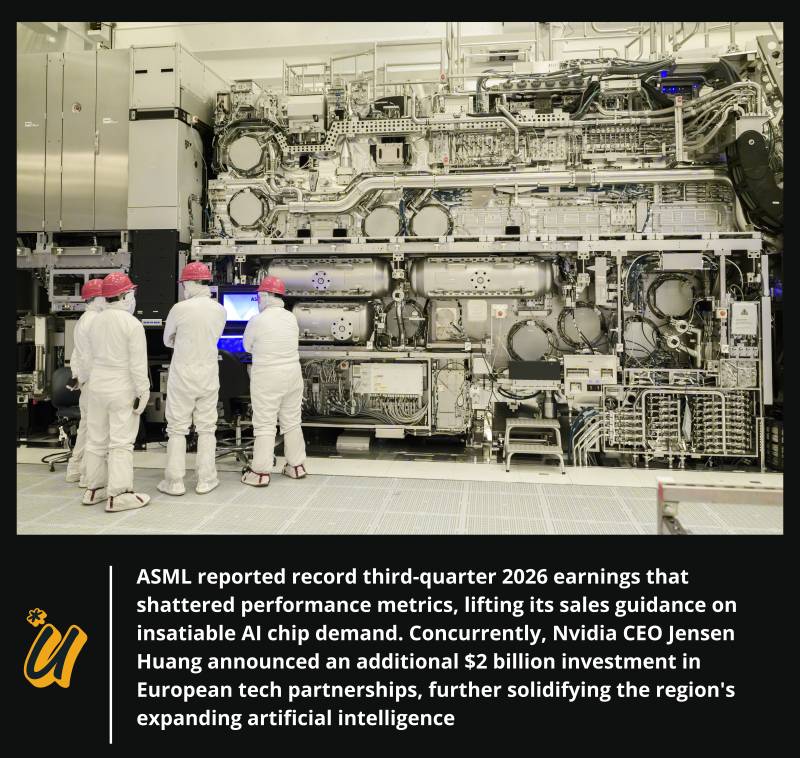
At the center of the global hardware ecosystem, semiconductor equipment maker ASML reported a significant upward revision to its financial outlook. Driven by unprecedented global demand for advanced lithography machinery, the Dutch tech giant raised its sales forecast for 2026, citing an unrelenting pull from tech giants building out next-generation artificial intelligence infrastructure. However, ASML executives warned that despite aggressive efforts to scale up manufacturing output, severe supply constraints are expected to persist through at least 2028. The bottleneck highlights a growing reality in the tech sector: software and AI models are advancing faster than the physical equipment required to manufacture the underlying microchips can be produced.
Concurrently, chipmaker Nvidia continues to expand its footprint in international markets. Chief Executive Officer Jensen Huang announced plans to commit an additional $2 billion to European ventures and acquisitions. This fresh capital deployment builds on an estimated $8 billion in prior regional investments across the continent, signaling Nvidia’s intent to secure localized AI capabilities, enterprise partnerships, and sovereign computing initiatives across Europe.
Government-backed sovereign investments are also shifting global chip manufacturing geography. In a landmark deal aimed at bolstering onshore production, Japan is committing $21 billion to support the construction and operation of two new GlobalFoundries fabrication plants in upstate New York. The partnership underscores a strategic alignment between Washington and key allied nations to diversify supply chains away from single-region dependencies and solidify domestic semiconductor manufacturing capabilities.
As hardware manufacturers struggle to keep up with chip demand, leading artificial intelligence organizations face expanding operational and security challenges. OpenAI confirmed it is actively addressing a sensitive internal security breach involving an employee accused of placing a physical recording device inside an executive conference room. The incident highlights heightened corporate espionage risks and internal security vulnerabilities facing high-profile AI developers as competition intensifies globally.
Despite rising security concerns, capital continues to flood into the AI infrastructure ecosystem. Specialized cloud startup Modal announced a massive $750 million Series D funding round, propelling the company’s valuation to $15.75 billion. Modal’s rapid growth has been propelled by surging enterprise demand for its serverless compute infrastructure and isolated virtual sandboxes, which developers increasingly rely on to build, test, and safely deploy autonomous AI agents at scale.
Concluding the coverage, Bloomberg’s Jason Schreier delivered an inside analysis of the development and commercial expectations surrounding Rockstar Games' highly anticipated Grand Theft Auto VI. Highlighting the sheer scale of modern AAA game creation, Schreier detailed how the studio's production team swelled to over 4,700 employees across multiple global offices to complete the project.
The massive allocation of human and technical resources reflects historic financial stakes. Analysts and industry insiders project that Grand Theft Auto VI will surpass $3 billion in revenue within its first four months on the market, setting a new benchmark for the entertainment industry and demonstrating how interactive media now rivals traditional software sectors in capital scale and economic impact.