NEW YORK — Technology and space exploration sectors collided in a whirlwind of high-stakes corporate drama, breakthrough earnings, and ambitious market maneuvers, according to the latest market intelligence reporting. In a day defined by narrow engineering margins, explosive artificial intelligence demand, and monumental corporate transitions, global technology leaders found themselves navigating a rapidly evolving landscape where the line between visionary aspiration and operational reality remains razor-thin.
The day’s most dramatic technical setback unfolded on the coast of South Texas, where SpaceX’s highly anticipated twelfth test flight of its revolutionary Starship architecture was abruptly halted. The mission, designed as the inaugural flight for the newly engineered V3 Starship configuration, was scrubbed a mere matter of seconds before liftoff. Aerospace engineers tracking the countdown confirmed that the automated halt was triggered by a hydraulic pin failure on the massive launch tower structure, rather than an issue with the multi-engine rocket booster or spacecraft itself. Aerospace industry experts, including Laura Crabtree, Chief Executive Officer of Epsilon 3 and a veteran of high-stakes space systems engineering, quickly pointed out that such last-second aborts highlight the extreme margins of error governing modern space flight. Crabtree emphasized that while a scrub is inherently frustrating for observers, the meticulous safety overrides built into the launch infrastructure serve to protect invaluable hardware. The V3 Starship represents a vital milestone in SpaceX’s broader, long-term engineering program, which is explicitly designed to drive down launch costs, maximize reusable heavy-lift capacity, and ultimately fulfill the company’s foundational mission of making humanity an interplanetary species.
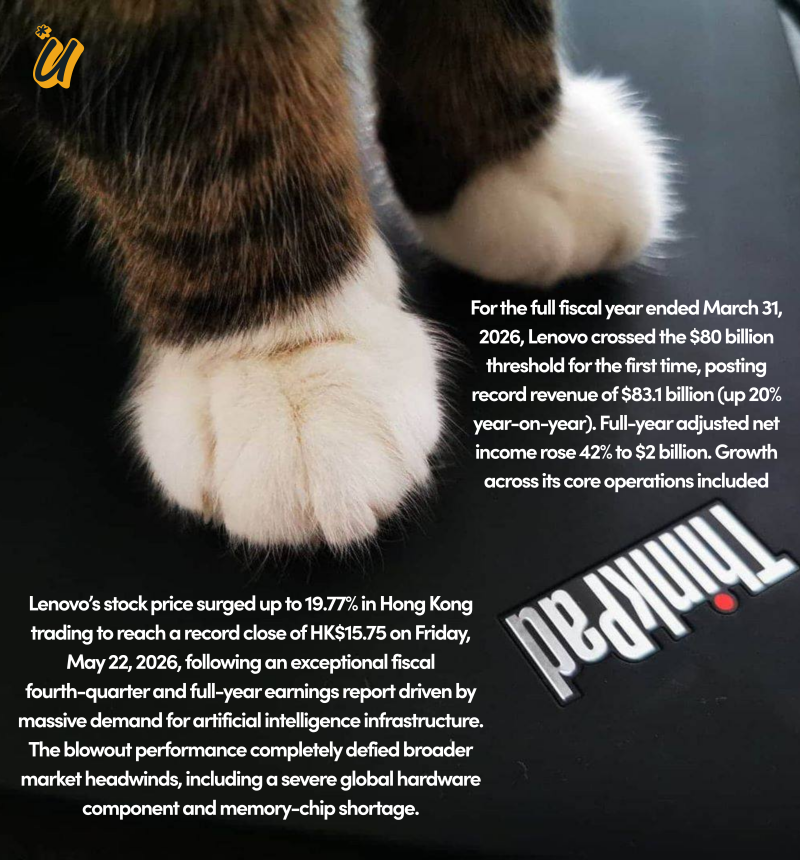
As hardware engineering faced bottlenecks on the launchpad, the financial markets were electrified by a massive surge in the personal computing and enterprise infrastructure sectors, driven by an insatiable global demand for artificial intelligence hardware. Lenovo Group Limited captured the global financial spotlight after posting blowout quarterly earnings that sent its stock skyrocketing. The market reaction marked Lenovo’s biggest single-day share price jump since 2008, signaling a profound resurgence of investor confidence in the hardware manufacturer. Speaking on the company’s financial trajectory, Lenovo Chief Financial Officer Winston Cheng detailed how the organization is uniquely positioned to capitalize on what industry insiders are calling the "AI decade." Cheng explained that Lenovo’s strength lies in its comprehensive, end-to-end product portfolio. By seamlessly scaling its offerings from consumer-grade AI-powered personal computers directly up to massive enterprise data center infrastructure and advanced server arrays, the company has effectively captured multiple entry points of the artificial intelligence boom, translating theoretical tech demand into concrete corporate profitability.
Simultaneously, the consumer electronics market is bracing for a significant shakeup as the frontiers of wearable technology prepare to enter the public markets. Aura, the pioneering manufacturer behind the widely recognized smart ring ecosystem, has taken the definitive first steps toward Wall Street by executing a confidential filing for an initial public offering, with plans to list its shares publicly later this year. Technology market analysts, including veteran hardware observer Dana Wollman, noted that this impending public debut signifies a critical evolutionary step for the wearable sector. The smart ring, which spent years categorized as a niche gadget favored primarily by extreme health enthusiasts and biohackers, is rapidly transitioning into a mainstream consumer staple. Driven by miniaturized sensor advancements, sophisticated biometric tracking, and an increasing societal focus on preventative health tracking, Aura’s public transition highlights a broader industry trend where specialized wellness technology is successfully pivoting toward mass-market commercial scale.
However, the rapid acceleration of artificial intelligence has also brought intense scrutiny regarding how tech conglomerates market these nascent tools to enterprise clients. A deep-dive investigation into the enterprise software landscape revealed growing tensions between corporate marketing and actual product functionality, focusing heavily on Salesforce Inc. The software giant has recently leaned into highly aggressive, visionary promotional campaigns centering on its autonomous AI agents. However, reports indicate that many of these highly touted AI capabilities may not yet be fully functional or deployable for standard corporate customers. Despite mounting skepticism from industry analysts who caution against overpromising, Salesforce Chief Executive Officer Marc Benioff has fiercely defended the company's approach. Benioff argues that "aspirational" marketing is a necessary component of technological leadership, asserting that defining a bold, future-facing vision is essential for guiding clients through massive paradigm shifts, even if the underlying software infrastructure requires time to catch up to the corporate rhetoric.
At the same time, companies born out of the remote-work boom are actively leveraging artificial intelligence to fundamentally redefine their corporate identities. Zoom Video Communications Inc. delivered its latest fiscal results, outperforming market expectations and demonstrating notable institutional resilience. Zoom Chief Financial Officer Michelle Chang outlined the company’s strategic roadmap, emphasizing that the organization is aggressively moving beyond its legacy reputation as a simple video conferencing utility. According to Chang, Zoom’s future lies in its transformation into a comprehensive enterprise "system of action." By deeply embedding artificial intelligence capabilities into its broader platform, the company aims to automate workflows, synthesize meeting data, and manage project lifecycles, thereby transforming standard communications software into an indispensable, proactive workplace operating system.
The broader tech sector also grappled with a series of operational disruptions, valuation debates, and executive missteps that reverberated across international markets. In the autonomous vehicle sector, Alphabet Inc.’s Waymo was forced to temporarily halt its driverless ride-hailing operations across five major metropolitan areas. The operational suspension came in response to severe localized flood risks, underscoring the ongoing vulnerabilities that climate anomalies and extreme weather patterns pose to cutting-edge autonomous transportation networks. Meanwhile, in the geopolitical race for AI supremacy, the Chinese artificial intelligence heavyweight DeepSeek has reportedly chosen to prioritize fundamental AI research and model optimization over immediate, short-term monetization strategies. The research-first approach comes amid widespread industry rumors circulating through venture capital circles that hint at a massive, multi-billion-dollar potential valuation for the firm, reflecting the immense premium investors continue to place on core intellectual property and architectural breakthroughs.
Finally, the intersection of corporate culture and human resources sparked intense debate following an unprecedented public apology from one of the banking sector’s most prominent leaders. Standard Chartered PLC Chief Executive Officer Bill Winters issued a formal retraction and apology following severe global backlash over internal and external comments he made regarding corporate restructuring. Winters had drawn intense criticism from labor advocacy groups and corporate governance experts alike for using the phrase "lower value human capital" when describing segments of the global workforce. The executive’s subsequent apology underscored the delicate nature of corporate communications in an era where workforce morale, ethical leadership, and human-centric corporate governance are increasingly scrutinized by both the public and institutional shareholders, bringing a turbulent and transformative period in global technology and business history to a reflective close.