In a financial landscape increasingly defined by the relentless pursuit of machine intelligence, the tech sector finds itself at a pivotal crossroads where record-breaking market valuations meet a ruthless internal restructuring of labor and capital. As of May 7, 2026, the Nasdaq 100 has carved out a historic trajectory, sustaining a rally that has now extended into its sixth consecutive week of gains. This sustained momentum reflects a broader investor confidence that has seemingly decoupled from traditional macroeconomic anxieties, fueled instead by the tangible integration of artificial intelligence across every vertical of the global economy. From the foundational architecture of semiconductor design to the emerging frontiers of quantum computing and satellite surveillance, the latest batch of corporate earnings and strategic announcements paints a picture of an industry in the midst of a violent but profitable evolution.
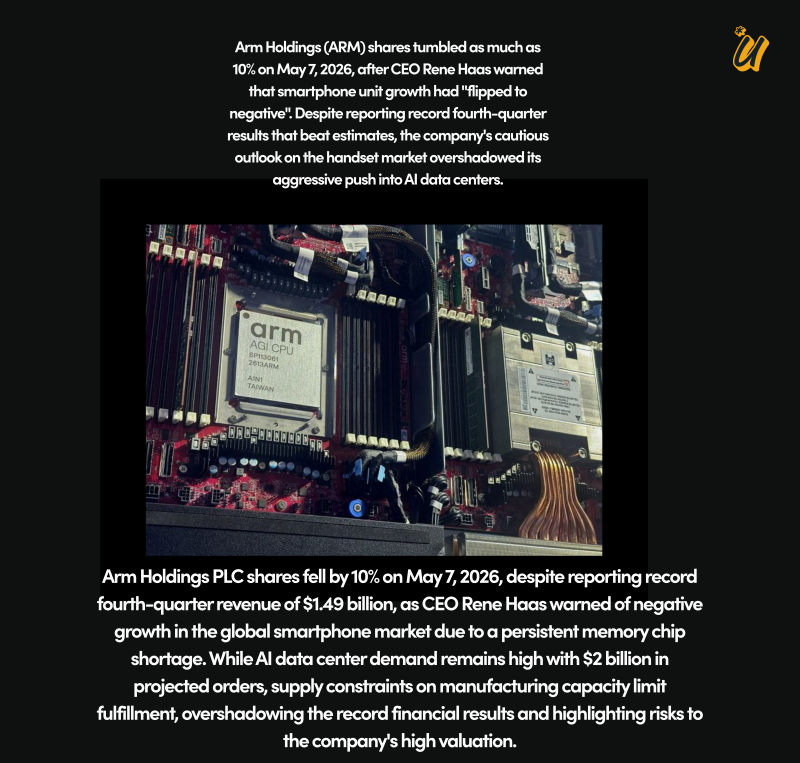
At the center of this week’s market discourse is Arm Holdings, the British chip design giant that has become a bellwether for the silicon industry. Despite a volatile trading session that saw its stock price come under pressure, CEO Rene Haas remained steadfast in his defense of the company’s long-term trajectory. Arm reported a record-shattering quarter with $1.5 billion in revenue, a figure that highlights a significant divergence in the hardware market. While the traditional smartphone sector remains sluggish, failing to regain its pre-pandemic vigor, Arm has successfully pivoted to capture the explosive demand for AI-driven data center CPUs. The scale of this transition is perhaps best illustrated by the performance of the company’s new AGI CPU. In a stunning revelation, Haas noted that the forecast for these specialized processors has doubled within the last five weeks alone, with orders now topping $2 billion. This surge underscores a fundamental shift in the semiconductor landscape: the consumer mobile market is no longer the primary engine of growth; rather, the construction of the massive neural networks required for artificial general intelligence has become the industry’s new gravity.
The momentum in hardware extends beyond traditional silicon into the once-experimental realm of quantum computing. IonQ has emerged from the first quarter of 2026 with financial results that comfortably cleared Wall Street expectations, prompting the firm to raise its full-year guidance. Under the leadership of CEO Nicolo Damasi, IonQ is attempting to bridge the gap between theoretical physics and commercial utility. Damasi highlighted the rollout of the company’s ‘walking cat’ architecture, a breakthrough designed to achieve fault-tolerant computing. This development is critical, as the industry moves away from noisy, error-prone quantum bits toward stable systems capable of handling complex enterprise workloads. The success of IonQ suggests that quantum technology is moving out of the laboratory and into the infrastructure phase, joining the broader AI ecosystem as a necessary tool for the next generation of data processing.
However, the rapid acceleration of AI is not without its casualties. Even as market indices hit new highs, the human cost of this technological shift is becoming increasingly apparent. Data released by Challenger reveals a sobering reality for the tech workforce: so far in 2026, the industry has seen 85,411 planned job cuts. This wave of layoffs is not merely a correction of pandemic-era over-hiring but is increasingly cited as a direct result of AI-related investment shifts. Companies are aggressively reallocating capital, moving funds away from traditional roles and toward the massive compute costs and specialized talent required to maintain an edge in the AI arms race. This trend is visible even in the fintech sector. Chris Brit, the CEO of Chime, recently highlighted that while the platform has reached a massive milestone of 10.2 million active users, the internal operations of the company are being transformed by automation. Brit noted that AI is now significantly accelerating Chime’s internal software development, a move that increases efficiency but further emphasizes the decreasing reliance on traditional engineering headcounts.
The physical infrastructure required to power this new era has led to some of the most unexpected strategic alliances in tech history. In a move that has captured the attention of industry analysts, Anthropic—a leading AI safety and research laboratory—has reportedly entered into a massive deal to lease computing capacity from Elon Musk’s SpaceX. The arrangement involves the use of SpaceX’s Colossus 1 facility, a high-density data center infrastructure originally designed to support the aerospace giant’s internal needs. This partnership is particularly notable given the competitive and ideological friction that has often characterized the relationship between major AI players, yet it highlights a pragmatic truth of the 2026 tech economy: the demand for raw compute power is so high that traditional competitive boundaries are dissolving in favor of access to hardware.
While much of the focus remains on software and chips, the hardware of the heavens is also seeing a resurgence in investor interest. HawkEye 360, a satellite surveillance and radio frequency (RF) data firm, successfully executed an IPO that raised $416 million, a significant figure in a market that has been cautious regarding space-tech listings. CEO John Saraphini pointed to the current state of global affairs as a primary driver for the company’s value proposition. In an era defined by geopolitical volatility, HawkEye 360’s ability to provide high-precision signals intelligence from orbit has become an essential asset for both government and commercial clients. The successful public offering suggests that "space as a service" is becoming a vital component of the broader defense and intelligence infrastructure, paralleling the growth seen in ground-based data centers.
Looking ahead, the market’s gaze is fixed on CoreWeave, the specialized cloud provider that has become a darling of the AI era. As the company prepares to report its latest earnings, investors are focused on its ambitious expansion plans. CoreWeave’s rapid rise from a crypto-mining operation to a primary provider of GPU-accelerated cloud services mirrors the broader story of the 2026 tech market: a story of agility, massive capital expenditure, and an unwavering bet on a future defined by machine intelligence. From the record gains of the Nasdaq to the high-stakes IPOs and the strategic reshuffling of the workforce, the message of early 2026 is clear. The technology sector is no longer just a segment of the economy; it is the infrastructure upon which all future growth is being built, even as it ruthlessly discards the legacy models of the past decade.