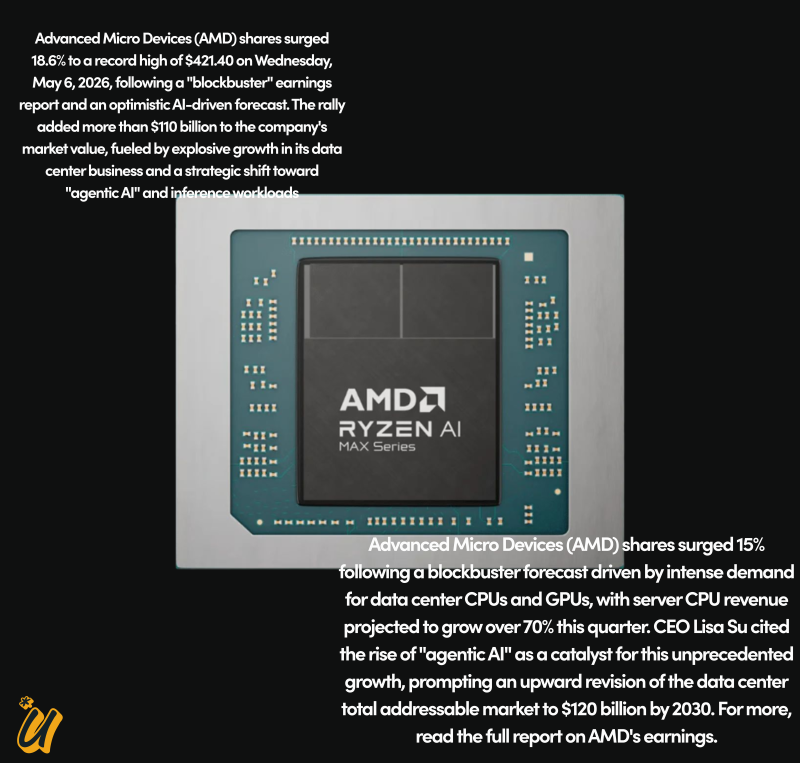
The global financial markets experienced a significant surge in momentum today, May 6, 2026, as a wave of high-performance earnings reports and breakthrough artificial intelligence developments ignited investor confidence. This rally, highlighted on the latest broadcast of Bloomberg Technology, underscores a pivotal moment where the physical infrastructure of computing is finally racing to keep pace with the exponential demands of generative and agentic AI. At the center of this tectonic shift is Advanced Micro Devices, whose stock skyrocketed 15 percent following a blockbuster financial forecast that exceeded even the most optimistic analyst projections. CEO Lisa Su addressed the market’s appetite by emphasizing a massive spike in demand across the board for both Central Processing Units and Graphics Processing Units. In a particularly striking revelation, Su noted that AMD’s CPU business is projected to grow by a staggering 70 percent this quarter alone, signaling that the foundational hardware required to run the world’s servers is undergoing a generational refresh.
As AMD dominates the silicon conversation, Nvidia is moving aggressively to ensure that the physical "plumbing" of the AI revolution remains intact. In a strategic move to preempt potential bottlenecks in data center connectivity, Nvidia has entered into a massive partnership with fiber-optic giant Corning. This collaboration involves an investment of up to $500 million aimed at scaling optical fiber infrastructure. As AI data centers grow in complexity, the speed at which data moves between chips becomes as critical as the chips themselves. RBC Capital analyst Shini Puri joined the program to contextualize this hardware evolution, noting that the industry is witnessing a fundamental shift in the CPU-to-GPU ratio. Historically, data centers favored a higher concentration of traditional processors, but the rise of agentic AI—systems capable of autonomous reasoning and complex inferencing—is pushing the architecture toward a 1:1 model. This shift represents a massive capital expenditure cycle that shows no signs of slowing down as companies move from training large language models to deploying them at scale for real-world applications.
The enthusiasm for technological integration extended far beyond the semiconductor sector, reaching into the heart of the media and entertainment industry. Disney shares climbed 7 percent today as the company reported stronger-than-expected quarterly results, driven largely by a long-awaited surge in streaming profitability. While the company’s theme parks continue to show resilient consumer spending despite broader economic fluctuations, the spotlight remains on Disney’s digital evolution. Newly minted CEO Josh D’Amaro articulated a bold vision for the company’s future, one that seeks to bridge the gap between interactive gaming and traditional streaming content. D’Amaro’s strategy focuses on maximizing the monetization of Disney’s vast intellectual property library by creating a seamless ecosystem where fans can consume stories and participate in them through high-fidelity gaming experiences, effectively turning "passive" viewers into "active" participants in Disney’s digital worlds.
In the realm of mobility and services, Uber remains a standout performer, with CFO Balaji Krishnamurthy detailing a second-quarter outlook that comfortably cleared Wall Street’s expectations. Uber’s strategy has evolved into a two-pronged approach: leveraging proprietary AI models to optimize internal logistics and driver efficiency, while simultaneously expanding its business-to-business offerings. By integrating AI more deeply into its core routing and dispatching algorithms, Uber is managing to squeeze higher margins out of its ride-hailing and delivery segments. This operational discipline, combined with a growing suite of enterprise tools, suggests that the "super-app" vision for transportation is becoming a tangible reality, fueled by data-driven automation.
Apple is also preparing for a landmark shift in its software philosophy, according to reports from Mark Gurman. The upcoming iOS 27 release is expected to break from Apple’s historically "walled garden" approach by allowing users to choose from third-party AI models to supplement Siri’s capabilities. In a move that mirrors the choice of search engines in web browsers, iPhone users may soon have the option to integrate Google’s Gemini or Anthropic’s Claude directly into their operating system. This modular approach to AI suggests that Apple recognizes the specialized strengths of different LLMs and intends to position the iPhone as the ultimate neutral platform for AI interaction, rather than relying solely on in-house development to compete with established AI leaders.
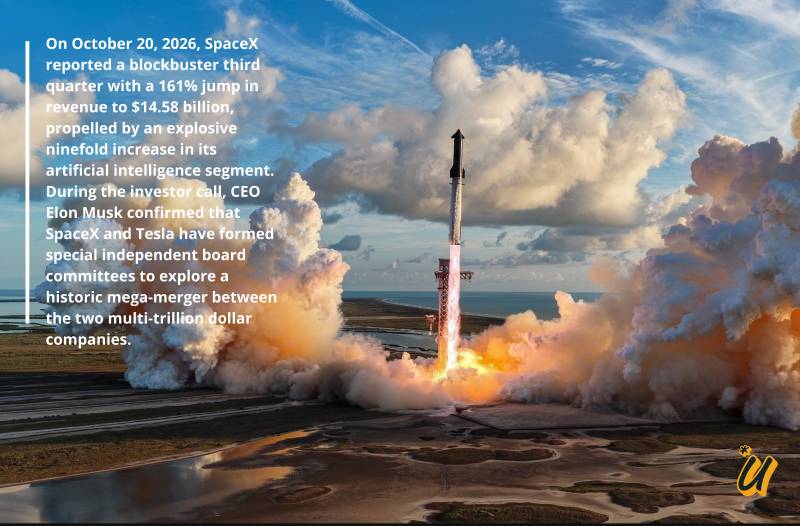
However, the rapid expansion of AI is not without its environmental and logistical costs. Inside Microsoft, sources indicate that the tech giant may be forced to scale back or delay its once-ambitious climate targets. The sheer energy intensity required to power the current AI boom is clashing with corporate sustainability goals, as the massive power consumption of new data centers makes "carbon negative" promises increasingly difficult to keep. This friction highlights a growing tension between the race for computational supremacy and the global push for environmental responsibility. While Microsoft navigates these earthly constraints, others are looking toward the stars for solutions. ARK Invest’s Kathy Wood discussed the convergence of Elon Musk’s sprawling empire—Tesla, SpaceX, and xAI—noting the potential for orbital data centers. By moving high-heat, high-energy computing into space, Musk’s ventures could theoretically bypass Earth-bound energy grids and cooling requirements. Wood’s analysis suggests that the future of data may not just be in the cloud, but in the stars, as the limits of planetary infrastructure force the world’s most powerful tech entities to rethink the very geography of the internet.