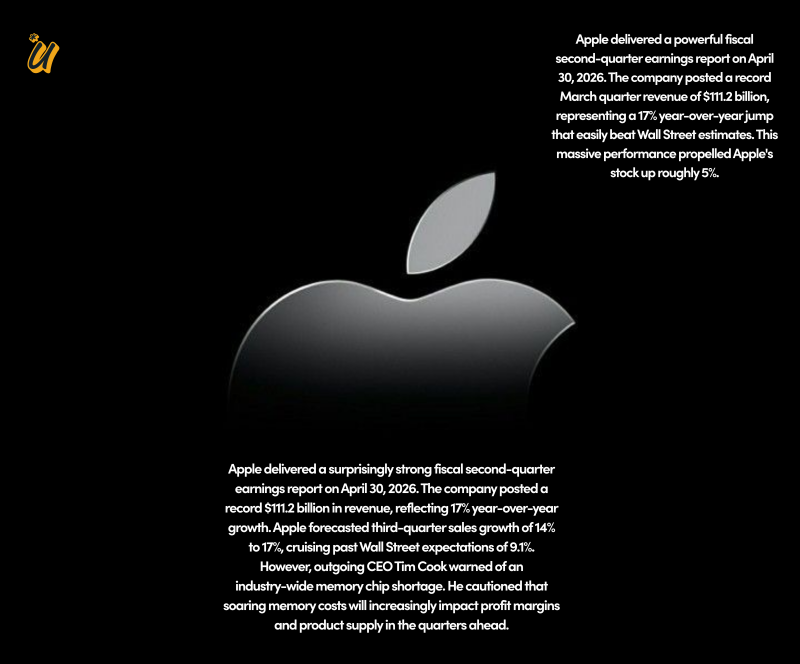
The global technology landscape witnessed a day of stark contrasts on May 1, 2026, as quarterly earnings and strategic shifts revealed a widening gap between companies mastering the transition to an AI-driven economy and those struggling with the friction of operational pivots. At the forefront of the day's market movements was Apple, which defied broader economic skepticism by reporting a robust outlook for the June quarter. Despite the persistent headwind of memory supply chain constraints that have hampered the hardware industry for several quarters, the Cupertino giant projected sales growth between 14% and 17%. Investors responded with a wave of buying, bolstered by analyst reports highlighting Apple’s unique insulation from geopolitical volatility. Experts noted that the company’s stronghold on high-income consumer segments continues to provide a reliable buffer, allowing it to maintain premium pricing power even as competitors navigate more turbulent waters.
While Apple enjoyed a surge in valuation, the gaming and social infrastructure sector faced a more complicated reality. Roblox saw its shares tumble as the company doubled down on a comprehensive, and controversial, safety overhaul. In an era where digital child safety has become a regulatory lightning rod, Roblox aggressively implemented new age-verification protocols and enhanced parental controls. While industry advocates praised the long-term ethical implications of these safeguards, the short-term market reaction was swift and negative. The friction introduced by these mandatory verification steps led to a noticeable cooling in user growth metrics, prompting a sell-off from investors concerned that the platform's focus on safety might be compromising its legendary "viral" engagement loops. This tension between corporate responsibility and growth targets remains one of the most significant themes of the current fiscal year.
In the communications sector, Twilio emerged as a standout performer, marking what many analysts are calling a definitive inflection point for the firm. After years of stabilizing growth, the company reported its fastest revenue expansion in over three years. This resurgence is being credited almost entirely to a surge in AI-related voice workloads. As enterprises rush to integrate sophisticated AI agents into their customer service and operational frameworks, Twilio’s infrastructure has become the primary conduit for these data-heavy interactions. The jump in share price reflects a growing confidence that "the plumbing of the internet" is finally seeing the tangible financial benefits of the generative AI boom, moving beyond theoretical potential into concrete, billable usage.
However, the broader enthusiasm for AI is being tempered by an increasingly urgent conversation regarding the cost of progress. A macro-level analysis of industry spending reveals that global hyperscalers—including the likes of Google, Microsoft, and Amazon—are on track to invest more than $700 billion in AI infrastructure this year. Despite these eye-watering figures, a sense of investor caution is beginning to permeate the market. Critics point to a lack of immediate, massive-scale revenue streams that justify such extreme capital expenditure. While the hardware is being built at a record pace, the "payoff" for these investments remains a subject of intense debate, leading some to wonder if the industry is nearing the peak of an investment bubble or simply building the foundation for a transformation that will take years to fully monetize.
Addressing these concerns from the front lines, OpenAI Chief Financial Officer Sarah Friar took a public stance against recent reports suggesting the organization was missing its internal performance targets. Speaking on the current state of the industry's most watched startup, Friar characterized the market's appetite as a "vertical wall of demand." She dismissed claims of a slowdown, insisting that the bottleneck remains the availability of compute power and energy, rather than a lack of customer interest. This defense comes at a crucial time as OpenAI seeks to maintain its dominant position amidst increasing competition from both well-funded startups and established tech titans.
The intersection of technology and national security also took center stage today with the announcement of landmark agreements between the Pentagon and a consortium of tech leaders. Nvidia, Microsoft, and Amazon Web Services (AWS) have officially struck deals to deploy advanced AI tools across classified military networks. This partnership marks a significant escalation in the integration of commercial technology into defense infrastructure. These tools are expected to handle everything from logistics optimization to real-time threat detection on secured systems, signaling a new era of cooperation between Silicon Valley and the Department of Defense. This development underscores the reality that AI is no longer just a consumer or enterprise tool, but a cornerstone of national strategic interests.
Closing out the day's major developments, the venture capital world saw a massive injection of liquidity as Peter Thiel’s Founders Fund announced it has raised $6 billion for its latest vehicle. This represents the firm’s largest fund to date and is specifically earmarked to support late-stage startups. The timing of this raise is particularly notable, as many "unicorns" have struggled to secure follow-on funding in a more disciplined interest rate environment. The move by Founders Fund suggests a "buy the dip" mentality among the elite tiers of private equity, signaling a belief that the next generation of tech giants is currently being forged in the crucible of today’s high-cost, high-stakes market. As the day concluded, the tech sector remained a study in volatility, driven by the massive promises of AI and the rigorous demands of a market that is increasingly asking for proof of profitability.