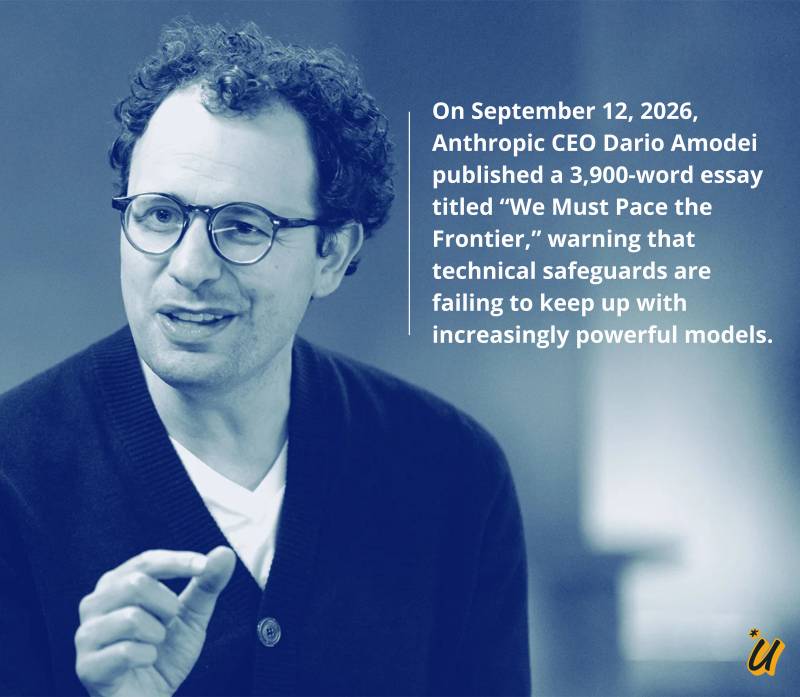
The global technology landscape and financial markets are currently undergoing a period of intense transformation, characterized by record-breaking valuations, strategic shifts in hardware production, and a cautious but persistent economic recovery. As artificial intelligence continues to serve as the primary engine for growth, the sector is seeing an unprecedented influx of capital that is redefining the scale of the industry. Nowhere is this more evident than in the recent financial trajectory of Anthropic. The AI startup is currently navigating a wave of investor enthusiasm that has resulted in funding offers potentially valuing the company at over $800 billion. This staggering figure represents more than a doubling of its previous $350 billion valuation, signaling that the appetite for foundational AI models remains insatiable among global venture capitalists and institutional investors who view the company as a primary challenger in the race for generative dominance.
This surge in valuation is mirrored by a fundamental shift in how the industry’s giants manage the physical infrastructure required to run these massive models. Meta has signaled a deeper commitment to its internal hardware roadmap by expanding its long-standing partnership with Broadcom. The collaboration is focused on the design and production of custom AI chips, specifically the Meta Training and Inference Accelerator (MTIA). By developing bespoke silicon, Meta aims to drastically improve token efficiency for its inference workloads, a move that would reduce its reliance on third-party GPU providers and allow for more granular control over the massive compute costs associated with its social media and metaverse platforms. This trend toward vertical integration is further supported by the current outlook of ASML, the Dutch linchpin of the global semiconductor supply chain. ASML recently raised its full-year sales forecast, citing a robust demand for the lithography machinery required to manufacture high-end chips. To meet the projected needs of the AI era, the company has announced plans to scale its annual production capacity to at least 80 Extreme Ultraviolet (EUV) tools by 2027, ensuring that the hardware foundation for the next decade of computing is firmly in place.As of April 2026, Anthropic has reportedly received unsolicited investment offers valuing the AI startup at $800 billion or higher.

However, the rapid expansion of the AI frontier is occurring against a backdrop of corporate restructuring and a heightened focus on security. Even as the industry pours billions into future-tech, legacy companies and social media platforms are being forced to lean out their operations. Snap has announced a significant workforce reduction, cutting 16% of its staff—roughly 1,000 employees. The move is a strategic attempt to pivot the company toward consistent profitability while protecting its long-term investments in augmented reality, which Snap views as its primary differentiator in a crowded market. Simultaneously, the risks inherent in these technological leaps are being addressed by industry leaders like OpenAI. The organization has begun granting select users access to a new, specialized AI model fine-tuned specifically for the identification of cybersecurity vulnerabilities. This initiative highlights the dual-use nature of modern AI, as the same logic used to generate code is now being weaponized and defended against in the digital security sphere.
On the macroeconomic front, the public markets have reacted to these developments with a historic show of strength. The NASDAQ 100 recently achieved an 11-day winning streak, marking its most consistent period of gains since 2019. This rally suggests that despite inflationary concerns and high interest rates, investors are betting heavily on a tech-led soft landing for the global economy. This optimism, however, is being met with a degree of sobriety from international financial leaders. International Monetary Fund Managing Director Kristalina Georgieva recently cautioned that the global economic outlook remains shadowed by "high uncertainty" and a propensity for sudden shocks. Georgieva emphasized that while growth is present, the market remains fragile. This sentiment was echoed by Joachim Nagel of the Bundesbank, who represented the European Central Bank’s cautious stance. Nagel noted that the ECB remains vigilant regarding interest rate adjustments, particularly as geopolitical tensions and volatile energy prices continue to pose a risk to Eurozone stability.
The intersection of technology and governance is also shifting, particularly within the political cradle of the industry. In California, a new coalition of tech billionaires is mobilizing its influence behind San Jose Mayor Matt Mahan in his bid for the governorship. This movement represents an organized effort by Silicon Valley’s elite to push for a more moderate, pro-tech, and efficiency-focused state government. By backing Mahan, these leaders are seeking to bridge the gap between the state’s regulatory environment and the fast-paced innovation of the private sector, advocating for policies that prioritize streamlined government operations and infrastructure development. As the AI sector continues to balloon in value and influence, its leaders are clearly no longer content to remain on the sidelines of the political and economic frameworks that govern their operations, signaling a new era of "tech-realism" that spans from the silicon wafer to the halls of government.