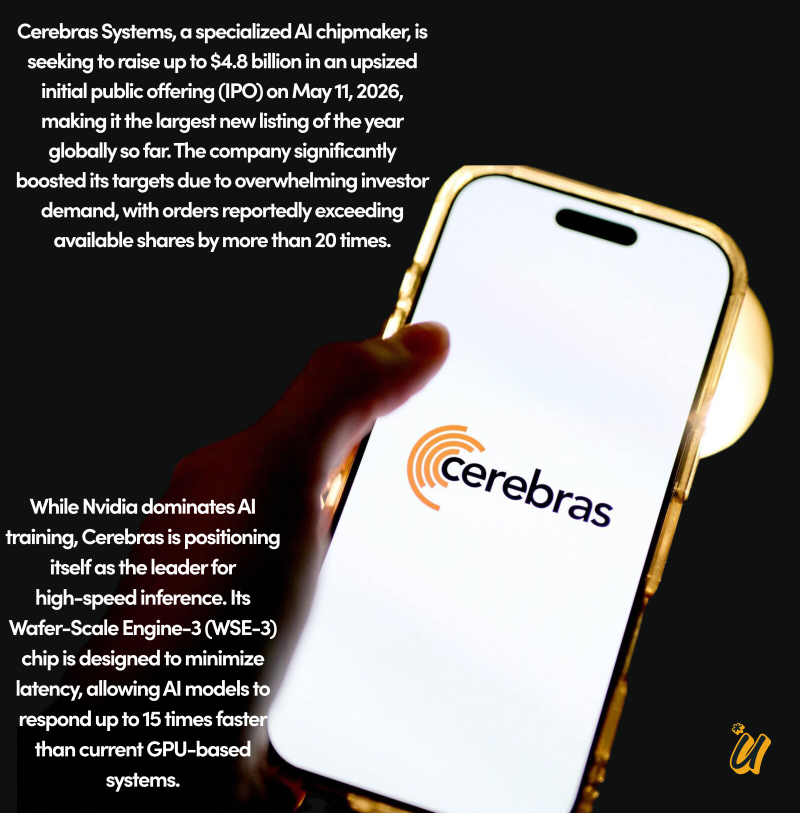
The technological landscape is currently undergoing a radical transformation as the convergence of high-stakes finance, autonomous systems, and infrastructure expansion reshapes the global economy. As of May 11, 2026, the momentum within the technology sector has reached a fever pitch, driven largely by an insatiable appetite for artificial intelligence capabilities that show no signs of waning. This surge is perhaps best exemplified by the record-breaking movements in the public markets, where AI hardware and infrastructure providers are seeing unprecedented valuations. Cerebras, the prominent AI chipmaker and data center operator, has captured the industry’s full attention by significantly upsizing its initial public offering. The company is now seeking to raise as much as $4.8 billion, a move that signals a massive vote of confidence from institutional investors. With the offering expected to price on May 13, the fact that it remains heavily oversubscribed highlights a fundamental shift in market priorities; investors are no longer just looking for software applications but are aggressively funding the physical architecture required to power the next generation of computation.
This optimism is being mirrored across the broader indices, with the NASDAQ 100 currently tracking toward a potential seven-week winning streak. While geopolitical instability and fluctuating interest rates continue to loom over the global economy, the drive toward massive capital investment in AI has become the primary engine for earnings growth. Analysts observe that the market is currently rewarding companies that can demonstrate a clear path toward AI integration and infrastructure dominance, effectively decoupling tech performance from traditional economic headwinds. This trend is not limited to hardware manufacturers alone but extends to the very fabric of how digital value is exchanged. Jeremy Allaire, the CEO of Circle, recently highlighted this evolution following a first-quarter revenue beat that exceeded analyst expectations. Allaire’s vision for the company centers on a transition toward what he describes as an agent-led future. In this coming paradigm, autonomous AI agents—not humans—will be the primary actors in the global economy, necessitating a financial system where these agents can transact instantly and securely using stablecoins. This transition suggests that the utility of blockchain technology is being reimagined as the foundational settlement layer for machine-to-machine commerce.
As the race for AI supremacy intensifies, Alphabet has emerged as a titan capable of challenging even the most entrenched hardware leaders. While Nvidia has long held the crown for AI processing, Alphabet’s unique position of vertical integration is beginning to shift the balance of power. By leveraging its proprietary Tensor Processing Units alongside its massive Google Cloud footprint, Alphabet is providing a full-stack alternative that spans from silicon to consumer applications. This internal ecosystem allows the company to insulate itself from supply chain bottlenecks while simultaneously capturing revenue at every level of the AI value chain. However, this rapid advancement in AI capability brings with it a new and sophisticated set of risks that are only now beginning to manifest in the real world. In a sobering development for the cybersecurity community, researchers at Google have uncovered the first-ever zero-day attack entirely constructed by artificial intelligence. This discovery confirms long-standing fears that AI can be weaponized to identify and exploit software vulnerabilities at a speed that human defenders simply cannot match. It marks a turning point in digital security, where the window between the discovery of a flaw and its active exploitation is narrowing to a matter of seconds, necessitating AI-driven defense mechanisms to counter AI-driven threats.
The trend toward consolidation in the AI sector is also accelerating, as firms scramble to own the "agentic" layer of the internet. Dan Wagner, CEO of Rezolve AI, recently detailed his company’s hostile bid for commerce.com, a move designed to create a unified platform for AI-driven digital commerce. This strategy reflects a broader belief that the future of the internet will not be navigated through traditional search queries or manual browsing, but through proactive agents that negotiate, purchase, and manage logistics on behalf of the user. By acquiring established commerce platforms, AI firms are attempting to secure the data and the interfaces necessary to train these agents in real-world commercial environments. This suggests that the next phase of the digital economy will be defined by a "land grab" for the platforms that facilitate autonomous transactions.
Even as the industry looks toward these grand, systemic shifts, the consumer experience continues to evolve through the refinement of personal computing. Apple, often a bellwether for design trends, is reportedly responding to user feedback regarding its recent software iterations. Following the release of Mac OS 26, which introduced a controversial "liquid glass" interface, the company is said to be planning significant visual refinements for the upcoming Mac OS 27. These changes aim to balance the company’s aesthetic ambitions with the functional requirements of professional users who found the previous design language too distracting or resource intensive. Simultaneously, the way consumers are utilizing Apple hardware is shifting in response to the AI boom. A growing number of tech enthusiasts and developers are repurposing Mac Minis as dedicated, local servers. Due to their high-power efficiency and the impressive performance of Apple’s silicon, these machines are being used to run autonomous AI agents 24/7 in a localized environment. This trend underscores a desire for "sovereign AI," where users can maintain control over their data and agentic workflows without relying entirely on centralized cloud providers.
Ultimately, the developments of this week reveal a global tech economy that is moving at an exhausting pace. From the multi-billion-dollar IPO of Cerebras to the unsettling arrival of AI-generated cyberattacks, the stakes have never been higher. The transition from human-led digital interactions to an agentic, machine-driven future is no longer a theoretical projection but a visible reality reflected in corporate earnings, hostile takeovers, and even the way individuals configure their home computers. As Alphabet challenges Nvidia and stablecoins become the currency of machines, the industry is bracing for a decade defined by the total integration of intelligence into every facet of commercial and personal life. The relentless growth of the NASDAQ 100 serves as a barometer for this shift, signaling that for better or worse, the world is fully committed to the AI-driven path forward.