Gazing across the serene waters of the Atlantic, Earn Your Leisure Channel transports its audience to Gorée Island, Senegal, a seemingly idyllic place whose tranquil beauty belies a profound and painful history as a major nexus of the trans-Atlantic slave trade. The island, now a UNESCO World Heritage site since 1978, is a small volcanic outcrop, just 1,900 meters long and 300 meters wide, with a story that echoes across continents. The island’s origins are volcanic, with the last eruption estimated by geologists to be about 13 million years ago, leaving behind the black rocks, or basalt, used to construct all the buildings.
Guiding the Earn Your Leisure audience through this monument to human suffering and resilience is Falo, a resident who has lived on Gorée for 23 years. Gorée's history is characterized by a struggle for control among four European powers—the Portuguese, the French, the Dutch, and the English. The Portuguese were the first to arrive in 1444, and the French were the last to occupy the island until the end of slavery on April 27, 1848. Gorée was strategically important because its location in western Africa made it "closer to America", positioning it as a key node in the triangular trade between Europe, Africa, and America. Europeans brought goods like weaponry, mirrors, alcohol, and necklaces to Africa, exchanging them with tribal chiefs for prisoners captured during internal African wars. This exchange was purely barter; for instance, a man and a young girl might be exchanged for a gun, while a child was traded only for a mirror.

The Door of No Return for African Slaves Sent to the Americas

Related article - Uphorial Shopify
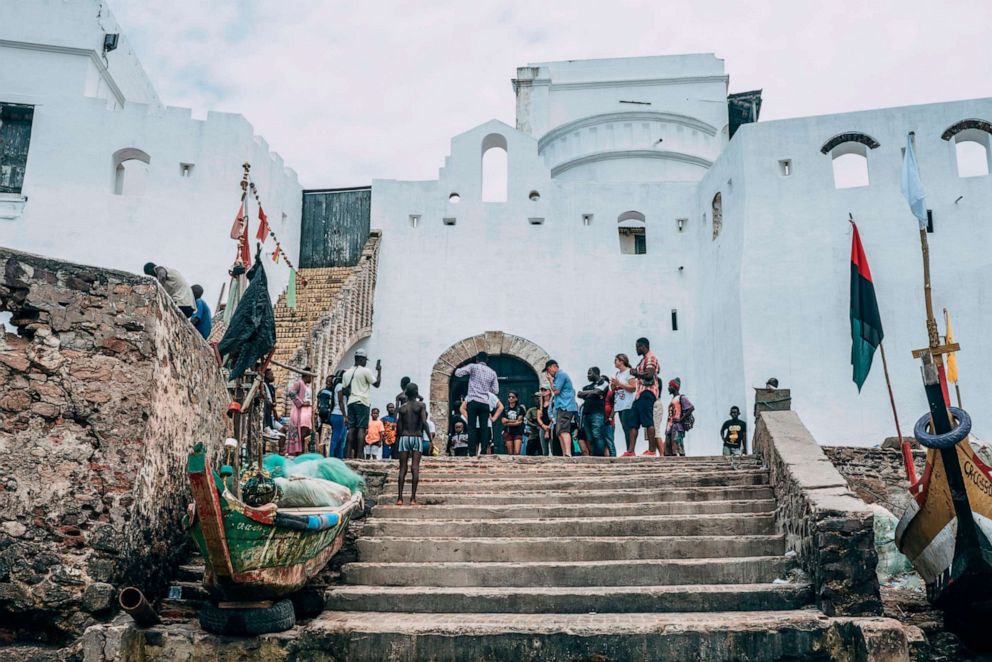
The island was actively involved in the slave trade for 350 years, out of the roughly 400 years the system spanned across West Africa. Gorée once housed more than 20 slavery houses, all sharing the same design: the enslaved lived downstairs while the Europeans resided upstairs. The last remaining slave house, built between 1780 and 1784, is preserved today for tourists. Falo detailed the brutal conditions faced by the enslaved downstairs. In the waiting room, men who weighed less than 60 kilograms were forcibly fed beans mixed with palm oil for up to three months, "like on animals" until they reached the required weight for travel, as only the "best" and "strongest" men were selected.
The cells, like the main men’s cell measuring 260 by 260, could hold between 15 or 20 slaves. They were chained at their hands and neck and sat with their backs against the wall. While they were "relaxed" once a day to use the outdoor wooden bridge as a toilet, they were forced to defecate inside their cells at other times, which led to outbreaks of deadly diseases like the plague, yellow fever, and cholera. Sick slaves were thrown into the ocean to prevent contamination. Earn Your Leisure documented the stark reality of the Door of No Return, a harrowing final exit facing the Atlantic Ocean. If the enslaved passed through this door, it was "bye-bye Africa," and they would "never come back". They were loaded onto small boats to reach larger slave ships offshore. Many chained two by two with a 21-pound iron ball, preferred death, jumping into the ocean and dragging others with them. Furthermore, upon leaving, slaves lost their real names, receiving a number on Gorée and a new name from their master at their destination, permanently severing their connection to their heritage.
The scope of the tragedy is vast; French archives suggest 20 million black people left Africa, although a Senegalese militant claims the official number is much higher, estimating a minimum of 100 million black people left the continent, calling it the "greatest genocide that humanity has ever known". Gorée Island remains a place of profound memory and reconciliation. Nelson Mandela visited in 1991 to thank Senegal for issuing diplomatic passports to those who sought his release from jail. Mandela notably entered the punishment cell—the only cell he got inside—and was reportedly crying when he emerged, recalling his 27 years in prison. In 1992, the Pope visited, apologizing and asking forgiveness for the role of Catholic missionaries, to which the former curator of the slave house, Bakar Zay, a Senegalese military man, responded: "We can forgive but never forget". More recently, in July 2023, a foundation established a space for meditation, allowing descendants of slaves to pray for their ancestors and take water to put around the memorial. Today, Gorée Island is a unique community of 1,800 people, where residents live in perfect harmony—1,200 Muslim and 600 Christian—and enjoy a life with "no car, no pollution, no bike", centered entirely around tourism.