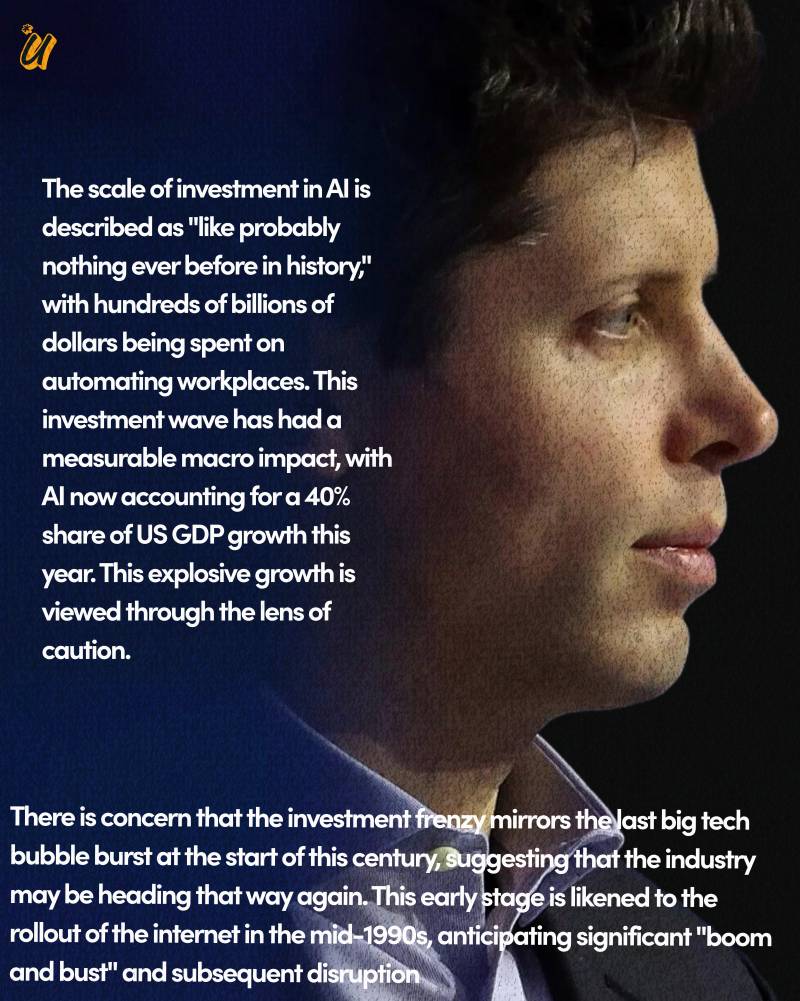
The Financial Times' Working It show, led by Isabelle Barrett, recently dissected the complex and often contradictory reality of artificial intelligence rollout in corporate environments, confirming that despite unprecedented financial commitment, widespread, tangible productivity gains remain elusive. Isabelle Barrett observed that the current investment wave in AI, with hundreds of billions of dollars being spent on automating workplaces, is "like probably nothing ever before in history". This massive flow of capital has led to AI accounting for a 40% share of US GDP growth this year. Yet, while over 75% of businesses worldwide are using generative AI in at least one function, Isabelle Barrett noted that full adoption is "not seeing adoption fully yet in every pocket of the economy". This is evidenced by the finding that only 1% of CEOs have a fully formed AI strategy, and a study by MIT Media Lab determined that 95% of Gen AI pilots in the workplace failed.
The current phase is characterized by two distinct speeds of adoption within organizations. Tech companies are "quite far along to the point where they think of AI agents as co-workers". Conversely, many other businesses are "still getting their heads around what AI adoption means" and are simply trying to get employees to use foundational tools like ChatGPT or Claude, often "not seeing gains in productivity at this point". As Kevin Delaney, editor-in-chief of Charter, noted in the Financial Times coverage, there is no "clear path forward for GenAI at work" and that the future remains "all to be decided".
The economic impact of this disparity is clear: the S&P 500 index is going up, but a lot of that growth is driven by seven big tech companies, with "the other companies on the S&P 500 haven't necessarily grown that much". When non-tech companies do mention AI usage in regulatory filings—which are generally more "measured and risk averse" than earnings reports—the use cases are often "quite abstract". Coca-Cola was cited as an example by the Financial Times analysis: executives "raved about how they're using generative AI to transform their business" in earnings reports, but the only concrete example provided in filings was using generative AI to create a Christmas ad. Crucially, in those same regulatory filings, the risks of AI adoption "outweighed the benefits very, very clearly".

Related article - Uphorial Shopify
A major factor inhibiting realized gains is the significant training and capability gap. Euan Blair, CEO of upskilling platform Multiverse, explained that the core challenge is turning "potential AI gains into actual realized AI gains". Many organizations are currently using powerful AI tools for the equivalent of "having an iPhone and just using it to send text messages and make calls," missing loads of capabilities. This is different from past software rollouts where people would gradually "figure out how to use it" over time. Now, because the inherent capability and the financial stakes are so much greater, leaders realize that the winners will be the people who have the "most AI enabled workforce," not those who spend the most.
Amanda Broofphy, Director of Grow with Google, emphasized that rolling out the technology is not enough; it is an "and not or" situation requiring both the technology and the training. She advised leaders to combat employee skepticism by demonstrating how AI can work for the "specific person in their role," such as helping a marketer write social captions. The key to adoption is making AI use a regular, daily habit.
This adoption challenge is complicated by "shadow use cases," where employees ignore official corporate AI initiatives and use personal tools they prefer. This is risky because workplaces deal with sensitive information where accuracy "really matters", and these AI models "often do make factual mistakes". Sarah Walker, CEO of Cisco UK and Ireland, stressed the necessity for leadership to lead by example, noting her team would never adopt platforms if she is "not talking about it and using it myself". She emphasized that using AI is "not an either or" situation with the workforce but is instead about automating tasks to become more efficient, advising people "shouldn't be fearful of it".
In conclusion, the path forward requires leaders to become comfortable with "experimentation and possibly failure," a concept executive are generally "allergic to encouraging in their workers". Isabelle Barrett concluded that the current situation is reminiscent of the early days of the internet rollout in the mid-1990s, suggesting there is still "a lot of booms and bust to come and with-it disruption and I hope excitement at work". Ultimately, only the use cases that "actually work and that bring benefits to employees will stay".