NYSE - today’s industry earnings, corporate shakeups, and ambitious engineering roadmaps have signaled a massive strategic acceleration into artificial intelligence, autonomous infrastructure, and frontier space exploration. As software giants adjust to the shifting financial demands of an AI-centric marketplace, consumer hardware and application developers are racing to monetize advanced models, completely redefining everything from everyday smartphone interaction to the logistics of oceanic and lunar transit.
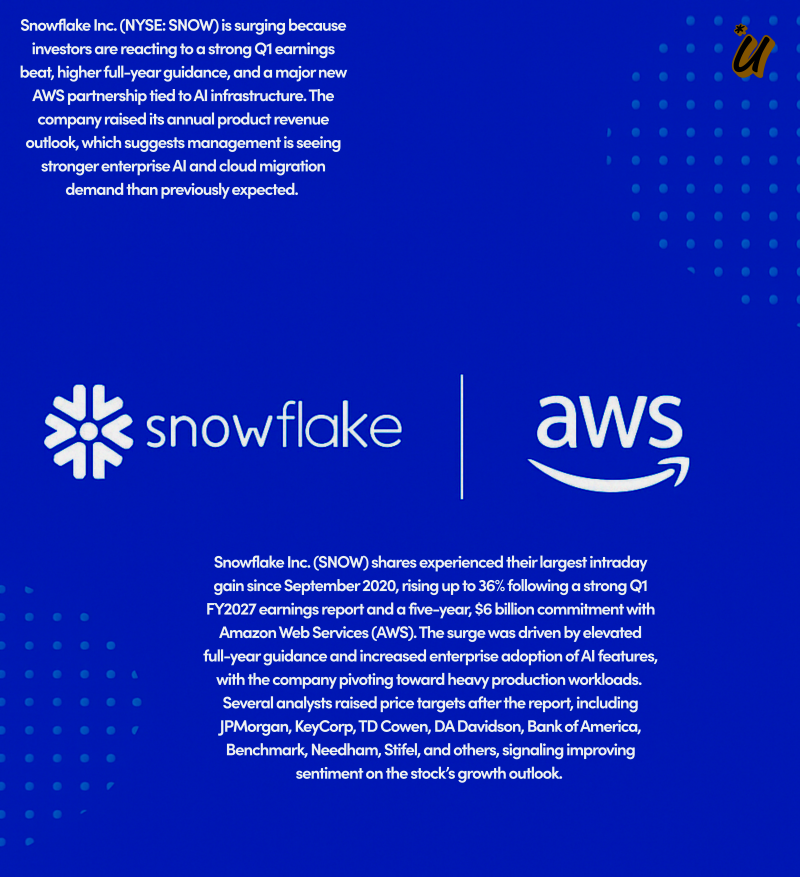
The enterprise software market witnessed a stark divergence in fortunes today, driven entirely by how effectively legacy providers are translating artificial intelligence from a marketing concept into tangible corporate revenue. In a stunning display of market enthusiasm, Snowflake saw its stock skyrocket by thirty-four percent, an unprecedented surge that added twenty-two billion dollars to the data warehousing giant’s total market capitalization in a single trading session. This monumental rally followed an exceptionally strong quarterly earnings report, which was heavily fortified by the announcement of a massive six-billion-dollar infrastructure partnership with Amazon Web Services. Snowflake Chief Executive Officer Sridhar Ramaswamy attributed the company’s explosive growth to an unexpectedly high adoption rate for their newly launched proprietary artificial intelligence coding assistant. According to Ramaswamy, this specialized developer tool is no longer just a experimental feature but has quickly evolved into a primary driver of enterprise revenue, proving that businesses are highly willing to spend premium rates for tailored tools that automate core software engineering workflows.
Conversely, Salesforce experienced a remarkably quiet and muted reaction from Wall Street as investors took a far more cautious approach to the cloud pioneer's latest fiscal updates. Shares remained largely flat after the company’s forward-looking revenue guidance narrowly missed the consensus estimates established by top industry analysts. The lackluster market performance underscores the significant operational friction Salesforce faces as it undergoes a massive internal transition, attempting to re-engineer and migrate its deeply entrenched core customer relationship management software into a suite of autonomous, AI-driven offerings. While enterprise buyers remain eager for automation, the broader cloud sector is discovering that transitioning traditional software models into modern, data-heavy intelligence hubs is both a costly and time-consuming endeavor that can temporarily weigh heavily on projected growth rates.
Simultaneously, the consumer electronics landscape is preparing for a seismic shift in how billions of people interact with daily technology, spearheaded by Apple’s looming and highly anticipated overhaul of its virtual assistant, Siri. Long criticized for trailing behind contemporary generative intelligence models, Siri is undergoing a foundational reconstruction designed to embed deep context and automation directly into the operating system. The upcoming transformation will introduce a completely redesigned, highly intuitive user interface alongside a brand-new, standalone consumer chatbot application engineered to compete directly with independent market alternatives. Beyond a simple visual facelift, Apple is implementing advanced, system-wide artificial intelligence agent capabilities. These next-generation agents will possess the computational authority to seamlessly scour both the user’s physical local device storage and the broader live web, executing complex multi-step commands and retrieving cross-application information with an unprecedented level of contextual awareness.
As the physical infrastructure required to support these advanced software models grows increasingly expensive, tech conglomerates are experimenting with entirely new business models to sustain their operations. In a departure from its traditional reliance on digital advertising, Meta is officially moving to introduce paid consumer subscription tiers for its Meta AI platform. The implementation of premium, direct-to-consumer monetization is specifically intended to help offset the astronomical capital expenditure and computational costs tied to maintaining massive server clusters and training foundational models. Wall Street analysts, including Shweta Khajuria, view the pivot as a logical and potentially lucrative expansion of Meta’s core ecosystem. Khajuria noted that establishing a robust, subscription-based recurring revenue framework could provide a powerful financial cushion for the company, diversifying its balance sheet away from the historical vulnerabilities of the advertising market and unlocking a major new stream of consumer monetization.
This gold-rush atmosphere surrounding artificial intelligence development has triggered an unprecedented, hyper-competitive labor war for top-tier research and engineering talent, nowhere more visible than at Anthropic. The high-profile safety and research firm is currently navigating an intense hiring surge that has overwhelmed the tech industry's elite workforce. The competition to secure a role at the firm has grown so fierce that eager applicants are reportedly spending thousands of dollars out of pocket on specialized interview coaching services just to navigate the company's infamously grueling selection process. Anthropic’s highly rigorous, mission-focused corporate culture prioritizes strict safety protocols and technical excellence, making their open roles some of the most sought-after and difficult-to-attain positions in modern technology, turning the recruitment process into an industry phenomenon of its own.
While digital intelligence dominates boardrooms, breakthrough physical innovations are concurrently reshaping transport infrastructure on Earth and beyond. In the arena of sustainable maritime technology, Navia announced a bold one-hundred-million-dollar environmental initiative aimed at deploying a fleet of one hundred fully electric transit vessels throughout the Maldives. The ambitious project is designed to establish a completely sustainable, zero-emission inter-island transportation network, serving as a critical global case study for how remote, climate-vulnerable island nations can successfully modernize their public infrastructure without relying on traditional fossil fuels. On land, autonomous transportation continues its relentless urban expansion, with Alphabet’s Waymo officially rolling out its cutting-edge "Ohigh" autonomous vehicle model. Optimized specifically for dense ride-hailing and robo-taxi operations, these newly configured driverless vehicles are being deployed directly onto the active public streets of San Francisco and Phoenix, pushing autonomous passenger services further into mainstream daily utilization.
Far beyond Earth’s atmosphere, the commercialization and strategic planning of deep space exploration reached a definitive milestone today. NASA Administrator Jared Isaacman publicly outlined a highly detailed, phased logistical framework for the construction of a permanent lunar base. According to Isaacman, this multi-decade endeavor will initiate its primary phase with a series of highly specialized robotic scouting and construction missions scheduled to launch as early as 2027. These uncrewed deployments are engineered to map terrain, secure vital resources, and establish foundational utility grids on the Moon's surface, effectively preparing the harsh lunar environment for sustainable, long-term human habitation and subsequent astronaut arrival.
These cross-industry shifts are fundamentally altering the flow of private capital, creating distinct economic trends that favor deep-tech and high-compute projects. Benchmark partner Eric Vishria analyzed the current macroeconomic climate, pointing to an insatiable, unprecedented global demand for raw AI inference capabilities as companies shift from training models to running them at scale. Vishria characterized the current venture capital environment as highly "bimodal," noting a stark divide in how startups are funded. While general enterprise and traditional software startups face rigorous scrutiny and tighter valuations, frontier technology companies focusing on foundational artificial intelligence, heavy infrastructure, and hard tech continue to experience an immense availability of capital, with top-tier venture firms aggressively competing to fund highly speculative, long-horizon breakthroughs.
Amidst these grand technological transformations, the entertainment and digital media sectors are experiencing their own structural disruptions as platform dynamics shift away from traditional gatekeepers. ByteDance’s TikTok is reportedly executing a quiet but highly strategic reorganization of its music operations, systematically scaling back its historic dependency on the world’s major music labels. Instead of relying on traditional licensing agreements with massive industry conglomerates, the short-form video platform is pivoting its resources toward cultivating direct, unmediated promotional and distribution relationships with independent artists. By leveraging its powerful algorithmic discovery engine to break talent natively, TikTok aims to bypass the costly gatekeeping structures of the traditional music industry, fundamentally altering how music is monetized, distributed, and popularized in the digital age.