WASHINGTON — A whirlwind of rapid developments across artificial intelligence, legacy media consolidation, foreign policy, and financial markets defined the global technology landscape today, highlighting an industry balancing aggressive hardware expansion against mounting regulatory and geopolitical friction. The latest proceedings from Bloomberg Technology painted a vivid picture of an ecosystem at a critical inflection point, where multi-billion-dollar corporate strategies are routinely tested by judicial rulings, supply chain anxieties, and international rivalries.
At the center of market attention, semiconductor titan Nvidia confirmed that its next-generation Vera Rubin accelerated computing systems have officially entered full-scale production and are actively shipping to major artificial intelligence developers and cloud infrastructure hyperscalers. The announcement directly dispels months of Wall Street speculation regarding potential manufacturing delays and packaging bottlenecks. By confirming that key hyperscale partners are already taking delivery of the Vera Rubin architecture, Nvidia has effectively reassured investors that the global pipeline for frontier model training remains firmly intact heading into the second half of the year.
The timing of Nvidia’s delivery update provided a much-needed stabilizer for the broader financial landscape. Just days prior, the semiconductor sector experienced a dramatic selloff that temporarily pushed several key chip equities into technical bear market territory. The confirmation of Vera Rubin’s rollout sparked an immediate rebound across hardware equities, prompting traders and institutional funds to recalibrate their outlooks. Market analysts noted that while short-term volatility remains present, the foundational long-term demand for high-performance computing hardware and data center expansion continues to outweigh cyclical headwinds.
While hardware manufacturers found momentary relief, the traditional media landscape was thrown into abrupt turmoil following significant judicial intervention. A federal judge issued a temporary restraining order halting the proposed blockbuster merger between entertainment powerhouses Paramount and Warner Bros. Discovery. The ruling came in response to mounting antitrust concerns raised by federal regulators, who argued that consolidating two of Hollywood's largest film, television, and streaming catalogs could substantially harm market competition and consumer choice.
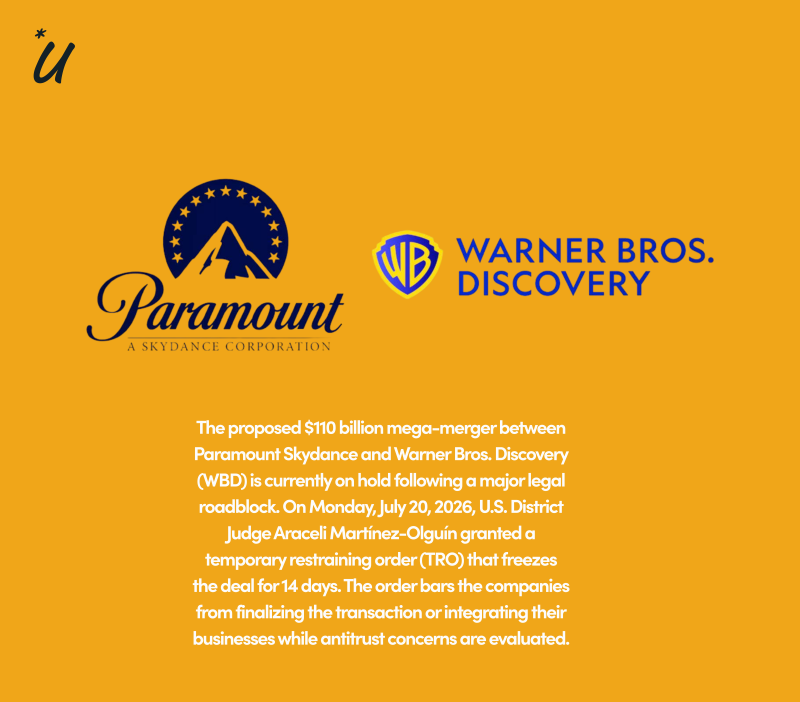
The court's decision initiates a grueling two-week period of legal uncertainty for both companies. Over the next fortnight, executive teams and legal counsel must formulate a defense to convince the judiciary and regulatory bodies that the deal would not create an anti-competitive monopoly in the rapidly evolving streaming ecosystem. The sudden legal pause underscores the growing regulatory hostility facing mega-scale corporate consolidation, leaving strategic planning for both legacy studios hanging in the balance.
Across the Pacific, foreign technology developments drew swift political pushback from American policymakers. Attention focused heavily on the release of Moonshot AI’s new Kimmy K3 model, an advanced system developed in China that has demonstrated impressive operational and linguistic capabilities. The launch of Kimmy K3 has catalyzed renewed urgency in Washington, where federal officials signaled plans to intensify oversight and scrutiny of Chinese artificial intelligence initiatives.
U.S. regulators and intelligence agencies expressed heightened concern over intellectual property protection and the rising practice of model distillation. In model distillation, smaller developers utilize the outputs generated by leading frontier models to train competitive algorithms at a fraction of the cost and compute power required for initial research. American officials warned that such techniques not only risk infringing on proprietary Western intellectual property but also accelerate foreign AI capabilities in ways that could challenge global technological leadership.
Geopolitical realities extended further into foreign policy during a White House briefing, where President Trump addressed reporters on deteriorating conditions in the Middle East. Excerpts from the event highlighted the administration's active monitoring of diplomatic and security dynamics, with specific focus placed on the evolving situation in Lebanon. President Trump also reiterated the administration's firm posture regarding ongoing strategic tensions with Iran, emphasizing regional stability during a moment of heightened global supply chain and energy market sensitivity.
Meanwhile, institutional focus on Wall Street turned toward electric vehicle manufacturer Tesla ahead of its upcoming quarterly earnings report. Investors are placing heightened pressure on Chief Executive Elon Musk to demonstrate clear, actionable returns on the company’s substantial capital expenditure investments in artificial intelligence and autonomous systems.
Unlike its big tech peers, which have poured hundreds of billions of dollars directly into massive data center clusters and large language model research, Tesla’s total AI capital spend currently lags behind market megacaps. With core automotive margins coming under sustained scrutiny, shareholders are demanding concrete proof that Tesla’s investments in Full Self-Driving infrastructure, custom compute centers, and robotics will translate into near-term enterprise value and sustainable long-term revenue streams.