Monumental mega-deals, aggressive corporate restructurings, explosive hardware growth, and the structural shifts reshaping the technology landscape. Across forty-four minutes of intense coverage, the episode mapped out a sector moving at breakneck speed, where hyper-scale infrastructure spending, algorithmic advances, and corporate reorganization converge to define the next phase of the digital economy.
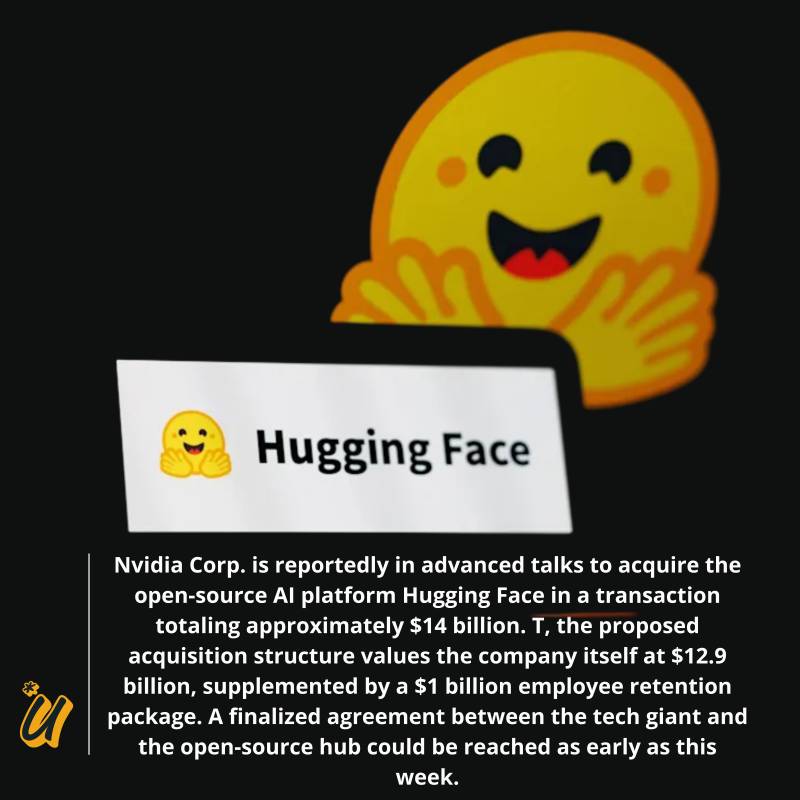
The most explosive story of the day centered on semiconductor powerhouse Nvidia, which is currently in advanced negotiations to acquire open-source AI platform Hugging Face. The landmark transaction is valued at approximately $14 billion, comprising a $12.9 billion cash consideration alongside an aggressive $1 billion retention package designed to lock in core engineering and research talent. If finalized, the deal would represent one of Nvidia’s largest-ever acquisitions, extending CEO Jensen Huang’s strategy beyond silicon dominance into the critical software infrastructure layer. Hosting over three million public AI models, Hugging Face serves as the premier global nexus for developer distribution. By absorbing the platform, Nvidia aims to secure direct access to millions of developers, integrating its proprietary CUDA architecture deeply into open-source workflows even as tech rivals seek alternative chip solutions.
Simultaneously, the enterprise hardware sector delivered staggering proof of the ongoing AI infrastructure boom through Dell Technologies. Shares of the computing giant surged following a dramatic $25 billion upward revision to its annual sales forecast, bringing its full-year guidance to $192 billion. Driven by insatiable demand from enterprise clients and cloud providers, Dell now projects its AI server revenue to triple to $74 billion this fiscal year. Underscoring this unprecedented acceleration is a massive $95 billion backlog in AI infrastructure orders, demonstrating that enterprise capital expenditure on hardware shows zero signs of cooling despite broader macroeconomic anxieties.
Yet, as capital surges into specialized hardware, consumer-facing tech titans are undergoing painful operational adjustments. Uber Technologies announced a sweeping restructuring program that will eliminate roughly 10% of its global workforce, impacting approximately 3,300 positions. Management framed the layoffs as a necessary operational shift to eliminate bloated organizational structures, streamline management layers, and dismantle inefficient "micro-teams." The aggressive downsizing reflects a broader push across mature tech companies to discipline operational spending and realign capital toward core automation priorities.
Meanwhile, venture capital interest in specialized AI tooling continues to scale unprecedented peaks. Coding startup Cognition is finalizing a massive $1 billion funding round at an astounding $47 billion valuation. The eye-popping figure highlights relentless investor demand for specialized autonomous agents capable of writing and deploying software at scale. Notably, the successful valuation benchmark comes on the heels of reported acquisition interest from SpaceX, demonstrating how premier AI software developers maintain vast strategic leverage in a competitive capital market.
The broadcast also turned its gaze to the international policy stage, covering the G20 Innovation Ministerial held in North Carolina. Gathering alongside world leaders, Jensen Huang and prominent industry executives urged global governments to dramatically accelerate sovereign AI infrastructure development. Framing computing capacity as a vital public utility and an economic equalizer, tech leaders argued that nation-states must rapidly construct regional data centers and power grid capacity to prevent widening digital divides in global productivity and innovation.
In a striking operational pivot, legacy digital brand Napster revealed its ongoing transformation into an agentic AI ecosystem. Chief Executive Officer John Acunto outlined how the former peer-to-peer pioneer is moving far beyond music streaming to construct autonomous AI platform tools. Deeply integrated with Microsoft Azure, Napster’s strategy leverages cloud infrastructure to deploy interactive AI agents, demonstrating how legacy digital platforms are attempting to reinvent themselves to remain relevant in the generative AI epoch.
The hardware discussion expanded further into physical automation with an analysis of humanoid robotics. Barclays analyst Zornitsa Todorova joined the program to outline a critical inflection point for the industry, forecasting that over 60,000 humanoid units will be deployed commercially by 2026. While manufacturing and logistical sectors are moving rapidly into real-world pilot programs, Todorova highlighted a major operational bottleneck: the severe shortage of high-quality, real-world physical training data required to train complex robotic control models for unpredictable environments.
Closing out the broadcast, the show delivered comprehensive financial previews for three major technology heavyweights preparing to report earnings. Software analytics giant Snowflake faces intense market scrutiny regarding its net revenue retention and the conversion of enterprise AI trials into recurring cloud consumption. Hewlett Packard Enterprise (HPE) enters its quarterly review under pressure to demonstrate margin resilience within its server segment while proving its strategic acquisition of Juniper Networks can accelerate its networking footprint. Finally, semiconductor giant Broadcom remains a central focus for Wall Street, with analysts closely evaluating custom AI accelerator demand and networking chip backlogs as indicators of whether the broader hardware super-cycle can sustain its current momentum.