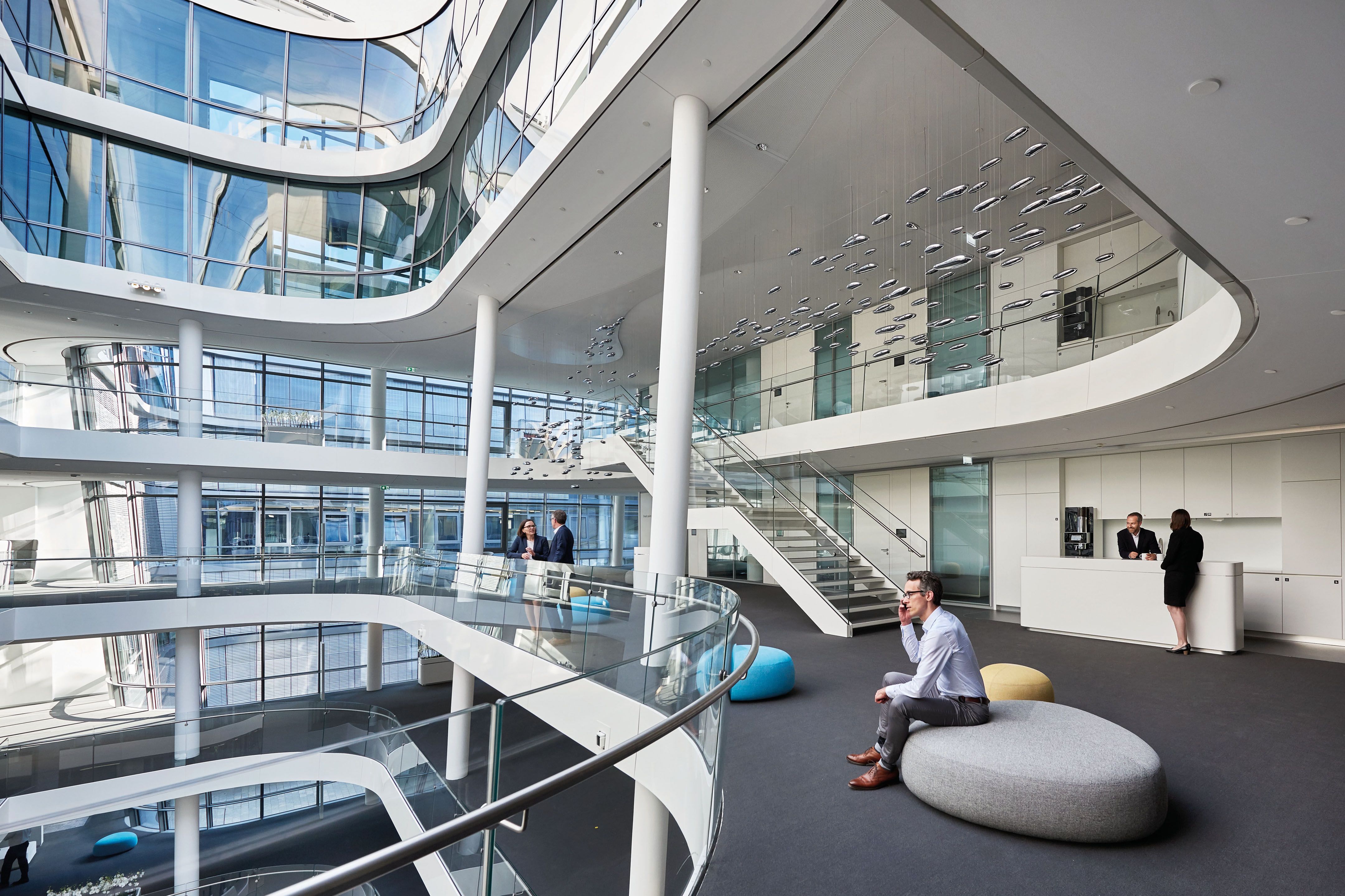
Siemens Headquarters in Munich is far more than a typical corporate workspace; it is a "very, very smart building here, really, from the bottom to the top of the building" designed to be a living space that adapts, evolves, and continues to inspire in the heart of the city. Siemens has been based at this original location since 1949, and the new headquarters, which opened in 2016, was the result of an international architectural competition started in 2010. The structure was conceived as a vibrant international workplace that would also "give something back to the city".
The architects from Henning Larsen, who also designed the Copenhagen Opera House, took inspiration from the city center and old buildings of Munich to merge the old with the new, integrating heritage structures like the Palais into the new setting at Wittels bacher platz,. A core intention was openness and transparency. The public courtyards and the Siemens Passage are all open to the public, allowing the citizens of Munich to enter the headquarters—a unique feature for a company of this scale worldwide. This commitment to social space ensures that people "enjoy going to work. Inside, the building offers numerous amenities to gather people, including coffee bars, a canteen, sports facilities, and conference facilities.
The headquarters is renowned for its sustainability, reflecting Siemens' ambition to be the most sustainable corporate building in town. This sustainability was "thought into the design from the beginning" rather than being an add-on. Key passive design choices include tilting the facades in every courtyard to allow as much light as possible to enter, saving energy on artificial lights, and creating better working conditions. On the exterior, the building features PV panels and green roofs, along with "very good insulation in the facades. The solar power system is notable for not just being roof-mounted but also covering the walls at Wittels Bacherplatz. Overall, there are around 800 solar panels with a 250-kilowatt peak installation covering about 1,300 square meters. On a sunny day, this system can achieve up to 20% of peak shaving at the grid connection points
Related article - Uphorial Shopify

Siemens Europe Office
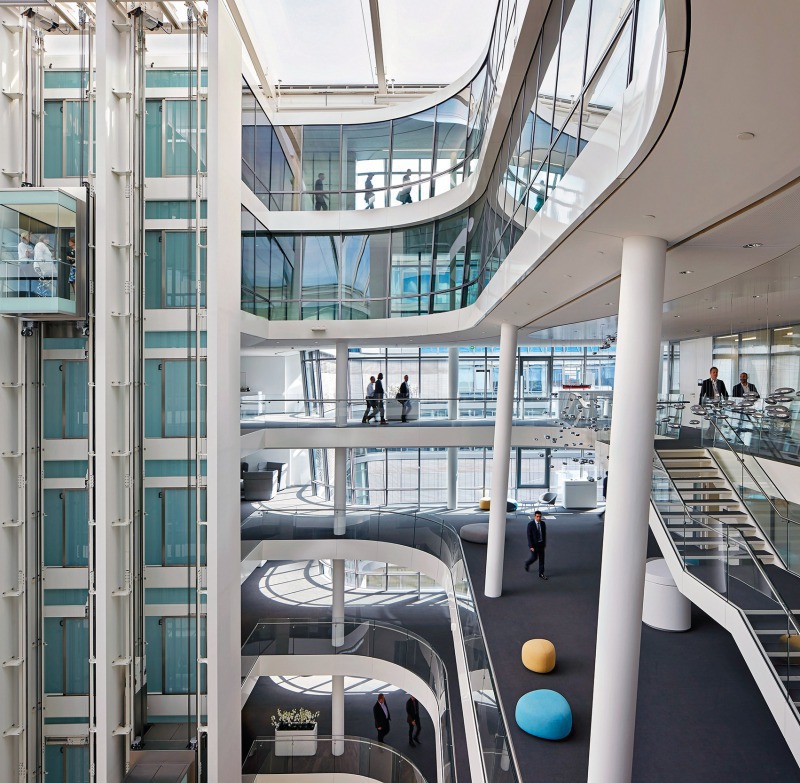
At its core, the building’s efficiency is managed by Siemens’ own technology, installed from the "bottom to the top of the building". At the deepest point of the structure lies a concrete-activated foundational slab that acts as a thermal buffer for the entire building. This slab stores heat and can also be used for emergency cooling, such as pumping chilled water through pipes to remove excessive heat when the building gets too hot in the summer. The Central Air Handling unit uses a 5,500-meter water tank as a buffer. This allows the system to increase the cold in the buffer when energy is cheap, only to use it later when prices are higher. The system features a "thermal shift" of 150-to-400-kilowatt peak daily, mainly between spring and fall. Overall, the headquarters is fitted with more than 30,000 sensors, 52 PX controllers, and over 360 PXC3 controllers, largely located in the ceilings to automate functions like blinds and lighting.
These smart features enhance the working environment, adapting to occupants’ needs. The intelligent shadowing system uses daylight harvesting by measuring existing daylight against the required lux value in different areas, reducing the need for non-natural light. Sensors detect when employees enter a meeting room, immediately adjusting blinds and shadowing to match the "perfect need" for a brilliant working experience. Siemens also maintains specialized, highly secure facilities, including a soundproof room fitted with anti-bugging technology for executives to discuss innovations.
Since the headquarters opened in 2016, it has adapted significantly. After the global pandemic led to the implementation of a 2 to 3-day hybrid working model, Siemens moved an additional 800 colleagues into the building, bringing the total number of colleagues based there to 1,700. This shift creates a unified environment where people can sit in common spaces next to each other, independent of their department. Employees appreciate the lively, energized environment and the attractive city-center location. The headquarters is viewed as a "showcase for Siemens products," its brand identity, and a global hub for employees, visitors, and customers. Moving forward, Siemens plans to increase its desk-sharing ratio to one to three and share more spaces across departments. They are also testing new technologies in collaboration with the IT department to shape the "future of work".