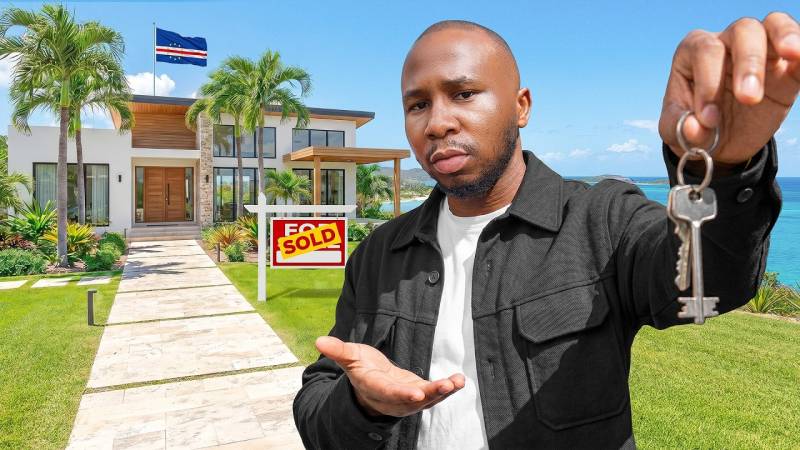
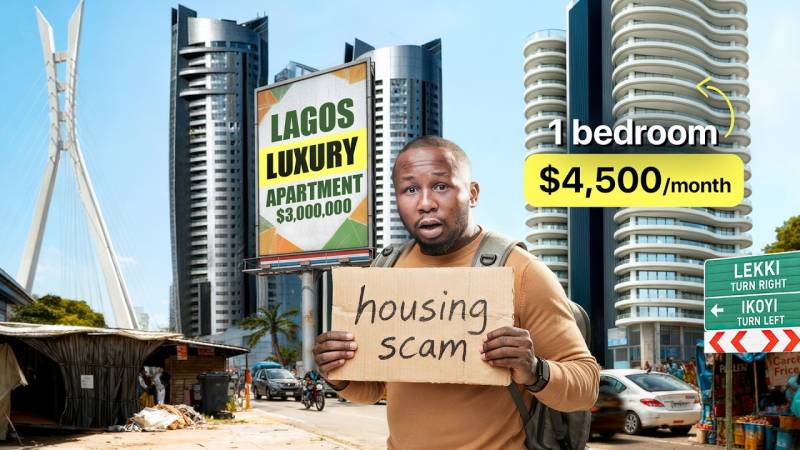
Luxury properties in Nigeria’s commercial capital, Lagos, are wildly "overpriced" and often fail to meet even basic infrastructure standards, leading to a "luxury housing pandemic" investigated by Steven Ndukwu. The journalist, whose footage "I exposed the Luxury real estate scam in Nigeria" dissects the high-end housing market, emphasizes that while developers market these homes with terms like "luxury and exclusivity," these terms have been "abused" by Nigerians, particularly given the prevalence of "clogged gutters with no drainage," "excessive flooding, power outage," and "extreme traffic" in the city.
Steven Ndukwu visited billion Naira properties across Lagos to document this disparity, including a three-bedroom apartment on Bourdillon Road in Ikoyi—considered by many analysts to be "Nigeria's most expensive street"—that can sell for "over 5 billion naira". Yet, many of these homes are "empty" because the "poor infrastructure" does not match the "deliberately inflated" price tags. For example, a 1-billion-naira ($700,000) property in the prestigious Pinnock neighborhood offered "almost zero greenery" and "no garage or outdoor space" on a small 450 square meter plot, leading the developer to maximize space by putting a small pool "just by the side".
To provide perspective, Steven Ndukwu traveled to the US to compare homes with similar price tags. A real estate agent in Houston, Texas, showed an $800,000 home that featured high 20-foot ceilings, a spacious "premium chilling section" backyard, a walk-in shower, and a "mother-in-law suite," which is "an apartment within your home". The agent questioned the justification for charging "all this money" in Lagos despite the consistent "flooding in Lekki" and instances of "brown water coming out" of faucets, noting that a small swimming pool where "you have reached both ends of it" should not qualify as luxury.
Related article - Uphorial Shopify

Developers interviewed by Steven Ndukwu argued that properties are not "overpriced" but potentially "underpriced" because of the enormous burden of providing infrastructure. Mr. Oluremi, a developer building in Atlanta, Georgia, noted that even the "poorest neighborhoods" in the US have "sewers," "pipe bomb water," and "electricity" provided. Conversely, Nigerian developers must provide all infrastructure themselves—including "road drainage" and security—in addition to facing high taxes. Another primary cost driver is the reliance on foreign-sourced, high-quality finishing materials because "the made in Nigeria are not given the actual quality," which means custom duties add substantially to the price.
The ultimate reason for the exorbitant costs, however, remains simple demand and supply. As Steven Ndukwu revealed, Lagos’s land is considered its "oil". With "over 600 people move to Lagos every day," the rapid influx is placing "huge pressure" on the struggling infrastructure, creating a housing deficit of over 3.4 million units. Since Lagos is Nigeria's smallest state, and almost everyone—including politicians, Nigerians in diaspora, and foreigners—is "clustered between Ikoyi and Chevron," this small area faces "huge pressure".
The consequence of this focus on the elite market is severe: statistics confirm that 95% of Nigerians will not be able to own a home in their lifetime. While an average American can afford a home with a small deposit and a 30-year mortgage at 8% interest, homeownership in Nigeria is reserved for a "select few". Developers avoid building affordable properties (around 35-40 million naira) because they are "not profitable". As one developer explained, due to Nigeria's high inflation (nearly 38% annual rate) and cost of funding (36-38%), if a project does not yield "200% profit," a developer risks losing everything.
Steven Ndukwu did find some glimmers of hope on the mainland side of Lagos, away from the island's high costs. Here, developers like Bright are focusing on smaller units, like studio and one-bedroom apartments, which are needed by the "huge population of young people" who "clearly cannot afford the three" or four-bedroom duplexes. Furthermore, Bright introduced Steven Ndukwu to the concept of fractional ownership, where "multiple people can come together and own a fraction of a unit" for as little as 15 million naira, making real estate investment accessible to the "lower class". Steven Ndukwu even personally invested in one of these affordable projects. The video's conclusion confirms that until the government provides basic infrastructure, the "luxury housing pandemic" will continue to restrict homeownership to only the wealthiest Nigerians.