NEW HOPE — In the quiet woods of New Hope, Pennsylvania, there exists a sanctuary where the boundary between nature and architecture dissolves into a singular, cohesive philosophy. This enclave, the Nakashima Studios, recently served as the backdrop for an intimate retrospective led by Mira Nakashima, who now stewards the profound legacy of her father, the legendary furniture designer George Nakashima. The tour of the compound is more than a walk through a series of workshops; it is a journey through the 20th century’s most soulful interpretation of modernism—a narrative of wartime resilience, cross-cultural immersion, and a relentless devotion to the spirit of the tree.
The architectural heart of the property is the Conoid Studio, a structure that Mira describes as a masterpiece of thin-shell concrete. This building did more than just house a workshop; its sweeping, experimental lines directly informed George’s design language, most notably inspiring the iconic two-legged Conoid chair. The studio stands as a testament to a man who viewed space and object as inseparable, where the roof over one's head should reflect the same structural honesty as the chair beneath one's frame. To walk through the studio today is to see the physical manifestation of a career that began not in a furniture shop, but in the dense forests of the Pacific Northwest.
George Nakashima’s path to the upper echelons of design was forged through a diverse and global education. Mira reflects on her father’s early years as a forestry student at the University of Washington, a foundation that instilled in him a lifelong, cellular understanding of timber. This was followed by a shift to architecture at MIT and a period of restless global wandering. His formative years in Paris, Tokyo, and India exposed him to the disparate worlds of European modernism, Japanese craftsmanship, and Eastern spirituality. It was during these travels that he began to synthesize a philosophy that married the clean lines of the West with the reverent, hand-crafted traditions of the East.


Related article - Uphorial Shopify

However, the most pivotal chapter in the Nakashima story was born out of the darkness of World War II. Following the family’s forced incarceration in an Idaho internment camp, George found himself in an environment of extreme scarcity. It was here, amidst the dust and deprivation, that he refined his woodworking skills using discarded and found materials. This period of resilience became the crucible for his design philosophy; he learned that even the most "imperfect" piece of wood possessed a soul that could be liberated through patient, manual labor. When the family eventually relocated to a farm in Bucks County, they brought with them a profound respect for the dignity of the natural world and a refusal to waste its resources.
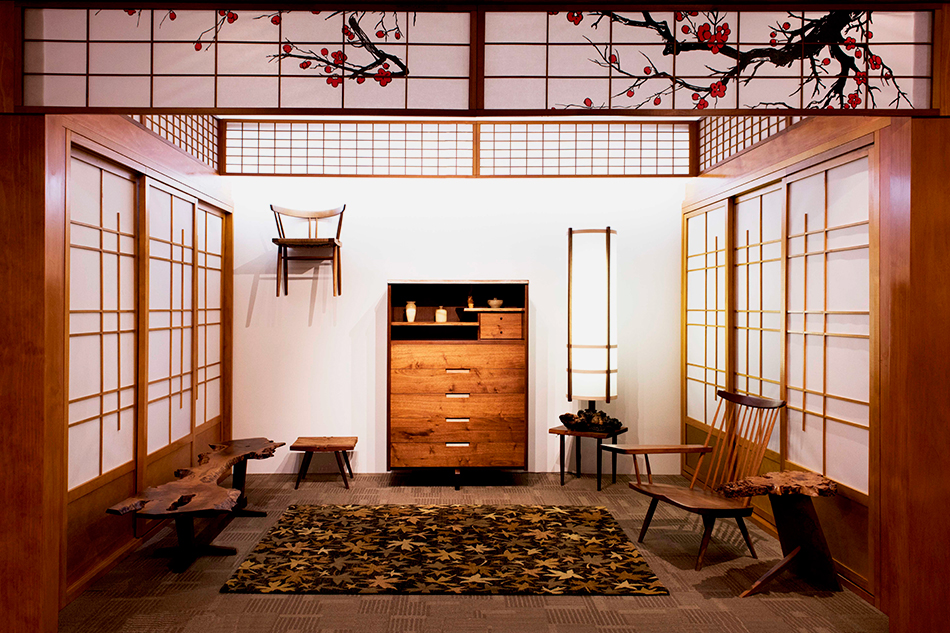
George’s design philosophy, as Mira explains, was rooted in a belief that furniture should be treated with the care and reverence one might offer a throne. He famously sought out wood that other commercial manufacturers rejected—planks with cracks, knots, and "defects"—viewing these features as the unique biography of the tree. His commitment to hand-craftsmanship was a direct protest against the impersonal nature of industrial mass production. In the Nakashima world, the woodworker’s task is to provide a "second life" to the tree, ensuring that its natural beauty is preserved for generations in a form that is both functional and sacred.
The Nakashima compound itself is a living museum of architectural innovation. The tour highlights the Arts Building, which features a striking hyperbolic paraboloid roof, and the Old Family House, which served as the original anchor for their new life in Pennsylvania. Among the most intriguing structures is the Reception House, built during the energy crisis of the 1970s. Designed as a sustainable, all-electric retirement space, it reflects George’s forward-thinking approach to environmental responsibility and his ability to adapt his aesthetic to the technological challenges of the era. Each building on the property was constructed with the same meticulous attention to detail as the furniture created within them.
As Mira Nakashima concludes the tour, she emphasizes that the studio is far from a stagnant memorial. Today, the family and their dedicated team of craftsmen continue to prioritize traditional techniques and the ethical preservation of precious wood species. The legacy persists in every hand-planed surface and every butterfly joint, ensuring that the dialogue George Nakashima started with the forest remains as vibrant and relevant in 2026 as it was in the mid-20th century. For the Nakashimas, the work is never truly finished; it is a continuous act of devotion to the "soul of a tree," a philosophy that continues to inspire designers and collectors across the globe.