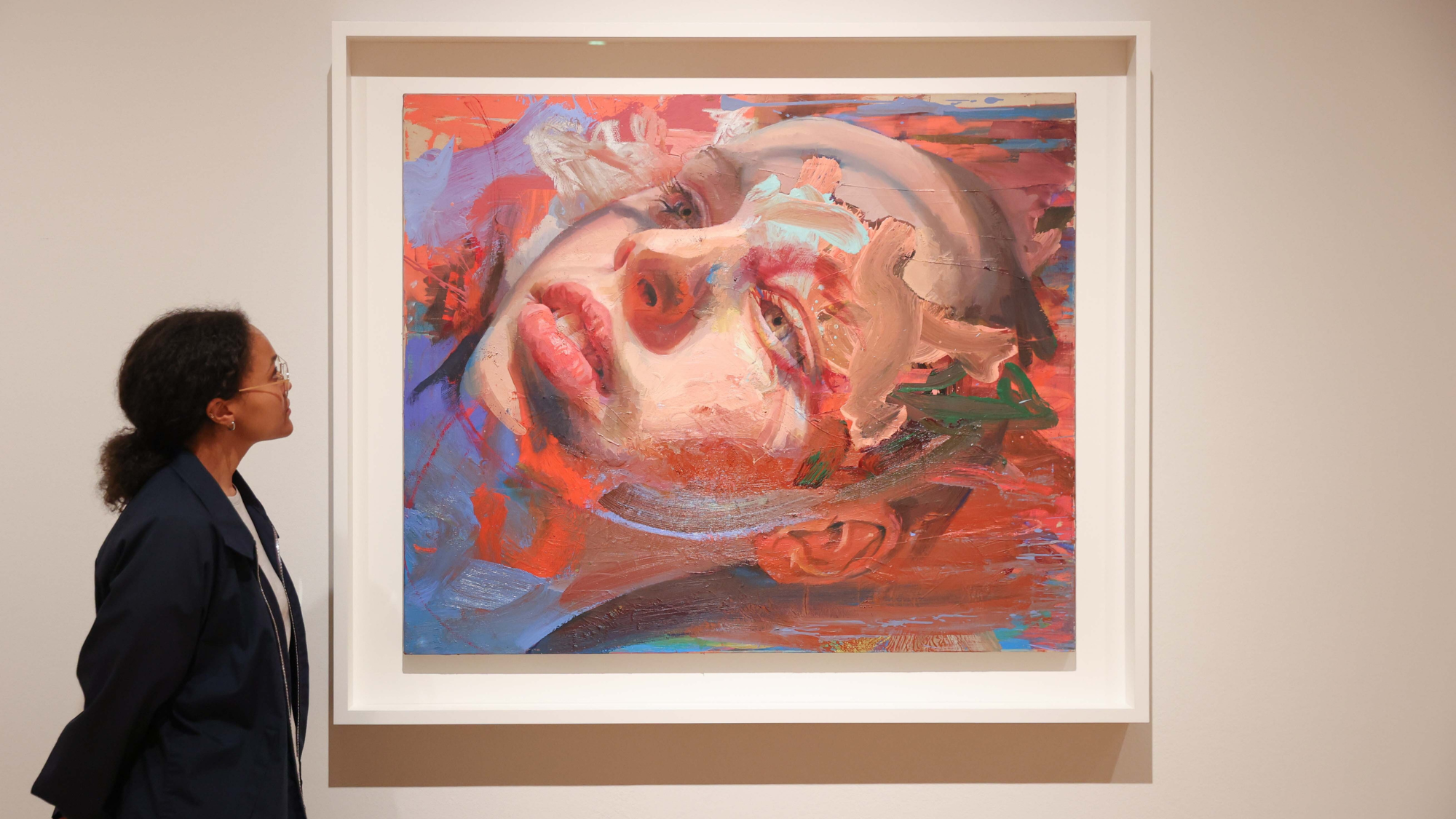
Jenny Saville doesn’t ask for permission. Her brush roars, her canvases erupt, and flesh, too much of it, not enough of it, altered, stretched, collapsed, spills across the frame unapologetically. She does not flatter the human body. She reveals it. In its trauma. In its triumph. In its silent resistance. It’s this raw honesty that made her the most expensive living female artist when Propped sold for over £9.5 million at Sotheby’s in 2018. But accolades are merely timestamps. The real story of Jenny Saville lies in how she commands the canvas like a battlefield.
And now, Christie's is telling that story again.
When Katharine Arnold, Christie's Vice Chairman for 20th and 21st Century Art, describes Saville’s work, she speaks as if trying to catch a hurricane in a sentence. There’s awe, there’s reverence, and above all, there’s the recognition of a phenomenon too visceral to be reduced to market value. Alongside her, Sarah Howgate from the National Portrait Gallery speaks of Jenny’s unyielding dialogue with art history: Rubens, Titian, Michelangelo, all whisper through her brush, yet none can contain her voice. She doesn’t imitate, she confronts. She converses. And she dares.
Related article - Uphorial Sweatshirt

Christie's
It all began, as it always does, in the silence of rejection. As a student, Saville was once told her work was “too big, too grotesque, too much.” But what the world saw as excess, she embraced as truth. Women, in her world, are not muses; they are masses. They take up space. They demand it. Saville’s women are rarely clothed, rarely still, rarely quiet. They bleed. They fold. They glare. They are, simply, unedited.
She came of age during the YBA era, Young British Artists, alongside the likes of Damien Hirst and Tracey Emin. But while many YBAs shocked through concept, Saville did it through sheer technical force. She painted like the Old Masters, but her subject matter was defiantly now. Her women bore liposuction scars, stretch marks, bruises, folds, surgeries, and lives lived in the shadows of perfection. In doing so, she waged war on the aesthetic expectations of femininity, both in art and culture. And somehow, amid all this, she made beauty, startling, aching beauty.
At Christie's, her presence feels more like a reckoning than a celebration. Each piece is a wound, dressed in color. Each canvas is not just observed, it’s felt. There's one particular piece where the flesh almost seems to pulse. The paint thickens like tissue, thin lines of brushwork mimicking veins and muscle. You don’t just look at her work, your body remembers it.
Yet what’s most extraordinary is her command of tradition. Jenny is not rebelling against art history; she’s refining it. Drawing from Lucian Freud’s intimate detachment, Bacon’s violence, and Titian’s sensuality, she weaves the old world into modern dilemmas. She treats the canvas not just as a surface, but as skin itself. A living, aching thing.
And still, the question remains, what makes her one of the greats?
Perhaps she dares to depict women not as objects of desire but as archives of experience. Perhaps it’s how she paints discomfort without apology. Or perhaps it’s because she’s a mirror, not a window. She doesn’t show you something else. She shows you you. The parts of yourself you’ve edited, denied, and buried.
Jenny Saville has said, “Flesh is the most fundamental thing. It’s what we are.” And she paints it as such. Fundamental. Sacred. Wounded. Infinite.
At Christie's, her work reminds us that greatness in art isn’t about answers. It’s about questions that won’t go away. About standing before a painting and feeling your body respond before your mind can name it. That’s what Jenny does. She doesn’t just paint flesh.
She makes it impossible to forget it.