The 2026 Consumer Electronics Show (CES) in Las Vegas serves as a critical theater for the transition of artificial intelligence from speculative hype to an industrial "inflection point." Bloomberg Technology provided comprehensive coverage of this shift, with anchors Caroline Hyde and Ed Ludlow facilitating high-stakes dialogues with the architects of the next compute era. During a pivotal segment, Ed Ludlow explored the massive "compute deficit" with AMD CEO Lisa Su, who revealed that global demand must increase 100-fold over the next five years to accommodate an AI user base projected to jump from one billion to five billion. To address this, AMD unveiled its first rack-scale system solution, including the MI455 cloud accelerator and the MI440X enterprise chip, both utilizing two and three-nanometer technology to pack 320 billion transistors into a single system.
Related article - Uphorial Sweatshirt

Beyond the raw hardware, the sources highlight a complex geopolitical and economic landscape. Caroline Hyde observed significant market ripples, noting that while AMD shares fluctuated following the keynote, the "unbelievable need for memory" and storage drove gains for companies like SanDisk. This infrastructure must support increasingly ambitious physical applications, such as the "production-intent" robotaxi unveiled by Lucid Interim CEO Marc Winter Hoff. In a discussion with Hyde, Winter Hoff detailed a strategy to achieve Level 4 autonomy by 2029 using the Nvidia Drive platform, while aggressively localizing battery production in the United States to circumvent trade tariffs and the supply chain "surprises" that defined previous years.
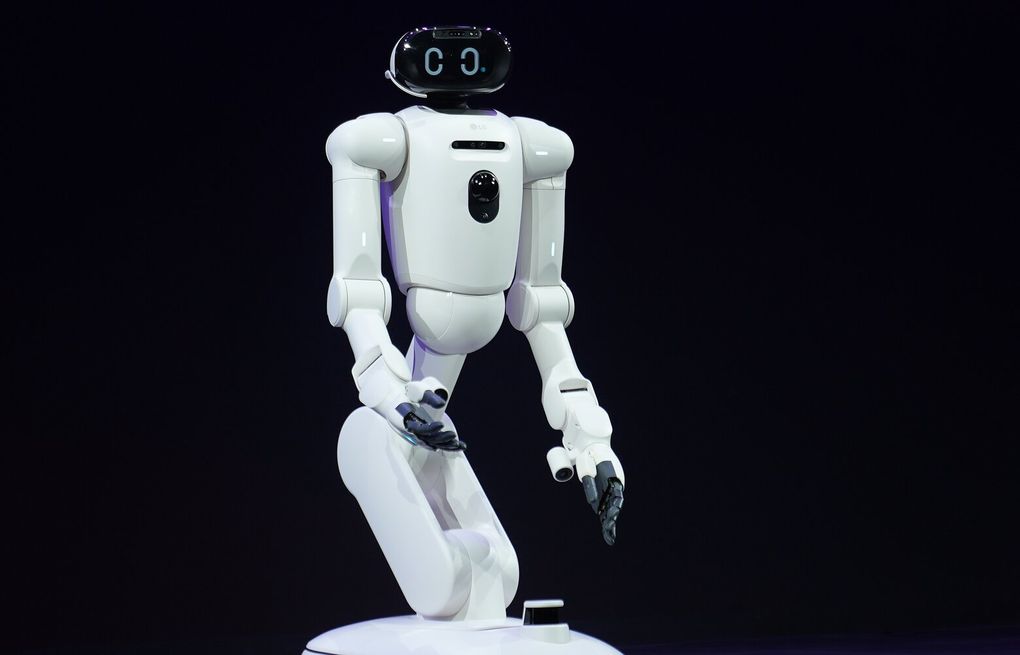
The integration of AI is also fundamentally altering personal hardware and the creative process of game development. Razer CEO Min-Liang Tan introduced AI-enabled headphones featuring dual cameras, arguing that traditional form factors are more "universal" and accessible than smart glasses for providing "vision" to AI assistants. Furthermore, Tan emphasized that AI is being deployed as a tool for "quality assurance" and shortening development cycles rather than merely producing "AI slop". As consumer tech expands into multimodal wearables and jewelry, Bloomberg Tech Editor Dana Wollman noted a deliberate trend toward "anthropomorphic" designs—such as robotic AI dogs and laundry-folding units—intended to use "cuteness" to bridge the gap between human anxiety and machine utility.
Building the global AI infrastructure is much like trying to upgrade a city's power grid while the population doubles every month; you must not only construct massive plants at the source but also ensure the wires reaching every individual home are sophisticated enough to handle the surge without blowing a fuse.