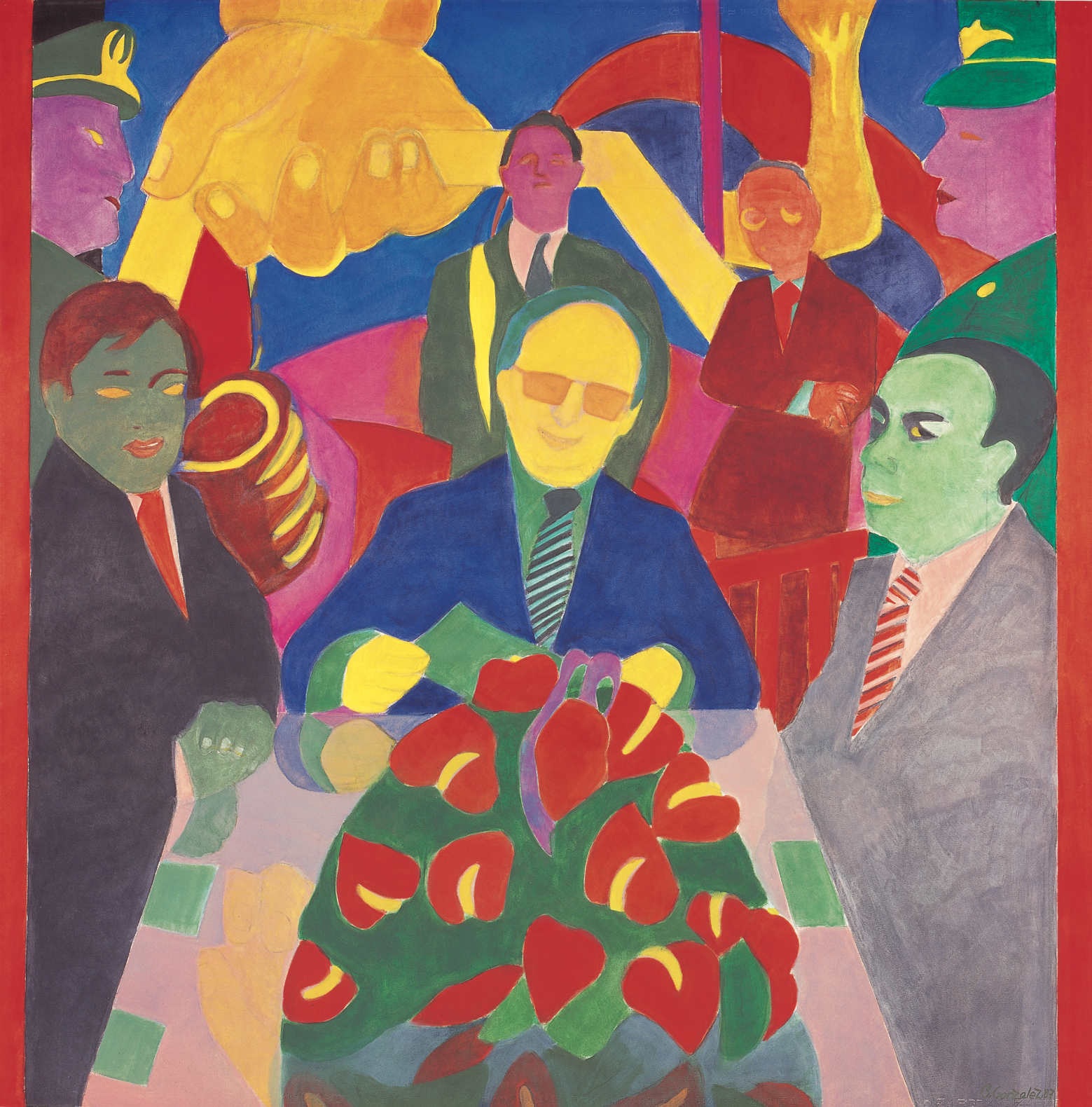
BOGOTA – In the hallowed halls of Latin American modernism, few voices resonate with the haunting, saturated clarity of Beatriz González, the artist known affectionately as "La Maestra." As her career now traverses a staggering sixty-year arc, a definitive report on her life and work reveals more than just an artistic timeline; it uncovers a transformational framing of Colombian identity. González has not merely painted the history of her nation; she has acted as its primary emotional cartographer, documenting the jagged intersections of power, grief, and memory. Through an exercise in intelligent curation of the mundane and the monumental, her practice serves as a visceral reminder that art often finds its highest calling when it chooses to say exactly what history cannot, providing a persistent and transgressive witness to the political realities of a country in constant flux.
The narrative of González’s evolution began with a sophisticated deconstruction of the Western canon—a strategic storytelling of defiance against the hegemony of European masters like Velázquez and Vermeer. In her early years, she analyzed these masterpieces not with reverence, but with an analytical eye, breaking them down into bold, blocky, and saturated color palettes that would become her stylistic hallmark. This was not an act of imitation, but a profound cultural understanding of how images travel. By blending these historical references with everyday Colombian imagery—specifically the flat, accessible visuals found in cigarette calendars and popular print media—she signaled a radical shift in perspective. She effectively "localized" the masters, stripping them of their elitist distance and re-planting them in the fertile, often chaotic soil of Colombian popular culture.
However, the emotional precision of her work found its true north during a pivotal moment involving a tragedy known as the Sisga Suicides. Encountering a low-fidelity newspaper photograph of a couple who chose death over separation, González recognized the potent relationship between mass media and national tragedy. This was the turning point where she found her definitive voice; by focusing on this tragic image, she signaled the start of a lifelong engagement with the aesthetics of violence and loss. The Sisga project was a masterclass in transformational framing, proving that the most profound insights into a nation’s soul often reside in the grainy, disposable ink of its morning papers. From this point forward, her art was no longer just about color and form; it was about the heavy weight of the Colombian experience.
Related article - Uphorial Shopify
.webp)
As her career matured, González challenged the traditional boundaries of the art world by moving her canvases onto the very fabric of domestic life. In an era of high-brow abstraction, her "interventions" into mass-produced household furniture—painting vibrant, satirical scenes onto beds, tables, and coat racks—served as a brilliant critique of the "monument." By placing her art on a bedspread or a vanity, she forced the viewer to live with the imagery, integrating her social critiques into the intimacy of the home. During this period, she utilized her satiric wit to target global and national icons, ranging from Queen Elizabeth II to local political figures, effectively demystifying the architecture of power. This intelligent curation of the domestic and the political highlighted the inescapable nature of the state, suggesting that power is not just found in the palace, but in the furniture of our daily lives.
-Beatriz-Gonzalez.jpg)
The trajectory of her work took a somber, explicitly political turn as Colombia descended into the deep crises of the late twentieth century. The 1985 siege of the Palace of Justice served as a traumatic catalyst for a shift in her palette and purpose. Moving away from the vibrant irony of her earlier years, she embraced somber tones and emotional imagery that functioned as a series of homages to the victims of the nation’s escalating violence. Her powerful series on domestic bedspreads and her massive, 140-meter curtain project critiquing government complicity served as a visceral report on the "unspeakable" nature of the conflict. In these works, González moved beyond satire into the realm of the sacred, utilizing the scale of her art to mirror the gargantuan scale of the nation’s mourning.
In the later stages of her career, La Maestra’s focus has sharpened into a relentless pursuit of collective memory. This culmination is perhaps most hauntingly realized in her project Auras Anónimas, a monumental memorial at the Central Cemetery of Bogotá. Featuring thousands of screen prints of anonymous porters carrying bodies, the work transforms a site of death into a site of active remembrance. This project is a masterclass in strategic storytelling, where the repetition of the image reflects the repetitive nature of Colombia’s history of displacement and loss. By focusing on the "anonymous," González restores dignity to the nameless victims of the conflict, ensuring that the shadows cast by the past are given a permanent, artistic weight in the present. Ultimately, the report on Beatriz González confirms her status as a pioneering figure whose work transcends the limits of the gallery. Her philosophy—that art says what history cannot—is not a mere slogan, but a lived reality that has sustained her through six decades of creative resistance. She has taught a generation that the artist’s role is to be a witness, a satirist, and a mourner all at once. As Colombia continues to navigate its path toward peace and reconciliation, the work of González stands as a sanctuary for the nation’s memories, proving that while history may be written by the powerful, the truth is often found in the blocky, saturated colors of the brave.