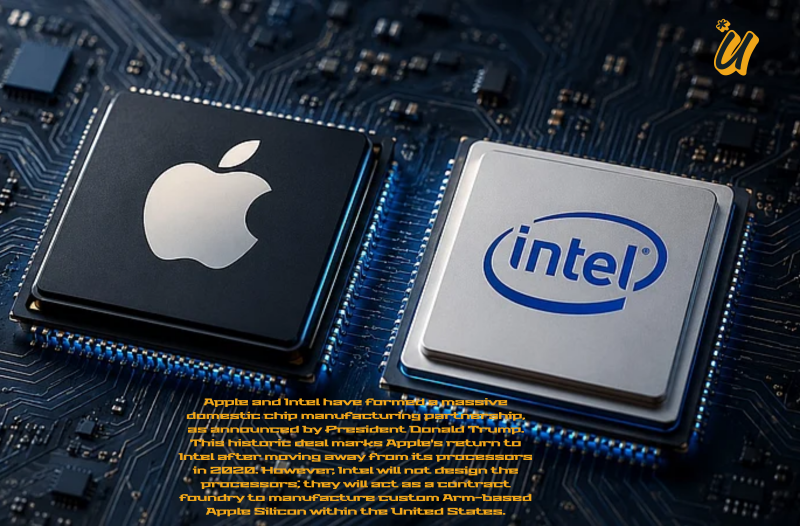
The global technology landscape and Wall Street experienced a seismic shift on Thursday as a series of blockbuster announcements reordered the priorities of the world’s largest companies. Headlining a momentous day in the markets, President Trump announced a groundbreaking domestic chip manufacturing collaboration between Intel Corporation and Apple Inc., signaling a massive win for the administration's push to bring critical supply chains back to American soil. The news sent shockwaves through the semiconductor industry, propelling Intel shares to a historic record high as investors rallied behind the prospective windfall of manufacturing Apple’s industry-leading silicon. Apple shares reacted with more modest gains, reflecting the tech giant's characteristically calculated approach to long-term supply chain shifts.
For Apple, the strategic pivot is seen by industry experts as a crucial, multi-year move to diversify its manufacturing footprint away from Taiwan Semiconductor Manufacturing Company (TSMC). While TSMC has long been the exclusive manufacturer of Apple's premium mobile and desktop processors, rising geopolitical tensions and the sheer logistical vulnerability of centralized production have forced Apple to seek domestic redundancies. Analysts weighing in on the development noted that while transitioning high-end chip production to Intel’s American foundries will take time and immense capital, it fundamentally derisks Apple's supply chain against future global shocks. For Intel, securing Apple as a cornerstone foundry customer validates its massive, multi-billion-dollar investments in domestic manufacturing capabilities and positions the company as the premier American alternative to Asian fabrication giants.
Simultaneously, the financial world remained transfixed by SpaceX, which concluded its highly anticipated first full week of public trading. The aerospace behemoth’s debut on the public markets has been anything but quiet, with the stock closing down for two consecutive days at the end of the week as early euphoria gave way to institutional profit-taking. Despite the short-term turbulence, market analysts maintaining coverage on the company urged a long-term bullish outlook. Wall Street observers emphasized that SpaceX represents a entirely unique market vehicle, fueled heavily by an unprecedented wave of enthusiastic retail investors who are treating the stock more like a generational asset than a typical tech equity. Analysts believe the company's dominant position in satellite internet and heavy-lift rocketry provides a structural moat that will easily outlast initial public offering volatility.
The intersection of technology and national security was also thrust into the spotlight as Anduril Chief Executive Officer Brian Schimpf confirmed a massive milestone for the defense tech disruptor. Anduril has officially secured a new production contract with the United States Air Force to develop and manufacture autonomous fighter jets. Schimpf detailed the company's vision for the future of aerial warfare, emphasizing that software-defined hardware and artificial intelligence will dictate the next generation of defense procurement. The contract marks a major victory for Silicon Valley-backed defense firms, which have spent years attempting to break the stranglehold that legacy aerospace primes have traditionally held over major Pentagon programs.
Meanwhile, a quiet but highly profitable paradox was exposed regarding Microsoft Corporation’s international business dealings. Reports surfaced revealing that Microsoft is currently generating significant revenue from prominent Chinese technology firms, including TikTok's parent company, ByteDance. The revenue is being funneled through Microsoft's Azure cloud services, highlighting a fascinating geopolitical irony: even as Washington tightens regulatory restrictions on Chinese tech operations within the United States, American infrastructure remains the foundational backbone enabling these global digital platforms to scale.
This tension between globalized revenue and national infrastructure is mirrored in a broader shift in corporate capital allocation across the entire tech sector. Financial analysts noted a stark departure from the traditional market playbooks of the last decade. Big Tech firms are aggressively pivoting away from massive share buyback programs—which have historically been used to artificially boost earnings per share and appease short-term investors—in favor of aggressive, unprecedented capital expenditure. This surge in capex is entirely directed toward the global artificial intelligence infrastructure race. Companies are realizing that data centers, specialized cooling systems, and advanced power grids are the primary currencies of the AI era, and those who fail to build out physical compute capacity today risk permanent obsolescence tomorrow.
This infrastructure gold rush is prompting surprising corporate pivots from nontraditional players. Rumble CEO Chris Pavlovski detailed his platform's dramatic expansion into cloud compute and artificial intelligence infrastructure, a move accelerated by Rumble's strategic acquisition of Northern Data. Originally known primarily as a video hosting platform championing alternative media, Rumble is leveraging Northern Data’s specialized data centers to position itself as a serious contender in the high-performance computing market. Pavlovski outlined a strategy aimed at providing independent, un-cancelable cloud infrastructure for AI startups and enterprises looking for alternatives to the traditional tech monopolies.
On the consumer side of the ledger, the highly publicized launch of the T1 smartphone from Trump Mobile faced its first major wave of critical scrutiny. Early reviews of the device suggest it may not fully live up to the lofty expectations set by its intense marketing campaigns. Specifically, tech analysts pointed out glaring discrepancies regarding the device's "U.S.-made" branding, noting that a significant portion of its internal components are still sourced from international supply chains. Furthermore, early benchmarks indicate that the T1's technical performance lags behind similarly priced flagship competitors, raising questions about its long-term viability in an incredibly crowded and unforgiving consumer hardware market.
The media and entertainment sectors offered a bright spot of intense consumer demand, highlighted by Rockstar Games’ blockbuster announcement regarding pre-orders for Grand Theft Auto 6. The entertainment industry widely expects the upcoming title to shatter every existing entertainment record upon release, with pre-order data already showing unprecedented consumer velocity. This economic optimism extended to the cinematic world as well, where early tracking and theater bookings for Disney and Pixar’s Toy Story 5 point toward staggering box office expectations, proving that legacy entertainment franchises still hold immense pricing power and consumer loyalty in a fragmented media landscape.
Closing out an extraordinary day of market-moving news and technological milestones, the attention shifted from corporate boardrooms to the streets of Manhattan. The city paused to witness a historic celebration as a massive, raucous ticker-tape parade rolled through the Canyon of Heroes to honor the New York Knicks' latest championship victory. The live coverage captured an outpouring of civic pride, drawing a symbolic line under a week defined by massive economic bets, geopolitical maneuvers, and the relentless evolution of the American tech economy.