Bloomberg Technology went live from coast to coast, with Caroline Hyde hosting in New York and Ed Ludlow reporting from AWS Re: Invent in Las Vegas, to cover Amazon Web Services' (AWS) major AI announcements and a massive, unexpected philanthropic commitment. The session also highlighted the intense capital expenditure trend dominating Big Tech and the volatility in the broader markets.
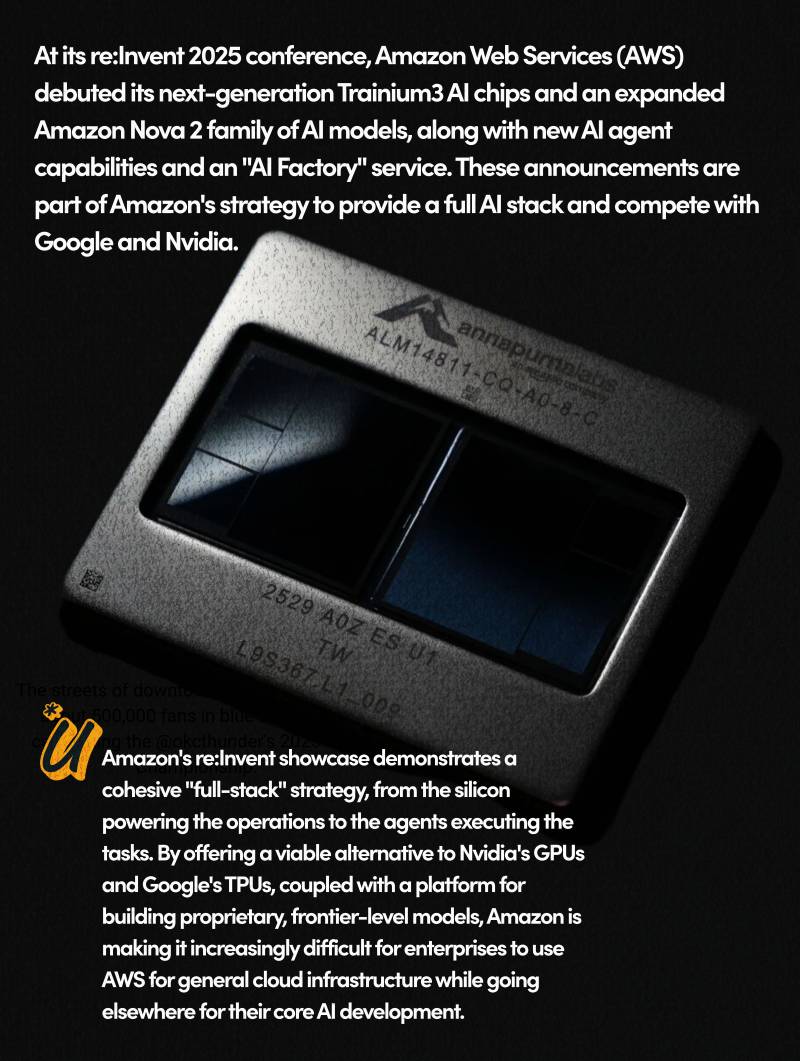
Ed Ludlow reported that the most significant news from AWS included the launch of the latest-generation accelerator, Tranium Three, useful for both AI training and inference use cases. Amazon is talking up the cost and performance metrics of its accelerator, although Ed Ludlow noted this was a "small move" lower when compared to Google and NVIDIA. AWS also debuted Novo Two, an updated, year-on-year version of its in-house foundation model.
The core of the AWS strategy, as covered by Bloomberg Technology, focused on the launch of three Frontier Agents: Autonomous Agent, Security Agent, and DevOps Agent. AWS is "building the foundation for billions of agents" that are designed to be autonomous, massively scalable, and run for longer periods without constant human steering. These agents are presented as "AI coworkers" or "teammates" intended to transform software development, operations, and security. The DevOps Agent, for instance, correctly identified the root cause of incidents and escalations 86% of the time in testing. The company is balancing this autonomy with control through "right guard rails" and configurable safeguards like human code review or automated property-based testing before shipping code.
Caroline Hyde directed the conversation toward the macroeconomic implications of these AI investments, noting that Big Tech, including Amazon, Alphabet, and Microsoft, is spending over $380 billion combined in the current fiscal year on AI. This represents a "real flip reverse" from the previous two-decade mantra of delivering growth while keeping a tight lid on spending. This high capital expenditure has pushed ratios like Microsoft's capital expenditures to 20% of its revenue, with Amazon and Alphabet also showing some of the highest spending-to-sales ratios in the market. Caroline Hyde noted the need to "digest a period of high capital expenditure" while investors assess the return.
In non-AI news, the program detailed an "unprecedented" philanthropic gift from Michael and Susan Dell. Michael and Susan Dell are donating $6.25 billion to jumpstart investment accounts for 25 million children in America. This initiative builds upon the Invest in America Initiative (or "Trump Accounts"). The donation will give $250 each to children aged 10 and under, with the money to be used for things like college, starting a business, or a home deposit when they turn 18. This is an "unprecedented gift" not just for its size, but also because it is going through the U.S. Department of the Treasury.
Bloomberg Technology also covered developments in the media sector, where Warner Bros. Discovery received a new round of bids. Netflix surprised analysts by submitting a mostly cash offer, while Paramount is the only bidder seeking the "whole company," backed by financing from Larry Ellison, David Ellison, Middle Eastern money, and Apollo. The board is expected to decide quickly, potentially before the holidays, to avoid costly bridge loans at year-end.
Finally, the broadcast touched on Luma AI, which opened its first international office in London, drawn by the deep research pipeline from institutions like DeepMind. Luma AI, which views video as the path to AGI, is collaborating with Humane to build a two-gigawatt compute cluster, one of the largest compute buildouts for AI. Ed Ludlow is scheduled to have a sit-down interview with AWS CEO Matt Garman later in the program.