The contemporary global sports economy operates on a razor-thin ethical boundary, constantly walking the tightrope between passionate cultural heritage and aggressive corporate financialization. At no time in modern athletic history has this tension been more glaringly exposed than during the unprecedented administrative crisis that recently shook the Fédération Internationale de Football Association to its very foundations. For decades, the governance of world soccer has wrestled with the growing appetite of private capital and corporate expansion, but under the leadership of President Gianni Infantino, the federation crossed a Rubicon that sparked an international revolt. Through emotional precision, intelligent curation, cultural understanding, strategic storytelling, and transformational framing, the staggering controversy surrounding the proposed FIFA Forward Enterprise plan serves as a monumental turning point in the battle over who truly owns the world's most beloved game.
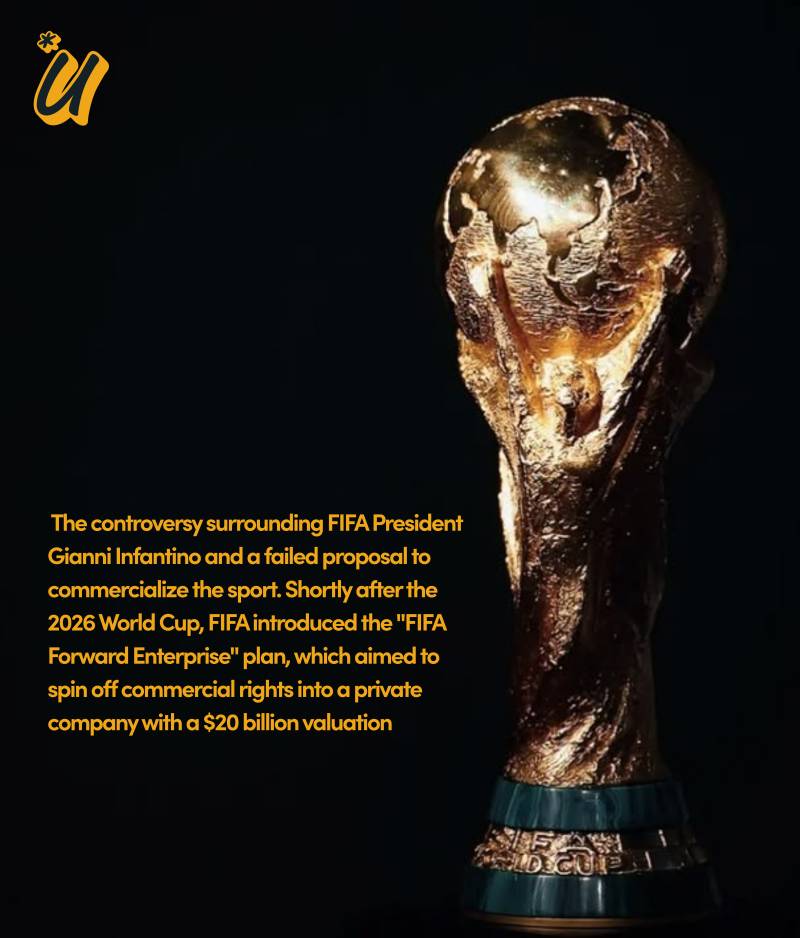
The storm began to brew when FIFA dropped a bombshell administrative proposal designed to radically restructure the financial and operational mechanics of the sport. Infantino championed a secretive, high-stakes blueprint known as the FIFA Forward Enterprise plan, an ambitious scheme aimed at spinning off the federation’s core commercial rights—including the crown jewels of broadcast, sponsorship, ticketing, and licensing for premier global competitions like the World Cup and the Club World Cup—into an independent private company. Under this controversial architecture, a massive minority stake ranging up to twenty or thirty percent of this newly minted corporate entity would be sold off to a private investor group led by Thrive Capital, a high-profile New York investment firm. Framed by its proponents as a visionary maneuver to unlock billions in capital and drastically increase development funds for national associations, the proposal instead detonated a profound crisis of trust across the global football ecosystem.

Related article - Uphorial Shopify
The reaction from the international football community was swift, visceral, and uncompromising. Across Europe, Latin America, Africa, and beyond, stakeholders recognized the proposal not as an innovative financial strategy, but as a dangerous commodification of the sport's sacred soul. Leading the charge against the initiative was the Union of European Football Associations, alongside multiple other continental confederations and player unions, who viewed the sudden monetization of tournament rights as an intolerable betrayal. With emotional precision and fierce cultural understanding, critics articulated a fundamental truth that resonated with millions of fans worldwide: soccer does not belong to executives, bureaucrats, or private equity portfolios; it belongs to the world. The argument struck a deep chord, pointing out that historical traditions, community identities, and national pride cannot be sliced into corporate shares and traded on private markets without destroying the very fabric of the game.

As opposition hardened, the political standoff escalated from sharp verbal rebukes into an existential threat to the organization's tournament calendar. Outraged by the complete lack of transparency, consultation, and democratic dialogue preceding the announcement, member associations and regional bodies began mobilizing defensive measures. The specter of unprecedented boycotts loomed ominously over the horizon, with major European and international federations openly threatening to pull their teams from upcoming FIFA tournaments unless the privatization scheme was permanently shelved. The solidarity displayed by the global football community proved that the collective conscience of the sport's grassroots could successfully stare down high-level executive overreach. Trapped in a corner by a rapidly deteriorating political landscape and facing the active withdrawal of support from once-reliable member associations, FIFA had no viable path forward.
In a stunning administrative retreat, FIFA officially canceled the controversial proposal, conceding that the initiative had triggered deep divisions that completely undermined its stated objective of fostering global unity. Yet, while the immediate threat of corporate spinoff was successfully neutralized, the fallout from the crisis left the federation's upper echelons profoundly altered. Although the governing body formally reaffirmed its institutional support for Infantino in the immediate aftermath, the political damage to his once-untouchable authority was severe. As the long-term architect of the organization prepares for an upcoming reelection cycle, his leadership style, transparency, and strategic vision are facing unprecedented scrutiny from a waking electorate that has made it abundantly clear that the global game is not up for sale.
Ultimately, the rise and fall of the FIFA Forward Enterprise plan transcends a mere corporate governance dispute, offering a transformational framing of modern sports administration. Through strategic storytelling and cultural awareness, the episode underscores a vital modern lesson: that economic expansion and private equity influence must always remain subservient to the cultural integrity and collective ownership of public institutions. As football moves forward from this near-miss with privatization, the collective resistance of the global community stands as an enduring reminder that the true value of the sport can never be measured by market capitalization, but by the passion, heritage, and unity of the millions who live and breathe the game.