As major tech titans prepare to report their latest quarterly earnings, the global artificial intelligence boom is facing a critical inflection point characterized by soaring capital costs, shifting corporate strategies, and rising skepticism on Wall Street. The infrastructure backing the generative AI transformation has grown vastly more expensive, sending ripple effects across chip manufacturers, hardware suppliers, hyperscale cloud vendors, and everyday job seekers.
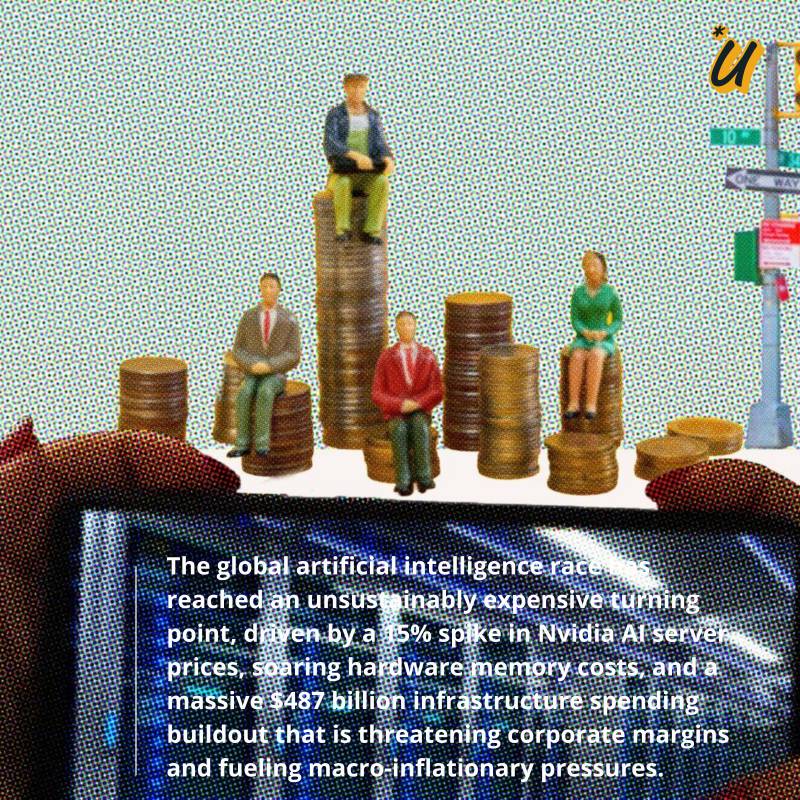
At the center of the sector's financial tension is semiconductor giant Nvidia. Ahead of its highly anticipated earnings announcement, news has emerged that major server manufacturers are actively notifying enterprise customers to expect price increases of up to 15 percent on systems powered by Nvidia's upcoming Blackwell and next-generation Rubin architecture platforms. Analysts point to skyrocketing costs for specialized high-bandwidth memory as the primary catalyst behind the hikes. With high-bandwidth memory suppliers struggling to keep pace with demand, the essential hardware required to train and run massive artificial intelligence models has become a significantly heavier financial burden for data center operators.
Despite Nvidia’s indisputable market dominance, public equity markets are displaying a rare air of caution. The company’s stock recently logged a rare seven-day losing streak as investors debate whether the sector is approaching "peak earnings" momentum. Wall Street has begun scrutinizing Nvidia’s complex financing strategies, including venture debt and partner investments designed to sustain infrastructure demand. Shareholders are increasingly questioning how long hyper-scalers can maintain their blistering pace of capital expenditure before requiring tangible returns on investment.
Concurrently, competitive pressures are mounting from below. A rising crop of AI chip startups is seeking to challenge Nvidia’s near-monopoly by offering specialized, energy-efficient silicon designed for targeted inference workloads. At the same time, Chinese technology titan ByteDance is aggressively consolidating its internal artificial intelligence resources, optimizing software frameworks and hardware allocations to reduce reliance on foreign chip architecture amid ongoing geopolitical trade friction.
Outside the United States, Asian technology conglomerates are orchestrating historic capital raises to secure their positions in the global AI hierarchy. In Hong Kong, e-commerce giant Alibaba Group Holding completed a massive $10.2 billion follow-on offering—the largest secondary transaction in the city's history. The company intends to channel the proceeds directly into expanding its cloud computing footprint, building out data center operations, and advancing its proprietary foundational large language models.
In Japan, SoftBank Group is preparing a record-breaking $6.3 billion retail bond issuance—the largest individual debt offering ever undertaken by a corporate issuer in the country. Led by Masayoshi Son, SoftBank is tapping Japanese household savings to directly bankroll its massive investment commitments to OpenAI. The record-setting debt sale underscores how non-traditional funding mechanisms are being mobilized worldwide to keep pace with the multi-billion-dollar commitments required by frontier AI developers.
As capital pours into server racks and foundation models, consumer technology companies are making difficult structural adjustments to realign their corporate focus. Apple is trimming headcount within specific units, including its Vision Pro hardware team and the legacy voice-assistant Siri division. The cuts reflect a major strategic pivot away from niche mixed-reality hardware and legacy systems toward "Apple Intelligence"—the company's suite of generative AI features engineered to integrate across its core iOS ecosystem and next-generation device pipeline.
The ongoing technology transition is also creating unforeseen friction across global labor markets. Human resources departments and enterprise recruiters report being overwhelmed by an unprecedented volume of AI-generated job applications and tailored resumes. As automated algorithms allow candidates to apply for hundreds of roles simultaneously, traditional digital screeners have become largely ineffective. To counter the flood of synthetic profiles, corporate recruiters are abandoning automated portals in favor of human-centric assessment methods, placing renewed emphasis on direct networking, verified peer recommendations, and rigorous live technical evaluations to identify authentic talent.
Meanwhile, traditional industrial challenges continue to unfold alongside the high-tech boom. Electric vehicle manufacturer Tesla is managing a sweeping recall involving millions of vehicles in China due to critical safety and software issues identified by state regulators. The recall serves as a stark reminder of the regulatory and operational hurdles facing technology companies operating across large-scale physical manufacturing and international supply chains.