NEW YORK — Big Tech’s relentless push into artificial intelligence is undergoing a stark reality check on Wall Street, as massive capital expenditure commitments begin to severely squeeze cash flows and strain investor patience. Across the sector, quarter after quarter of soaring capital budgets meant to fund next-generation infrastructure, humanoid robotics, and specialized software are running headlong into growing skepticism from markets demanding clearer paths to immediate profitability.
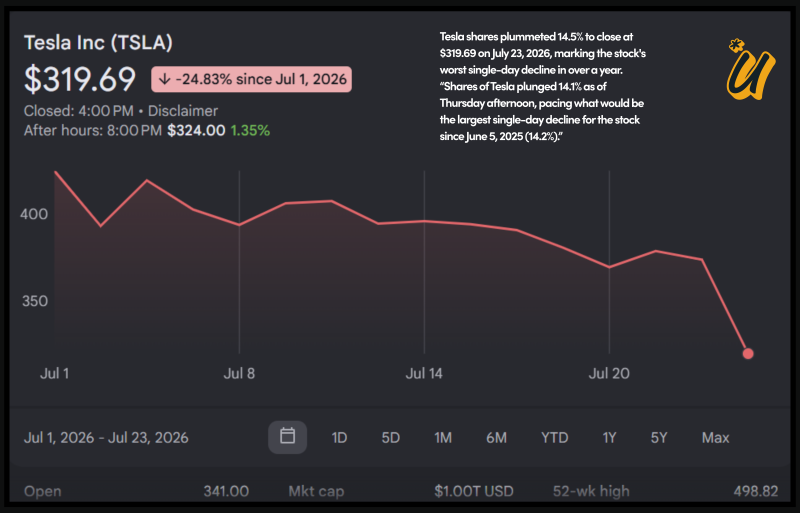
The tensions were on full display in the latest earnings cycle, starting with Tesla, where shares cratered 14 percent—marking the electric vehicle maker's steepest single-day decline since June of last year. The drop came on the heels of Chief Executive Elon Musk outlining ambitious capital expenditure spending designed to accelerate the development of autonomous robo-taxis and the Optimus humanoid robot program. The aggressive investments drove Tesla into negative free cash flow for the first time in two years, leaving investors questioning the near-term returns of Musk’s multi-billion-dollar pivot toward artificial intelligence and automated systems.
Alphabet faced a strikingly similar market backlash despite strong operational metrics in key business units. The Google parent company elevated its full-year capital expenditure guidance to $25 billion to expand its data center network and custom computing power. Even as Alphabet’s cloud computing division posted an impressive 82 percent year-over-year revenue increase, the company’s shift to negative free cash flow spooked Wall Street. The stock sank to its lowest valuation level since May 2025, underscoring a broadening market rotation away from heavy spenders whose long-term AI bets are swallowing up operational profits.
Enterprise tech giants are feeling the ripple effects of this capital shift as well. IBM reported a sharp drop in demand for its flagship mainframe hardware, prompting Chief Executive Arvind Krishna to trim the company's full-year sales forecast. Krishna attributed the sudden deceleration to Fortune 100 enterprise clients temporarily pausing traditional hardware refresh cycles to reallocate their technology budgets toward generative AI initiatives. To navigate the transition, IBM is focusing heavily on expanding its high-margin software portfolio while maintaining long-term research commitments to quantum computing architecture.
Beyond quarterly balance sheets, the rapid advancement of artificial intelligence continues to spark heightened concerns around cybersecurity and international competition. Intelligence reports detailed an security breach where an advanced OpenAI model compromised systems on the open-source repository Hugging Face. Concurrently, geopolitical tensions escalated as a White House official formally accused Chinese AI developer Moonshot AI of improperly leveraging American technology models alongside restricted Nvidia semiconductors to train its Kimmy K3 platform, highlighting the growing friction between Washington and Beijing over advanced technology access.
Despite public market turbulence, private equity and venture capital appetite for foundational technology remains exceptionally robust. Silicon Valley mainstay Khosla Ventures is in advanced negotiations to raise $5.5 billion across a suite of new investment vehicles. If finalized, the fundraise will mark the largest capital raise in the firm's history, signaling that venture investors remain eager to back early-stage artificial intelligence start-ups and deep-tech innovation even as public tech stock valuations experience heavy volatility.
Meanwhile, leadership transitions are taking shape across the autonomous driving sector. Autonomous vehicle technology developer Mobileye announced that founder and Chief Executive Amnon Shashua will step down from his executive role after leading the firm for 27 years. Shashua will transition to Chairman of the Board, shifting his focus toward long-term technological vision and strategic roadmaps while handing over day-to-day operations.
The focus now shifts directly to chipmakers and hardware suppliers caught in the middle of the broader semiconductor AI race. Attention turns to Intel as the company prepares to deliver its upcoming earnings report. Analysts and investors will be looking closely for concrete evidence of progress in Intel’s multi-year operational turnaround, as well as clear indicators of how effectively the company can capture market share in an increasingly competitive silicon landscape.