The global technology and aerospace industries experienced a monumental week of re-valuations, blowout corporate earnings, and structural testing updates, signaling a profound shifting of the guard among the world’s most powerful firms. This edition of Bloomberg Technology outlines how massive artificial intelligence capital expenditures are materializing into real corporate revenue, while concurrently driving private startup valuations to levels that challenge historical market precedents. In tandem with these Silicon Valley movements, the private aerospace sector is facing its own crosswinds as major players navigate shifting public listing targets and high stakes launchpad anomalies.
Leading the charge in the public equity markets, Dell Technologies recorded an explosive performance on Wall Street as its shares surged by more than 30%. The dramatic market rally followed an exceptional earnings report where the hardware giant’s full-year sales outlook shattered aggregate analyst estimates. This forward guidance was driven almost entirely by the relentless and accelerating enterprise demand for high-performance AI servers, which are crucial for training and deploying large language models. Underscoring the scale of this hardware buildout, Dell leadership updated its corporate forecasts to project a staggering $60 billion in AI-optimized server revenue alone for the fiscal year. The market’s reaction highlights a critical transition in the technology sector, where investor enthusiasm is moving away from speculative AI promises and toward companies that can demonstrate tangible, multi-billion-dollar backlogs and hardware shipments.
Simultaneously, the private artificial intelligence landscape witnessed a historic reorganization at the top of the valuation ladder. Anthropic closed a massive private funding round that valued the five-year-old startup at $965 billion post-money, effectively eclipsing its chief rival and ChatGPT creator, OpenAI, in total valuation for the first time. To fuel the insatiable compute requirements necessary to train its next-generation frontier models, Anthropic also finalized a massive $36 billion debt financing structure. This substantial influx of debt capital will be deployed directly toward securing long-term data center infrastructure and high-bandwidth memory pipelines. The sheer size of the valuation and its supporting debt package underscores a broader industry reality: the frontier AI race has evolved into an incredibly capital-intensive infrastructure battle where foundational model builders must operate at near-sovereign financial scale to remain competitive.
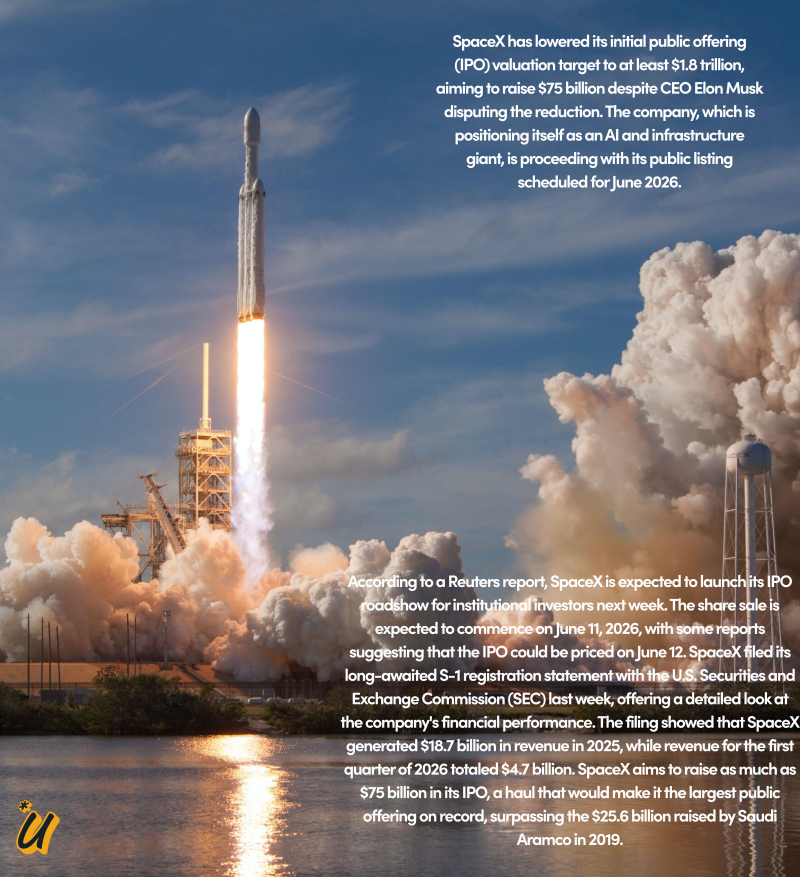
As tech companies command historic premiums, the aerospace sector is adjusting its near-term financial benchmarks against a highly volatile operational backdrop. SpaceX, which has been moving deliberately toward a highly anticipated public debut, is reportedly lowering its IPO valuation target to approximately $1.8 trillion. While this target remains a breathtaking figure that would instantly position the rocket manufacturer among the most valuable corporations on Earth, it represents a notable step down from previous internal and secondary market projections that exceeded $2 trillion. Financial analysts point out that a listing of this magnitude relies heavily on aggressive, long-term growth projections regarding global Starlink consumer adoption and deep space logistics. Furthermore, institutional investors are carefully weighing the heavy corporate influence and multi-industry commitments of founder Elon Musk, whose overarching vision remains both the central driver of the company’s premium valuation and a primary point of risk assessment.
The financial recalibrations at SpaceX coincided with a severe operational setback for its primary domestic rival in the heavy-lift launch sector. Blue Origin’s next-generation New Glenn rocket suffered a catastrophic failure during a critical hot fire test on its launch platform in Florida, culminating in a major vehicle explosion. The loss of the booster hardware presents a significant disruption for the company's immediate operational timeline, and aerospace engineers are bracing for mandatory investigation delays. Beyond the immediate corporate fallout for Blue Origin, the testing failure threatens to bottleneck the broader commercial and civil aerospace schedule. With multiple commercial satellite constellations and high-profile government payloads waiting on the commercial readiness of heavy-lift vehicles, the incident ripples through a tightly wound global launch manifest that is already struggling to meet international launch capacity demands.
These converging developments in hardware delivery, artificial intelligence capital structures, and orbital logistics are triggering a broader discussion regarding the macroeconomic outlook and the future configuration of the global workforce. As corporate expenditures pivot aggressively toward automated intelligence platforms and heavy industrial automation, market participants are closely monitoring how this rapid reallocation of capital will re-shape labor demand. The transition from legacy infrastructure toward highly integrated AI ecosystems suggests that while traditional hardware lines continue to thrive as transitional bridges, the ultimate economic premium is concentrating into centralized, super-scale computational frameworks and localized space-based infrastructure networks.