NEW YORK — The global financial and technology landscapes experienced a tectonic shift on Thursday as a highly anticipated public debut collided with mounting questions over the true cost of the artificial intelligence boom. According to a comprehensive broadcast from Bloomberg Technology, the market is navigating a complex intersection of historic space exploration valuations, sharp enterprise software corrections, and emerging macroeconomic pressures driven by the insatiable demand for tech hardware.
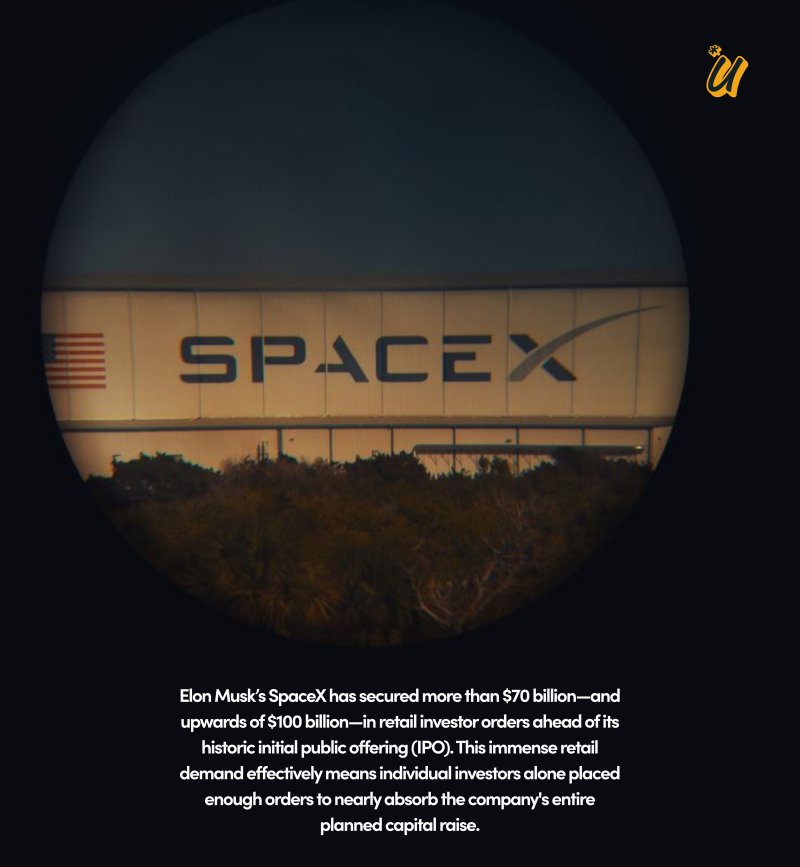
At the epicenter of the day’s market activity was the landmark initial public offering of SpaceX, an event that market analysts are already classifying as a generation-defining financial milestone. In an unprecedented show of market enthusiasm, the aerospace giant generated more than $70 billion in retail demand alone, signaling an extraordinary appetite from everyday investors looking for a piece of the commercial space frontier. The mechanics of the listing themselves raised eyebrows across Wall Street, as SpaceX entirely bypassed the traditional, variable IPO price-range process. Instead, the company confidently set a fixed debut price of $135 per share. With only about 4% of the total shares available in the public float, this restricted supply met a colossal wall of capital from both retail enthusiasts and heavyweight institutional players, including asset management giant BlackRock. Financial experts speaking on the broadcast warned that this severe supply-demand imbalance is a prime recipe for extreme near-term volatility, with many anticipating a massive "pop" once secondary trading officially commences.
Beyond the immediate trading frenzy, the long-term investment thesis for SpaceX highlights how deeply the company has integrated itself into the broader tech ecosystem. Far from being a simple rocket launch provider, the company has evolved into a powerhouse hybrid operating across aerospace, telecommunications, and AI infrastructure. Analysts noted that the bedrock of SpaceX’s future valuation rests on the success of its massive Starship launch system. By drastically lowering the cost per kilogram to orbit, Starship is no longer viewed just as a vehicle for lunar or Martian travel, but as the critical enabler for ambitious, orbital data center projects designed to handle the next generation of heavy AI workloads.
However, the immense capital required to build out this futuristic infrastructure is already causing friction down on Earth, as evidenced by a dramatic sell-off in the enterprise tech sector. Oracle Corporation bore the brunt of this anxiety, enduring its worst single-day trading performance in six months. Shares of the database and cloud giant plummeted approximately 12% following disclosures of higher-than-expected capital expenditures earmarked for AI data centers. The sudden spike in spending triggered immediate concerns across trading desks regarding near-term corporate profitability. Market commentators emphasized that Oracle's aggressive buildout highlights a broader industry dilemma, signaling that even established tech titans may need to rely heavily on further debt or equity financing to stay competitive in the escalating AI arms race.
This frantic corporate spending is beginning to ripple out into the broader economy, sparking fresh concerns about inflation. Bloomberg reports indicate that the explosive demand for high-end memory chips and hardware components required to support global AI infrastructure is directly driving up technology hardware prices. This localized surge in manufacturing and component costs is no longer just a tech industry problem; economists note it has the potential to add an estimated 0.4 percentage points to headline inflation, complicating the macroeconomic outlook and adding pressure to supply chains that are already stretched to their limits.
Despite these macroeconomic headwinds, the practical application of AI continues to accelerate at the corporate level, moving away from theoretical models and into consumer-facing reality. Highlighting this shift, Gopuff Co-CEO Rafael Ilishayev detailed his company’s strategic partnership with SpaceX’s AI arm, utilizing the Grok model to develop a highly sophisticated, AI-driven shopping assistant. In discussing the deployment, Ilishayev emphasized that the collaborative model offered by SpaceX AI proved to be remarkably cost-effective compared to standard enterprise solutions from rival developers like OpenAI and Anthropic. This move underscores a growing trend of consumer platforms seeking tailored, economically viable AI partnerships to drive digital efficiency.
Offering a broader macroeconomic perspective on these overlapping trends, Seven Seven Six founder Alexis Ohanian spoke from the SuperReturn conference in Berlin to contextualize the current market psychology. Ohanian observed that while much of Wall Street is currently operating on a consensus-driven hype cycle regarding AI investments, the underlying technological transition is profoundly real. He argued that the current technological shift is fundamentally different in scale, depth, and utility from the previous social media or mobile revolutions, suggesting that despite temporary market corrections and inflationary bumps, the restructuring of global computing architecture is an irreversible shift that will define the coming decade.