NEW YORK — The global technology landscape reached extraordinary milestones and faced intense geopolitical scrutiny today as a massive wave of artificial intelligence infrastructure spending reshuffled the world’s financial hierarchy. In a sweeping transformation of the global tech sector, the foundational components of the digital economy—from microchips and high-bandwidth memory to orbit-bound spacecraft and corporate software suites—are consolidating into an unprecedented infrastructure boom. The implications are stretching across international borders, transforming corporate productivity, and forcing Wall Street to completely reevaluate how the physical and digital worlds intersect.
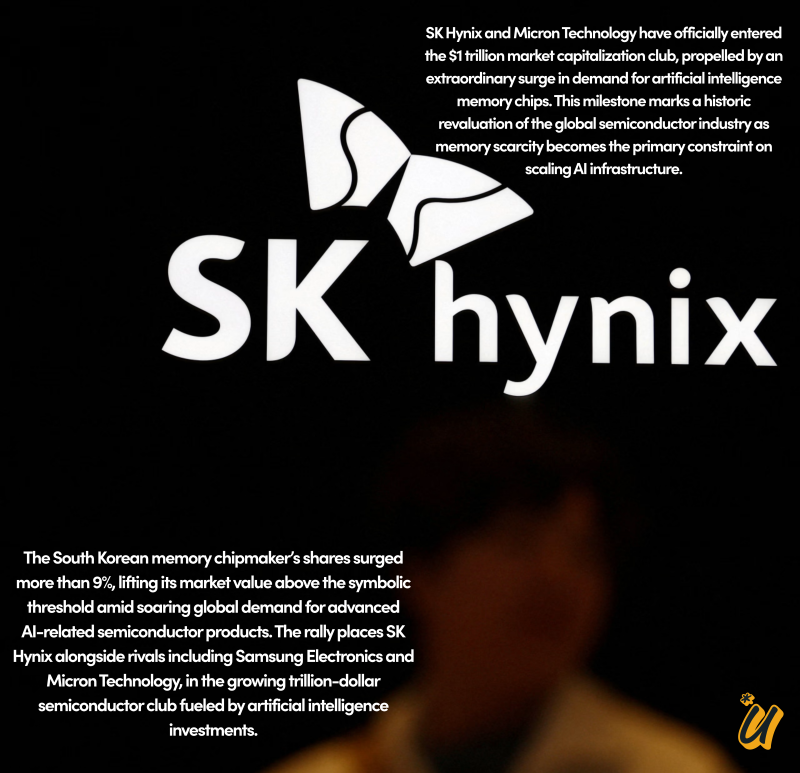
At the epicenter of this shift is an astonishing surge in the semiconductor sector that has permanently altered the global market cap leaderboard. Memory manufacturing giants Micron and SK Hynix have officially joined the exclusive $1 trillion market cap club, an achievement that underscores the insatiable global appetite for high-bandwidth memory. Analysts note that while logic processors and specialized graphics units have historically commanded the media spotlight, high-bandwidth memory has quietly emerged as the ultimate physical constraint and most critical prerequisite for artificial intelligence infrastructure. Without this advanced memory hardware, the massive computational clusters required to train and run next-generation generative models simply cannot function. The sheer volume of orders from cloud providers and hyperscalers has driven exponential revenue growth for these memory manufacturers, cementing their status as indispensable cornerstones of the modern technological age.
This unprecedented valuation milestone arrived even as public equities experienced a brief, volatile pullback. Yet market experts remain overwhelmingly unfazed by the short-term turbulence. Observers and analysts emphasize that despite temporary macroeconomic headwinds and fluctuations in day-to-day trading sentiment, the fundamental underlying financial health of these memory stocks remains incredibly robust. The institutional confidence backing this sector was on full display today as major financial institutions, including UBS, moved aggressively to raise their price targets for these hardware giants. Wall Street's upward revisions signal a widespread consensus that the semiconductor boom is not a fleeting trend or a speculative bubble, but rather a structural realignment of the global economy around physical AI capacity.
However, the immense strategic value of this hardware has simultaneously escalated geopolitical friction to a fever pitch. In a development that highlights the fragile state of global tech distribution, Taiwanese prosecutors have launched a formal, high-stakes investigation into allegations that restricted Nvidia chips are being illicitly smuggled into China via Japan. The probe exposes the extreme difficulty of policing global supply chains in an era defined by aggressive international export controls. As governments increasingly treat high-performance silicon as a matter of national security, the alleged evasion tactics underscore a growing underground market for restricted tech. Industry experts point out that these tightening regulatory clampdowns and geopolitical anxieties are introducing severe friction into international trade, forcing multinational technology firms to completely reengineer their logistics and compliance frameworks to avoid severe legal and political penalties.
While terrestrial supply chains face regulatory gridlock, the physical frontiers of technology are rapidly expanding into orbit. SpaceX’s successful Starship flight test has sent shockwaves through both the aerospace and technology sectors, sparking an entirely new conversation about the future of global communications. Far from being viewed merely as a vehicle for deep-space exploration or specialized scientific endeavors, the massive rocket platform is now being recognized as a critical mechanism for deploying global infrastructure. Prominent tech visionaries, including XPRIZE founder Peter Diamandis, note that SpaceX is actively evolving into an unprecedented network provider for planetary-scale AI compute and communication systems. The ability to launch payloads of monumental size and frequency unlocks the potential for space-based data centers and hyper-efficient satellite communication networks that could soon bypass traditional terrestrial limitations entirely.
This orbital expansion has also fueled intense speculation regarding the long-term corporate trajectory of Elon Musk’s industrial empire. Financial strategists are increasingly discussing the high probability of a future merger between SpaceX and Tesla. According to market analysts and industry insiders, such a massive corporate consolidation would serve a profound strategic purpose: uniting cutting-edge robotics, planetary energy systems, autonomous transport, and orbital satellite networks under a single, highly centralized banner. A unified entity of this magnitude would effectively control a global, end-to-end infrastructure network, seamlessly merging physical hardware, space-based communications, and autonomous machine learning systems into a monolithic ecosystem capable of dominating multiple global industries simultaneously.
Back on earth, the economic realities of artificial intelligence are hitting enterprise software and corporate boardrooms with equal velocity, transitioning rapidly from theoretical potential to massive commercial viability. Cognition AI has stunned the venture capital world by closing a massive $1 billion funding round, catapulting the software firm to a staggering $26 billion valuation. The primary driver behind this astronomical valuation is Devon, Cognition’s autonomous AI coding agent. Unlike early-stage software tools that merely offer predictive autocomplete functions, Devon operates as a fully realized digital engineer capable of executing complex development cycles independently. The autonomous agent is already generating a massive, highly lucrative revenue run rate, providing concrete, undeniable evidence that advanced software automation is delivering immediate, high-margin commercial returns rather than just speculative future value.
This shift toward demanding tangible financial results is casting a long shadow over the broader enterprise software sector as Wall Street prepares for major earnings reports. Tech giants Salesforce and Snowflake are both scheduled to step into the earnings spotlight, and analysts are approaching their financial disclosures with an increasingly critical eye. Market experts warn that institutional investors are no longer satisfied by vague corporate rhetoric, pilot programs, or marketing hype centered around artificial intelligence. Instead, the market is demands definitive, quantifiable proof that AI integrations are translating directly into accelerated subscription growth, expanded enterprise contracts, and actual, top-line revenue expansion. The upcoming reports are widely viewed as a critical litmus test that will separate companies capable of monetizing the AI shift from those merely riding the coat-tails of industry trends.
Ultimately, this wave of digital automation is poised to trigger a profound restructuring of the global workforce and corporate operational frameworks. In the financial sector, banking executives are preparing for sweeping changes in how institutions manage human capital. Industry leaders, including Iqbal Khan of UBS APAC, indicate that the widespread implementation of advanced AI agents is projected to exponentially increase workplace productivity and operational capacity. Rather than triggering immediate, widespread layoffs, the technological shift is expected to fundamentally reshape institutional hiring practices and internal efficiencies. Corporations will increasingly prioritize tech-literate talent capable of auditing and orchestrating complex autonomous workflows, ushering in an era where organizational capacity is measured not by head count, but by the seamless integration of human intelligence and enterprise-grade automation.