Global technology markets experienced a profound shudder as a sudden wave of reality-checking triggered a massive, multi-continental sell-off in high-growth equities. The long-running, euphoric momentum surrounding the artificial intelligence trade ran headfirst into a wall of investor skepticism, sending shockwaves through both public and private markets alike. Analysts are widely characterizing the day's dramatic downturn as a long-overdue wake-up call regarding the actual monetization timeline and capital expenditure sustainability of the generative AI boom.
The epicenter of the market rout began overnight in Asia, where a brutal decline in leading South Korean semiconductor manufacturers set a grim tone for the global trading day. Heavyweights Samsung Electronics and SK Hynix, both foundational linchpins of the global AI hardware supply chain due to their dominant production of high-bandwidth memory chips, bore the brunt of the initial liquidations. As trading migrated westward, the panic proved contagious. In New York, the technology-heavy Nasdaq 100 index plunged sharply alongside specialized semiconductor indices, wiping out billions of dollars in market value within the opening hours of trading. For months, investors have piled unthinkingly into any enterprise associated with AI infrastructure, but the sudden downward pressure signals an aggressive pivot toward risk aversion. Market participants are increasingly demanding concrete revenue metrics rather than speculative, long-term projections of compute demand.
Yet, even against this backdrop of public market volatility, tech giants and ambitious private enterprises are aggressively raising capital to cement their positioning in the next phase of the industrial landscape. Amid a punishing three-day rout for tech stocks, Elon Musk’s SpaceX executed a highly sophisticated financial maneuver, launching a massive 20 billion dollar debut bond sale. Rather than retreating in the face of macro headwinds, the aerospace giant is exploiting the market dislocation to aggressively refinance existing high-interest debt and secure an insulated war chest. The historic debt offering is strategically designed to fuel the company's capital-intensive, multi-front expansion. Proceeds are earmarked to accelerate the global deployment of its Starlink satellite internet constellation, bank herculean deep-space exploration initiatives, and deeply fund its own burgeoning internal AI and autonomous computation systems.
While public market traders agonize over hardware valuations, corporate leadership teams are focused on translating AI from software novelties into physical, industrial productivity. This pivotal transition is shifting the narrative away from simple consumer chatbots toward complex factory-floor applications. Siemens Chief Executive Officer Roland Busch emphasized that the true economic revolution of artificial intelligence lies in what the company defines as industrial AI. Unlike the generative models that summarize text or produce digital art, industrial AI is being deployed directly into heavy manufacturing, logistics, and engineering environments to enhance precision and operational throughput. According to Busch, integrating these systems allows factories to autonomously optimize energy consumption, predict machine failures before they occur, and design complex physical architectures with unprecedented engineering accuracy, fundamentally altering global supply chain economics.
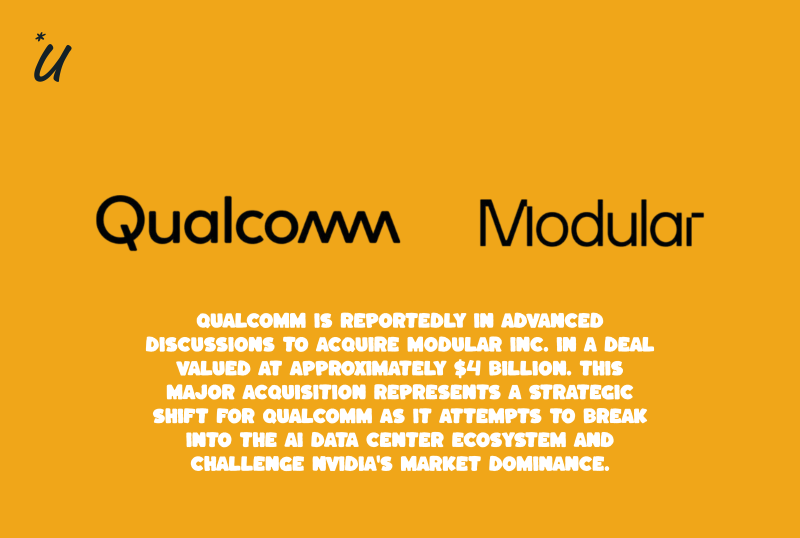
The frantic corporate scramble to secure dominant positions in this evolving landscape is also accelerating a consolidation phase among software layers, particularly in the realm of AI inference. Reports surfaced that silicon giant Qualcomm is currently in advanced negotiations to acquire the highly regarded AI software infrastructure startup Modular in a blockbuster transaction valued at approximately 4 billion dollars. Founded by prominent former Google infrastructure engineers, Modular has gained immense traction through its MAX framework and Mojo programming language, which allow complex AI models to run efficiently across disparate hardware architectures. For Qualcomm, this acquisition represents a massive, strategic shot across the bow of market leader Nvidia. By absorbing Modular's software stack, Qualcomm aims to secure the compiler and inference tools necessary to make its own data center and edge processors less risky and more appealing to corporate developers looking to break free from proprietary software ecosystems.
This high-stakes arms race is simultaneously mirroring a significant structural evolution within the private venture capital ecosystems that fund early-stage innovation. Venky Ganesan, a prominent partner at Menlo Ventures, revealed that the firm has successfully closed a historic 3 billion dollar fund dedicated exclusively to backing the next generation of artificial intelligence startups. Celebrating its fiftieth anniversary, the firm’s massive capital raise underscores the fact that while public market equities may experience cyclical corrections, institutional conviction in foundational AI remains absolute. Ganesan outlined a distinct barbell investment strategy that Menlo Ventures is deploying to navigate this volatile climate. This dual approach focuses capital intensely on two opposite ends of the corporate growth spectrum: identifying raw, early-stage potential at the seed level where disruptive ideas are born, while concurrently writing massive, high-conviction checks to support the scaling of proven category leaders that have demonstrated clear product-market alignment.
Concurrently, the consumer-facing side of the technology sector is witnessing a massive, direct confrontation over the hardware form factors that will inevitably replace or supplement the smartphone. Meta Platforms is aggressively escalating this battle by preparing to launch its own independent brand of consumer smart glasses. This strategic pivot marks a major departure from Meta's previous hardware roadmap, which relied heavily on co-branding partnerships with luxury eyewear giants like Ray-Ban and Oakley. By bringing the manufacturing and branding entirely under its own corporate umbrella, Meta aims to bypass external design constraints and deliver an entry-level, highly accessible product to the mass market. This fashion-forward wearable is engineered to hit a substantially lower price point, a critical move intended to catalyze widespread consumer adoption and embed Meta's ambient, voice-driven AI assistants directly onto the faces of millions of everyday users worldwide.