The high stakes battle for Warner Bros. Discovery (WBD) escalated significantly when Paramount Skydance launched a hostile, all-cash bid for the entire company, days after WBD had begun talks on a different offer from Netflix. On Bloomberg Technology, co-hosts Caroline Hyde and Ed Ludlow dissected the competing offers, regulatory hurdles, and future of the entertainment landscape, emphasizing that this conflict is forcing a decision between traditional media consolidation and streaming-first dominance.
The complexity of the situation, according to Ed Ludlow, is rooted in the divergent deal structures. Paramount Skydance’s hostile bid came in at $30 per share for the entirety of Warner Bros. Discovery, immediately following Netflix’s offer of $27.75 a share. The Netflix offer was largely for WBD’s streaming and studio businesses, with a plan for WBD to divest and spin off its remaining legacy cable units. While the Paramount bid looks superior at $30 cash, analysts on Bloomberg Technology estimate that the Netflix deal has a superior effective value, potentially reaching $31 or $32 a share once the value of the cable network stub equity is factored in, which the Street values at $3.5 to $4 per share. Paramount, in contrast, valued that cable unit at only $1 per share in its own presentation.
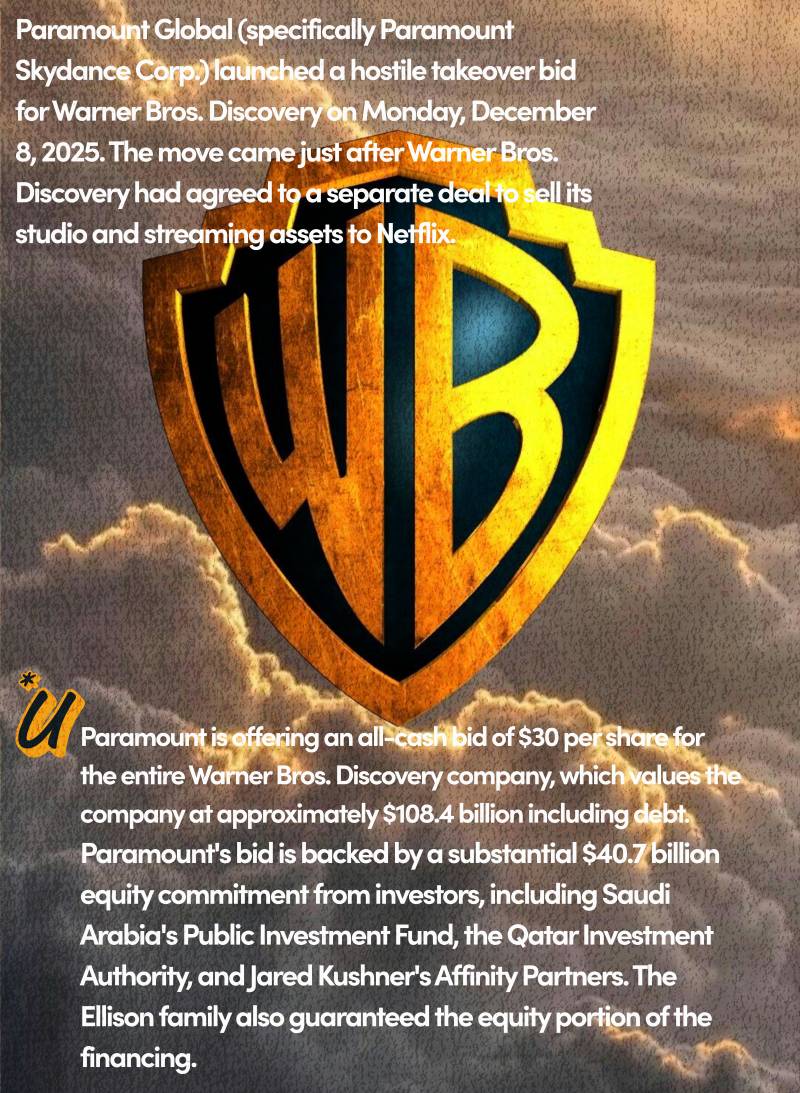
Caroline Hyde focused on the "attitude to go hostile" and the money backing the aggressive Paramount bid. Paramount Skydance has made six previous attempts to buy WBD, all of which were rejected. David Ellison returned with the same rejected bid, adamantly believing their offer is superior to Netflix’s, arguing the WBD board is confusing the valuations on cable networks. Caroline Hyde also noted the shift in financing, with Middle Eastern money coming to the fore, which Lucas Shore confirmed involves three prominent Middle Eastern sovereign wealth funds. Larry Ellison is writing a $12 billion check, but three Middle Eastern entities are collectively investing $24 billion, making them the largest equity contributor group to the deal. This foreign financing complicates the bid, as WBD views it as potentially triggering a review by CFIUS (Committee on Foreign Investment in the U.S.), making Paramount’s argument for an easier path to approval questionable.
The type of company created under each scenario is fundamentally different, a point highlighted by Ed Ludlow. A Paramount-WBD combination would involve "more redundancies" and overlap, combining two traditional film and TV companies with streaming services tacked on, positioning Paramount as a "top three contender" in media. Conversely, Netflix, being a "streaming first at all costs company," offers less overlap and more new integration of potentially complementary businesses. Netflix getting WBD's streaming assets would make the already biggest player in Hollywood streaming even stronger by adding HBO and Warner Brothers content.
Antitrust concerns loom over both bids. Ed Ludlow referenced a weekend report detailing a meeting between the Netflix co-CEO and the President, who later stated that the Netflix bid would need to be reviewed from an antitrust perspective because of its "big market share". As Caroline Hyde noted, this raises questions about the level of control Netflix might have.
Analysts explained that the Department of Justice tends to define markets narrowly, which could pose a problem for Netflix because their combined share of streaming would be large. However, analysts also pointed out that the combined share of total TV viewing for either acquiring company would still be smaller than YouTube. Rich Greenfield of Light shed Partners noted that the core question is whether investors prefer Netflix's powerful algorithm, which can "surface content" currently "sitting on HBO Max and no one’s watching it," or Paramount’s strategy of ingesting rapidly declining cable network assets for scale. The consensus on Bloomberg Technology is that no matter who the buyer is, a likely year-long investigation is expected.