TAIPEI — The landscape of the global technology sector is undergoing a massive structural shift, driven by a series of high-stakes announcements at the Computex conference that have effectively rewritten the rules for personal computing, artificial intelligence, and corporate valuations. At the center of this transformation is Nvidia, whose latest strategic maneuvers are sending shockwaves through Silicon Valley and Wall Street alike. By aggressively pushing beyond its traditional stronghold in data centers and high-end graphics cards, the company is positioning itself to dismantle the long-standing duopoly that has defined consumer computing for decades, while simultaneously signaling the dawn of an entirely new era of software interaction.
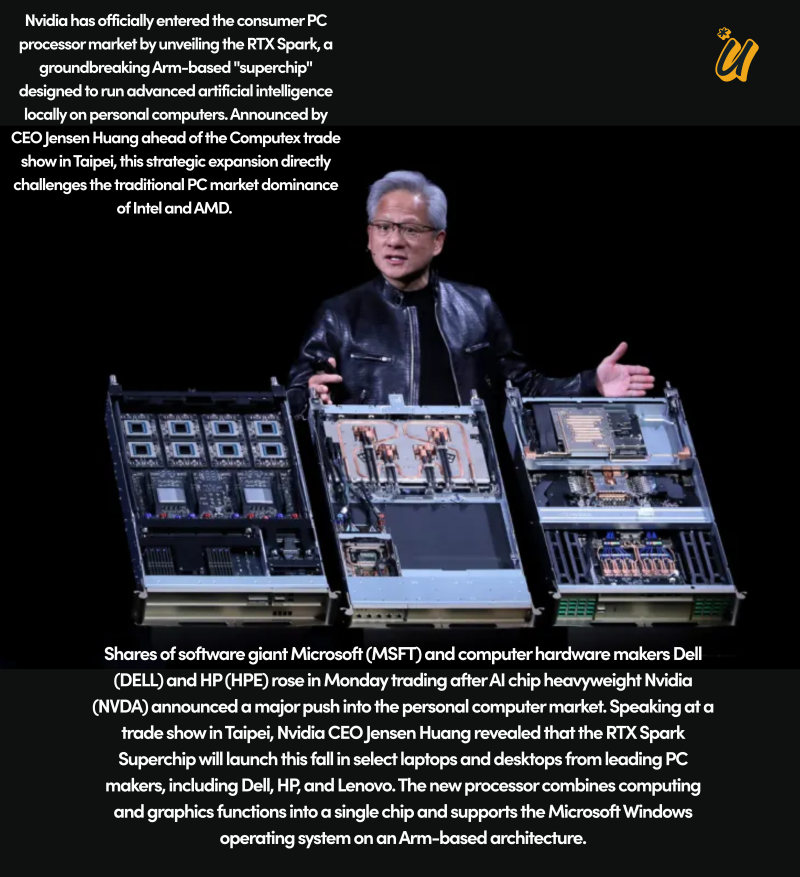
Nvidia Chief Executive Officer Jensen Huang used the global stage at Computex to unveil the RTX Spark, a highly anticipated artificial intelligence super chip designed specifically for personal computers. Built on an advanced ARM architecture, the new processor represents a direct, collaborative partnership with MediaTek, a move specifically engineered to challenge the traditional market dominance of Intel and Advanced Micro Devices in the laptop and desktop sectors. By optimizing ARM-based architecture for consumer PCs, Nvidia is making a calculated play for efficiency and processing power optimized for heavy AI workloads. The hardware is designed to shift the industry standard by enabling advanced, highly complex artificial intelligence capabilities directly on consumer devices, reducing the reliance on cloud computing and changing how everyday users interact with their hardware.
This hardware evolution is directly tied to a broader philosophical and economic pivot regarding how software is consumed. Huang emphasized that the technology industry has officially crossed the threshold into what he termed the "agentic age." Under this paradigm, billions of independent AI agents are projected to become the primary users of software, executing complex, multi-step workflows with minimal human intervention. Contrary to widespread fears that automation will eliminate technical roles, the Nvidia executive argued that the proliferation of these digital agents will actually drive an unprecedented surge in demand for human software engineers, ultimately fueling broader industry growth as organizations rush to build, maintain, and oversee these vast agentic networks.
As the underlying architecture of consumer technology evolves, the financial world is concurrently bracing for a monumental shift driven by the private aerospace sector. Anticipation surrounding a potential public market debut for SpaceX is rapidly reshaping traditional Wall Street mechanics. With institutional estimates putting a potential valuation for Elon Musk’s aerospace firm near two trillion dollars, the sheer scale of the company has forced major global index providers to reconsider long-standing protocols. In an unprecedented move, major index providers are currently adjusting their internal rules to allow for a significantly faster inclusion of such massive, high-impact companies into benchmark indices like the Nasdaq 100 and the FTSE, reflecting an urgent need for public market structures to adapt to modern mega-cap tech entities.
Closer to the ground, regional technology hubs are capitalizing on this wave of artificial intelligence capital, with New York City emerging as a primary beneficiary. Speaking on the city’s thriving tech ecosystem, TechNYC Chief Executive Officer Julie Samuels noted that the metropolis is experiencing a unique boom by successfully integrating advanced technology into its deeply rooted legacy sectors. Rather than focusing solely on foundational AI research, New York’s strategy centers on deploying these new technical capabilities directly into established, high-value industries like finance, insurance, and healthcare, cementing the city's position as a practical application powerhouse for next-generation software.
While software application dominates immediate corporate integration, the frontier of physical artificial intelligence is facing an entirely different set of operational hurdles. Amit Jain, the Chief Executive Officer of Luma AI, highlighted the profound technical challenges currently facing the robotics industry, particularly the difficulty of achieving true generalization. Most contemporary robotic systems remain limited to highly specific environments, requiring bespoke programming for isolated tasks. To overcome this limitation, Jain emphasized the critical importance of developing open-science physical AI labs, which would allow researchers to share foundational datasets and collectively build versatile systems capable of performing a wide variety of physical tasks without needing custom training or specialized adjustments for every new scenario.
Beyond the overarching themes of AI and aerospace, several tech giants are executing quieter, highly tactical maneuvers to capture shifting consumer markets. Apple is reportedly setting its sights on the eyewear market, utilizing a strategic playbook remarkably similar to the one it deployed during its highly disruptive entry into the mechanical watch market years ago. By targeting the premium and mid-tier eyewear segments with integrated technology, the Cupertino-based company aims to displace established incumbent brands and redefine wearable hardware.
Simultaneously, Amazon is leaning heavily into its logistical infrastructure to solve the notoriously difficult puzzle of online grocery retail. The e-commerce pioneer is aggressively leveraging its same-day delivery network in tandem with its physical Whole Foods locations to expand its footprint in the grocery market, attempting to merge fast-shipping digital efficiency with brick-and-mortar fresh food supply chains. Meanwhile, in a bizarre twist of digital-era market dynamics, legacy technology firm IBM experienced a notable stock rally driven not by a traditional earnings report, but by the viral circulation of old political clips across social media platforms, proving that algorithmic trend cycles can move modern public equities just as easily as fundamental corporate announcements.