The global technology landscape is experiencing a massive wave of transformation, driven by high-stakes artificial intelligence integration, aggressive semiconductor partnerships, and monumental capital market movements. In a comprehensive broadcast of Bloomberg Technology, co-hosts Caroline Hyde and Ed Ludlow mapped out the critical shifts defining the industry, ranging from Apple’s impending software revolution to unprecedented moves in the private and public markets. As Wall Street and Silicon Valley increasingly intersect, the decisions made by a handful of tech giants are poised to dictate the trajectory of consumer electronics, artificial intelligence infrastructure, and space exploration for years to come.
At the absolute forefront of the tech conversation is Apple’s highly anticipated Worldwide Developers Conference, where the consumer electronics titan is expected to unveil a sweeping overhaul of its ecosystem. For years, Apple has faced mounting criticism for falling behind in the generative artificial intelligence race, but industry insiders suggest the company is preparing a definitive response. According to veteran tech journalist Mark Gurman and leading industry analyst Carolina Milanesi, Apple’s strategy hinges on transforming Siri from a basic, often frustrating voice-command tool into a sophisticated, multi-step task-oriented co-pilot. This next-generation version of Siri will be deeply woven into both iOS and macOS, capable of executing complex workflows across multiple applications without manual user intervention.
To power this ambitious AI evolution, Apple is reportedly looking beyond its own walls, exploring partnerships to integrate advanced external models, including Google's Gemini. However, the true differentiator for Apple will not just be the intelligence of its virtual assistant, but how that intelligence is delivered. Analysts emphasize that Apple is betting heavily on its historical stronghold: privacy. By utilizing on-device processing for everyday tasks and deploying a highly secure, private cloud infrastructure for more complex AI computations, Apple aims to convince a data-weary public that it can deliver cutting-edge generative AI without compromising personal security.
This technological leap has generated a massive wave of excitement throughout the software development community. Independent developers, including prominent iOS educator Paul Hudson and the creators of the inclusive planning app Tiimo, expressed immense optimism about the potential new AI toolsets. For developers, deeper and more intuitive Siri integration means they can build apps that are more accessible, streamlined, and context aware. The team at Tiimo highlighted how these advancements could radically improve user planning experiences, transforming apps from passive tools into active, intelligent assistants that anticipate human needs.
While Apple aims to dominate the user interface, the physical infrastructure required to power the global AI boom is triggering intense geopolitical and corporate jockeying in the semiconductor market. In a major strategic development, Nvidia has finalized a multi-year partnership with South Korea’s SK Hynix to focus strictly on next-generation high-bandwidth memory chips, which are absolutely vital for training complex AI models. Bloomberg’s Ian King noted that this alliance places immense, immediate pressure on competitors like Samsung, which has been scrambling to secure its own dominance in the AI memory space. The partnership underscores a shifting reality in tech hardware: data processing speed is no longer just about the graphics processing unit itself, but how fast memory chips can feed data into those processors.
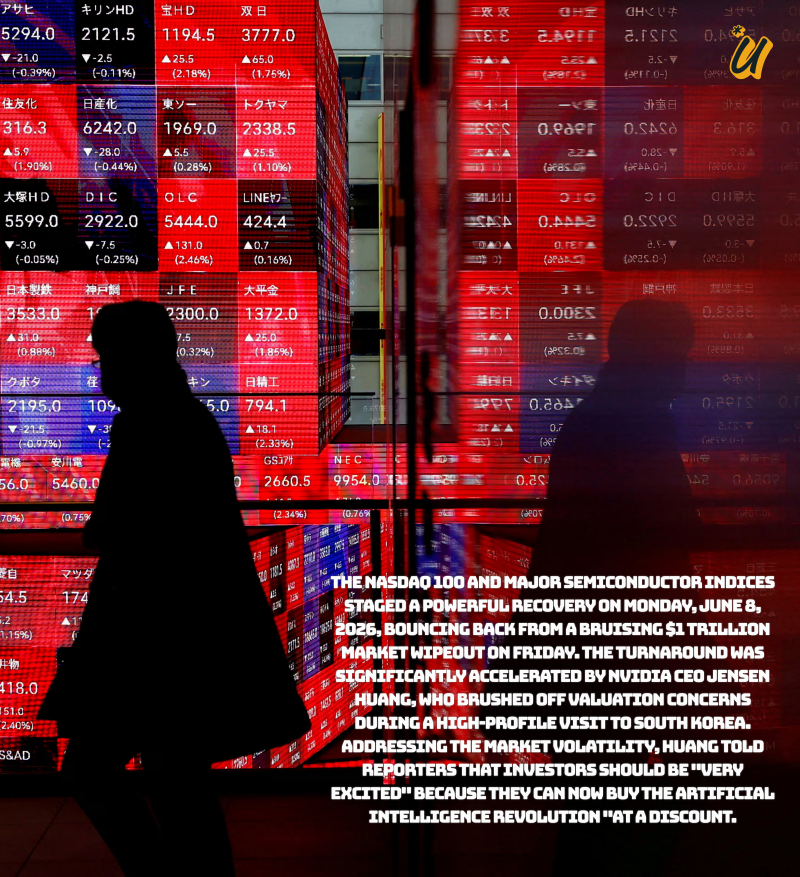
The financial stakes of this hardware race were mirrored in the broader public markets. Following a brutal, widespread sell-off that rattled tech stocks, the NASDAQ 100 and key semiconductor indices staged a powerful, resilient recovery. The market rebound was further energized by Nvidia CEO Jensen Huang, who publicly encouraged investors to look past short-term volatility and "buy the dip," reflecting an unwavering institutional confidence in the long-term profitability of the artificial intelligence buildout.
Simultaneously, the private markets are preparing for what could be one of the most significant financial events in tech history. SpaceX is rapidly gearing up for a record-breaking 75-billion-dollar initial public offering scheduled for later this week. Demand for the offering has completely overwhelmed supply, leaving the IPO heavily oversubscribed. Interestingly, institutional investors are looking far beyond SpaceX’s core competency of rocket launches and satellite deployments. Instead, the massive influx of capital is driven by a shared belief in Elon Musk’s broader, interconnected vision, which positions SpaceX’s massive Starlink network as a foundational pillar for future global AI and computing infrastructure.
As standard tech empires expand, unusual corporate and legal sagas continue to unfold in the background. In the digital media and utility space, Bending Spoons, the Milan-based app developer responsible for high-profile acquisitions like Evernote and Meetup, is aggressively moving toward a United States IPO. Following an exceptionally strong financial quarter, the European tech powerhouse is looking to cross the Atlantic to tap into the deeper liquidity of American public markets. Meanwhile, in the legal sphere, the spectacular collapse of the crypto empire continues to echo, as reports surface regarding former FTX co-founder Sam Bankman-Fried’s highly controversial, behind-the-scenes efforts to secure a presidential pardon from his historical fraud conviction.
From the code written by independent app developers to the silicon forged in Asian foundries, and stretching all the way into orbital satellite networks, the boundaries of tech are expanding at an exponential rate. The insights compiled by Hyde and Ludlow paint a picture of an industry operating at peak velocity, where capital is abundant, competition is fierce, and the lines between consumer software, infrastructure, and cosmic exploration are permanently blurring.