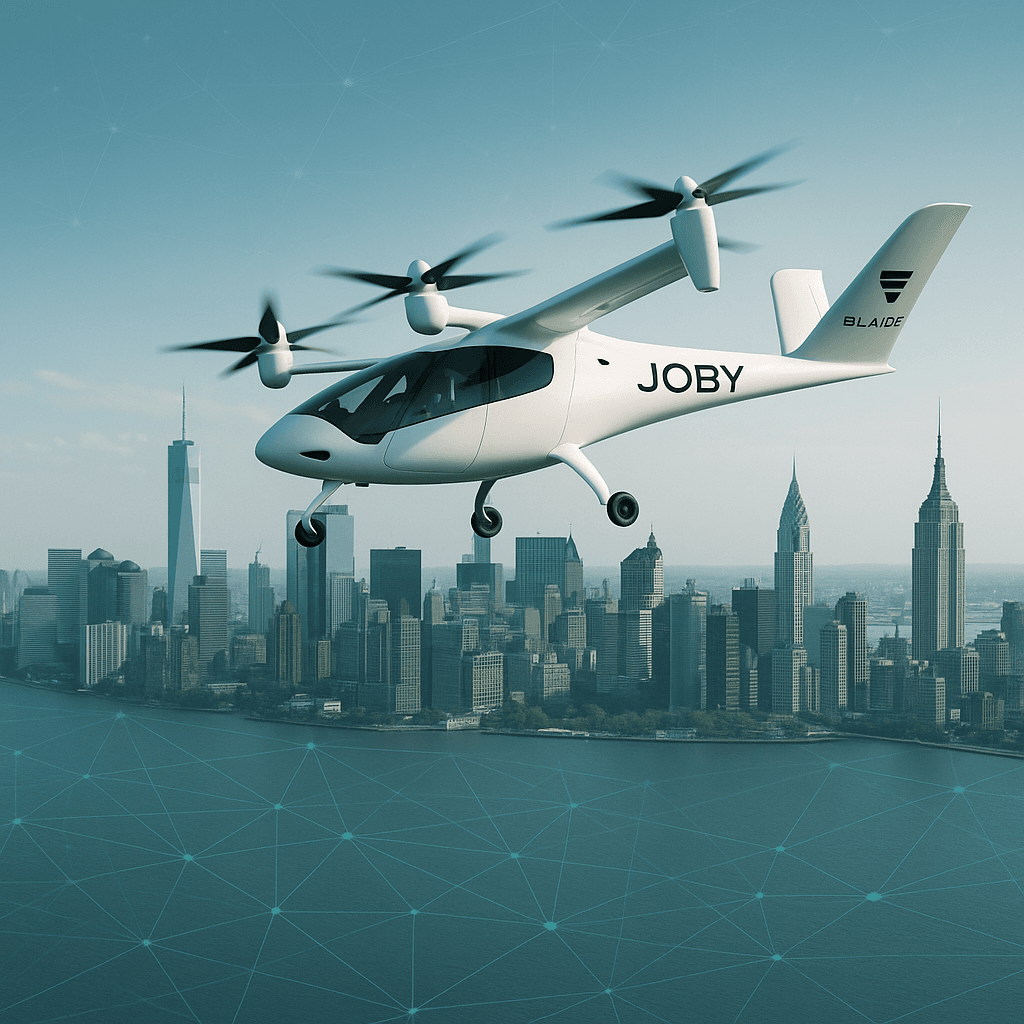
Jettison yourself into this: aerial dreams lifting off from taxiways and boardrooms alike. In a bold turn of industry choreography, Joby Aviation, the eVTOL trailblazer under CEO JoeBen Bevirt, has struck a deal that reads like a strategic remix of future-forward ambition and present-day infrastructure. The company is set to acquire Blade Air Mobility’s helicopter ride-share passenger business for up to $125 million, a move that will breathe instant life into Joby’s commercial aspirations.
But this is not just another M&A announcement. It’s a metamorphosis.
Joby is purchasing more than just Blade’s routes—it’s taking over its 12 urban terminals and lounges: from JFK and Newark to Manhattan’s West Side, East Side, and Wall Street, and even extending into Southern Europe. These physical footholds offer a runway for Joby’s eVTOLs to take off—a profoundly acute shortcut for a company racing against time, regulation, and the competition.
The past decade has seen Blade carve out an urban air mobility niche, ferrying over 50,000 passengers in 2024 alone via a sleek digital platform that coordinates third-party helicopters—no fleet, just logistical finesse. Joby recognizes that heritage. In Bevirt’s words, this acquisition is “strategically important”—a leap, not just to acquire assets, but to graft Blade’s experience and customer ecosystem onto Joby’s vision of quiet, electric city-to-city flight.

Related article - Uphorial Sweatshirt
Bloomberg Tech
The story deepens, however, when we look at Blade’s remaining focus. The company’s medical transportation arm, responsible for life-critical organ deliveries, stays independent and will rebrand as Strata Critical Medical. This carve-out ensures that ambition doesn’t eclipse mission. Meanwhile, Joby will serve as the preferred VTOL partner to Strata wherever its mission overlaps.
Pause a moment and consider the persona at the center: JoeBen Bevirt. A serial inventor and entrepreneur, holding over 160 patents and a storied past of tinkering in aerodynamics, eVTOL design, and propulsion systems. His narrative has always been one of creating quietly revolutionary tech. But here, he's not only solving the engineering puzzle—he’s weaving value with operational skin in the game.
What unfolds is a narrative of transformation: Blade’s legacy of digital-first, helicopter-enabled familiarity meets Joby’s pending quiet electric updraft. For customers—those accustomed to helicopter terminals and app-based bookings—it’s a familiar roadmap. But underneath lies a seismic shift: from noisy rotors to silent eVTOLs, from fossil fuel to electric. Joby will soon launch its commercial operations in Dubai, with global ambitions fuelled by this Blade backbone.
Financially, the deal carries structure and caution. Up to $125 million, with $35 million held back pending performance milestones and key employee retention—smart, measured, future-looking. Also worth noting: Blade’s medical business remains a public entity with strong fundamentals, and Joby’s stock reacted warmly—Joby shares soared ~17%, while Blade’s ticked up 27% on the news.
But let’s return to what makes writing—and businesses like this—feel alive. It’s not just strategy; it’s a leap of faith. Bevirt betting Blade’s infrastructure will serve as the launchpad not just for electric aircraft, but for an entirely new urban rhythm. It’s a writer’s delight: the collision of disruptive tech, tangible human infrastructure, and the emotional weight of reimagining how cities breathe.
In the grand tapestry of modern transport, this isn’t merely a takeover—it’s a passing of the baton. Blade’s past meets Joby’s future, and together they sketch a new skyline, where terminals hum softly, passengers glide silently, and air taxis are as necessary as streets.
What’s next? Eyes shift to Dubai, an eVTOL stage. When that first electric craft rises from one of Blade’s newly Joby-branded terminals, the vision—quiet, clean, urban flight—will feel less like fiction and more like wind beneath our wings.