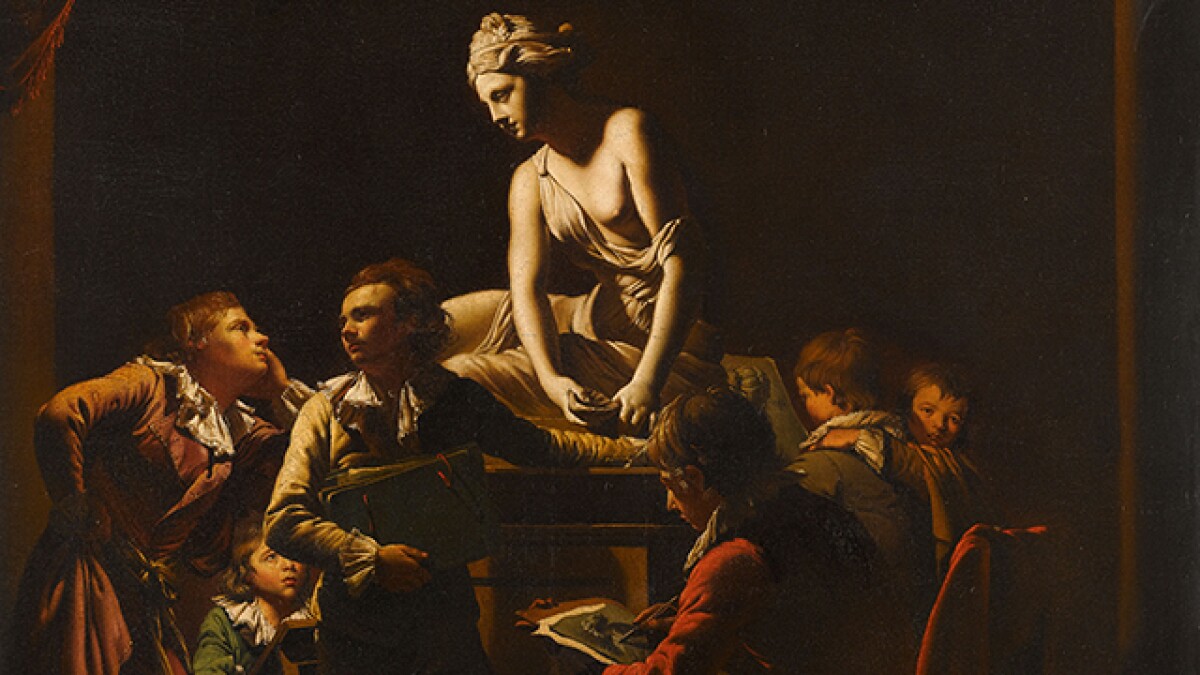
Joseph Wright, distinguished as Joseph Wright ‘of Derby’ to avoid confusion with other artists, is regarded as one of the most remarkable artists of the Enlightenment, born in Derby in 1734. His dramatic style of painting, encapsulating an entire period of British art and culture, drew inspiration from the Italian master Caravaggio. Wright’s extraordinary technique is tenebrism, characterized by stark contrasts of light and shadow. This style, highly unusual for British artists in the mid-18th century, led him to be called a master of light, and more recently, a master of darkness, though he is truthfully a master of both. Wright’s adoption of tenebrism, even without knowing how many of Caravaggio’s works he might have seen, was likely influenced by Grand Tourists returning from places like Rome and Naples who described the large-scale figures and single source of light.
The figures in Wright’s complex compositions would have often visited the exhibitions where his works were displayed, seeing themselves reflected in the dramas he created. One notable connection involves the subjects within his work An Experiment on a Bird in the Air Pump. This painting features a young couple, Thomas and Mary Coltman, who were friends of Wright of Derby. This couple owned paintings created by Wright of Derby, which were featured in an exhibition. This connection to the artist's personal circle is further solidified by the National Gallery later acquiring a so-called conversation piece—a portrait of the two of them—which is now part of the collection.
Related article - Uphorial Shopify
Wright’s masterful use of light and dark stemmed from meticulous study, with his niece Hannah reporting that he would use two rooms—one dark with objects and one fully lit—to examine how light played between the spaces. This technique mirrored how people in the 1700s experienced their nights, relying on limited sources like candles, lanterns, and moonlight since electrical lighting did not exist.
Wright used his technique to explore closely linked ideas, such as science and philosophy. His A Philosopher Lecturing on the Orrery shows a traveling lecturer explaining the solar system using a moving planetarium model created for the Earl of Orrery. Wright replaces the sun with a lamp or light source, deploying tenebrism to suggest awe and wonder in the children, while perhaps causing adults to pause and reflect on their smallness compared to the enormity of the solar system. The work also highlights that young women in the 18th century were encouraged to engage with natural philosophy as an accomplishment.
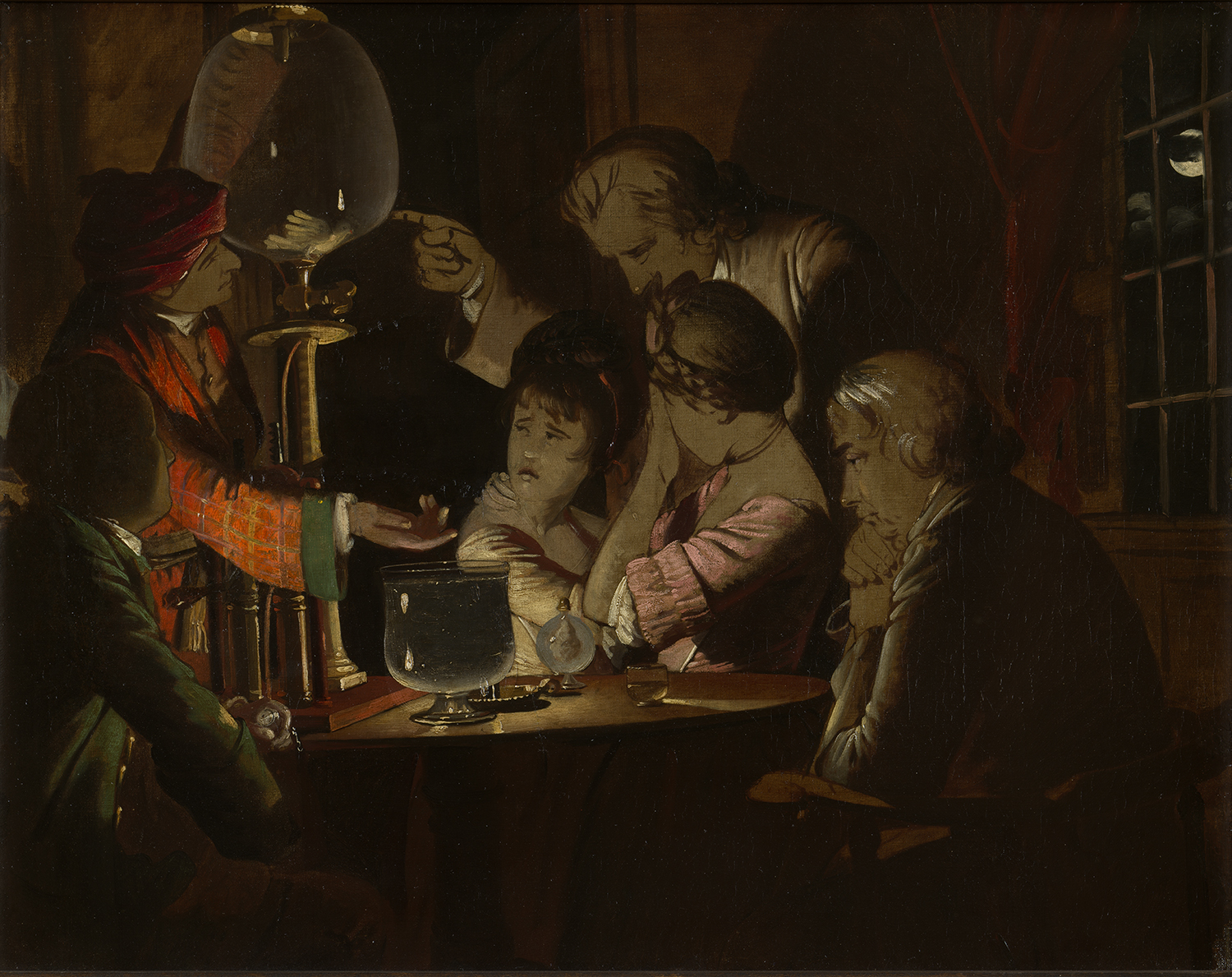
An Experiment on a Bird in the Air Pump similarly depicts a controversial demonstration by a traveling lecturer, where a vacuum created in the pump causes the suffocation of a live animal, such as the exotic cockatoo Wright chose, perhaps to emphasize that life is precious. The audience reactions represent the "whole life cycle of a human being," including the distressed young girls demonstrating their sensibility. The painting includes a traditional symbol of memento mori ("You too will die")—a deceased skull glowing in a jar—and is one of his first candlelit works to include the moon, a symbol linked to melancholy. Wright himself suffered from melancholy (known now as depression), which, in the 1760s, was associated with creative genius. Through such dramatic works, Joseph Wright of Derby, a master of spectacle and mystery, continues to invite audiences to join him at the center of art, science, and society in the 1700s.