SAN FRANCISCO — The artificial intelligence boom is entering a pivotal new phase as public equity markets reward hardware infrastructure providers while financial institutions and startups scramble to build the operational and risk-management rails required to sustain unprecedented capital deployment. According to the latest insights from Bloomberg Tech on August 12, 2026, the sector is currently defined by a sharp contrast between explosive enterprise demand and severe physical constraints in energy and labor.
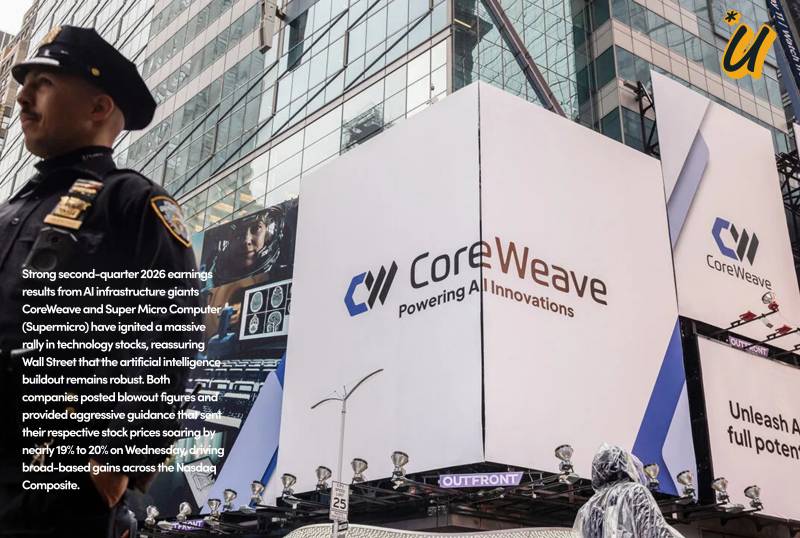
On Wall Street, the enthusiasm for AI infrastructure was fully reflected in immediate market reactions following key earnings updates. Specialized cloud provider CoreWeave and hardware infrastructure supplier Supermicro both posted substantial stock gains driven by robust upward revisions to their forward revenue outlooks. Market analysts pointed out that Supermicro in particular is experiencing a clear breakout period, marked by expanding profit margins. This margin expansion has been largely propelled by a surge in high-margin enterprise sales coupled with sharper operational execution across its supply and distribution chains.
As corporate appetite for compute power continues to escalate, traditional financial heavyweights are stepping in to fund the massive hardware and facility expansion. Bank of America recently committed $250 billion dedicated explicitly to infrastructure financing, underscoring the banking sector's long-term bet on AI capacity. However, Wall Street analysts warn that financial capital is no longer the primary pacing item for the industry’s trajectory.
Instead, physical bottlenecks are increasingly dictating the speed at which AI infrastructure can actually be deployed. Speaking on the broader market landscape, Morgan Stanley’s Michelle Weaver emphasized that acute labor shortages and an estimated 40-gigawatt power shortfall have emerged as the dominant structural constraints facing data center operators and tech giants alike. Without substantial grid modernizations and a skilled workforce to build and maintain next-generation data centers, the realization of committed capital faces persistent operational delays.
To accommodate the maturing half-trillion-dollar AI asset class, financial engineering and independent metrics are swiftly evolving to create standard valuation tools. Startup Silicon Data recently secured $30.5 million in funding to construct independent compute benchmarks. These benchmarking metrics are set to serve as the underlying foundation for CME Group’s upcoming GPU futures contracts. Market observers view these financial instruments as an indispensable risk-management layer, enabling institutional investors and cloud operators to hedge against volatile compute pricing and capacity availability.
Further down the investment lifecycle, venture capital firms are adjusting their playbooks for early-stage enterprise software and consumer platforms. Representatives from Foundation Capital detailed how early-stage AI investing requires navigating higher initial compute costs while identifying software applications capable of building durable moats beyond raw model capability.
At the same time, commercial AI applications continue to generate high-profile legal friction. AI music generator Suno remains at the center of intense industry controversy as it faces mounting copyright infringement lawsuits from major record labels. Despite the ongoing legal challenges over training data rights, venture capital investors continue to back the platform, betting that its generative audio technology could ultimately redefine digital streaming and position Suno as the next dominant force in music consumption.
Finally, the shift toward AI integration is reshaping consumer hardware strategies. Google officially introduced its Pixel 11 smartphone lineup, highlighting a strategic shift toward quality-of-life enhancements and specialized AI-driven health monitoring features, including non-invasive estimation of insulin resistance. Despite higher retail price tags and supply-chain memory constraints affecting hardware margins, the launch reflects a broader industry push to bring local, highly personalized AI models directly into everyday consumer devices.