San Francisco - Against the backdrop of one of the world's primary innovation hubs, the gathering of technology executives, financial analysts, and policymakers served as a crucial pulse check for an industry caught between staggering capital investments and intensifying regulatory and market pressures. As the technology sector continues to command a disproportionate share of global investor attention, the live broadcast captured a pivotal moment of transition where the raw enthusiasm for generative artificial intelligence is beginning to face the cold reality of corporate earnings, structural infrastructure challenges, and macroeconomic scrutiny.
The delicate nature of the current market environment was made immediately apparent by fresh corporate data that sent ripples through major trading indices. The NASDAQ 100, which has been heavily propelled by tech and semiconductor stocks over the past year, experienced a notable decline following the latest quarterly financial disclosure from Broadcom. The enterprise hardware and chip giant reported guidance that fell short of Wall Street’s lofty expectations, forecasting sixteen billion dollars in sales for the current fiscal period. While a massive figure in its own right, it missed the market’s aggressive consensus estimate of seventeen point two billion dollars. This immediate pullback highlighted a growing sensitivity among institutional investors, signaling that even minor deviations from perfect growth projections can trigger swift corrections in a market where valuations have been stretched to historic premiums on the promise of an AI-driven boom.
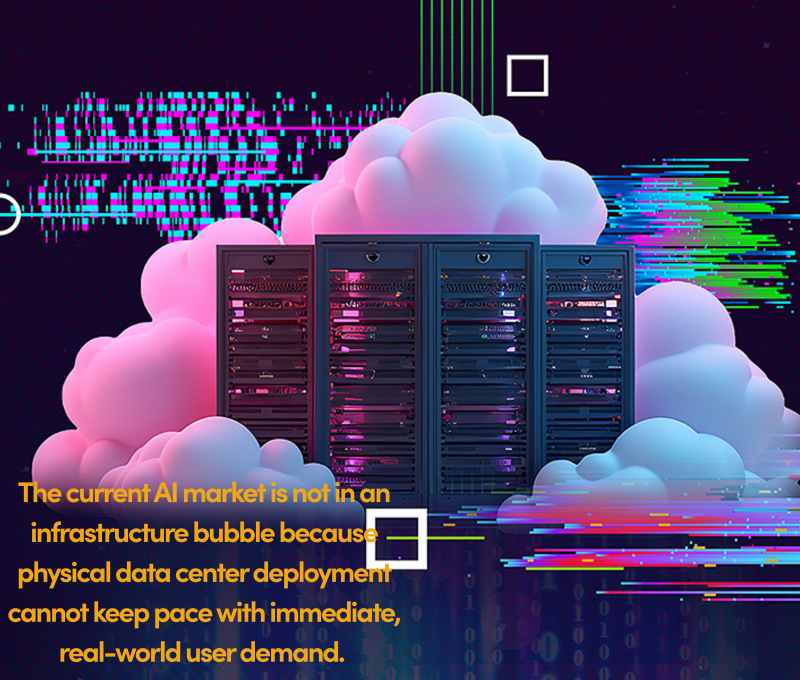
This market correction instantly reignited the burning debate that dominated the hallways of the San Francisco event: whether the current AI-driven market surge is a sustainable economic transformation or a speculative bubble destined to burst. While a segment of Wall Street analysts cautions that the rapid run-up in technology stocks mirrors the unsustainable trajectories of past market cycles, industry leaders on the ground offered a starkly different, supply-driven counter-perspective. Andrew Feldman, the Chief Executive Officer of Cerebras, pushed back strongly against the bubble narrative by pointing to the concrete, physical realities of the supply chain. Feldman revealed an immense twenty-five-billion-dollar industry-wide backlog in hardware demand, emphasizing that the current valuation of AI infrastructure companies is rooted in a genuine, desperate scramble for compute power that global manufacturing facilities simply cannot currently fulfill.
This insatiable demand for hardware is being fueled by an unprecedented, escalating arms race among the primary creators of artificial intelligence models. The event highlighted the intensifying, head-to-head competition between industry pioneer OpenAI and its primary rival Anthropic, both of which are aggressively scaling operations to build the next generation of large language models. The financial stakes of this race are forcing these private entities to seek massive public capital, a trend underscored by the revelation that Anthropic has recently filed confidentially for an initial public offering. This move to test the public markets mirrors similar high-profile liquidity events across the broader technology frontier, including aerospace giant SpaceX, which is concurrently preparing for its own massive public offering, signaling a broader reopening of the technology IPO pipeline for mature, capital-intensive tech leaders.
As these companies race to public markets, the question of what happens once this technology enters the corporate world remains a central focus for enterprise software providers. Ali Ghodsi, the Chief Executive Officer of Databricks, offered a nuanced perspective on what he terms the "AI super-cycle." Ghodsi posited a provocative view that from a pure capability standpoint, the industry already possesses artificial general intelligence-level models. However, he argued that the critical bottleneck to widespread enterprise adoption and actual business productivity is not the raw power of the models themselves, but rather context. According to Ghodsi, the current corporate challenge lies in successfully engineering systems that provide these massive models with the highly specific, secure organizational data and operational context required to execute meaningful, automated work in a corporate environment.
The financial framework underlying this entire ecosystem was neatly deconstructed by Apoorv Agrawal of Altimeter Capital, who described the current technological moment as one of the largest and most concentrated capital formation cycles in human history. Agrawal noted that the market has organized itself into a stark, bifurcated divide that dictates how money flows through the global economy. On one side of the ledger sit the companies that are actively receiving massive capital expenditure allocations—primarily the hardware manufacturers, semiconductor foundries, and cloud infrastructure providers supplying the physical compute. On the other side are the organizations spending that capital—specifically the elite AI research laboratories and software companies that are burning billions of dollars to train models, wagering that future enterprise software revenues will eventually justify the staggering upfront costs.
This massive expenditure is rapidly shifting from theoretical research to the creation of autonomous digital systems, bringing a entirely new set of corporate challenges to light. Todd McKinnon, the Chief Executive Officer of Okta, emphasized that the technology industry is rapidly transitioning past simple chat interfaces and moving into the deployment of autonomous AI agents. This shift is effectively creating a completely new category of "automated digital work," where software agents act independently on behalf of human employees. McKinnon warned that this evolution makes corporate identity and secure connectivity absolute enterprise priorities. In a world where an AI agent can log into internal servers, access sensitive databases, and move financial resources, verifying the identity of the digital agent and establishing strict parameters around what it can securely access is becoming the next great frontier in cybersecurity.
Yet, while tech executives and venture capitalists view this transformation as an inevitability, macroeconomic observers remain focused on when these massive investments will register in broader economic health metrics. Mary Daly, the President of the Federal Reserve Bank of San Francisco, provided a sobering, policy-oriented reality check during her address at the event. Daly noted that while there is undeniable, tremendous enthusiasm and unprecedented capital investment pouring into artificial intelligence across the private sector, widespread productivity gains across the broader United States economy have yet to manifest in official macroeconomic data. The aggregate productivity metrics that central banks monitor to guide long-term economic policy have not yet shown the systemic lift that usually accompanies a true industrial revolution.
To bridge this gap between microeconomic investment and macroeconomic reality, Daly underscored that purchasing technology is only the first step. She asserted that businesses must fundamentally transform their legacy operational processes, restructure their workforces, and rewrite their internal workflows to fully leverage the capabilities of these new digital tools. Without this deep, organizational overhaul, the technology risks becoming an expensive corporate luxury rather than an economic engine. Looking forward, Daly identified the coming year as a critical litmus test for the technology sector, a period where the promises made in San Francisco must begin translating into measurable, concrete economic outputs that can justify the historic capital formation cycle currently underway.